Introduction
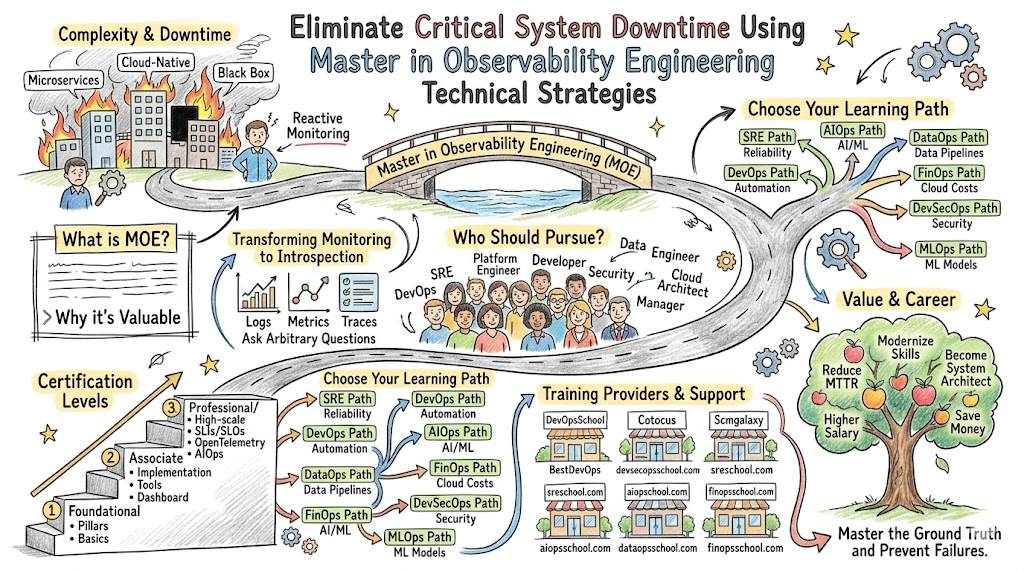
The Master in Observability Engineering (MOE) is a comprehensive professional program designed to bridge the gap between traditional monitoring and modern system reliability. This guide is crafted for engineers and technical leaders who need to move beyond simple dashboards to achieve deep, actionable insights into complex, distributed environments. As cloud-native architectures become the standard, the ability to observe internal states from external outputs has become a critical pillar of DevOps, SRE, and platform engineering.
By following this guide, professionals will gain a clear understanding of the certification landscape and how it integrates with high-level career trajectories. This curriculum is not just about learning tools; it is about mastering the culture of transparency and data-driven decision-making in software production. DevOpsSchool provides the framework and resources necessary to navigate this journey, helping you determine which level of expertise matches your current role and future aspirations.
What is the Master in Observability Engineering (MOE)?
The Master in Observability Engineering (MOE) represents a shift from reactive troubleshooting to proactive system understanding. It is a structured learning path that focuses on the three pillars of observability—metrics, logs, and traces—while integrating modern concepts like OpenTelemetry and eBPF. This program exists because traditional monitoring often fails in microservices environments where “unknown unknowns” are the primary cause of downtime.
This certification prioritizes production-focused learning, ensuring that engineers can handle real-world telemetry data at scale. It aligns perfectly with modern enterprise practices where uptime is measured in fractions of a percent and user experience is directly tied to system performance. Instead of focusing solely on theoretical knowledge, the MOE emphasizes the implementation of instrumentation and the analysis of high-cardinality data.
Who Should Pursue Master in Observability Engineering (MOE)?
This program is tailored for software engineers who are responsible for the health and performance of applications in production. Site Reliability Engineers (SREs) and DevOps professionals will find it particularly beneficial, as it provides the technical depth required to build resilient platforms. Cloud architects and security professionals also gain significant value by learning how to monitor traffic patterns and detect anomalies through granular telemetry.
Whether you are a beginner looking to enter the infrastructure space or a seasoned engineering manager overseeing a large-scale platform, this certification provides the necessary context. In the Indian market and globally, there is a massive demand for engineers who can reduce Mean Time to Resolution (MTTR). For technical leaders, the MOE offers a framework to standardize observability across multiple teams and business units.
Why Master in Observability Engineering (MOE) is Valuable
The demand for observability expertise has surged as organizations migrate to Kubernetes and serverless architectures. This certification is valuable because it focuses on vendor-neutral standards like OpenTelemetry, ensuring that your skills remain relevant even if your company switches from one commercial tool to another. It provides a long-term career advantage by focusing on the underlying principles of data collection and analysis.
Investing time in the MOE program yields a high return on career growth by positioning you as a specialist in a high-growth niche. Enterprise adoption of observability tools is at an all-time high, and companies are willing to pay a premium for professionals who can optimize system performance and reduce operational costs. It helps you transition from being a “tool operator” to a “system architect” who understands the pulse of the digital infrastructure.
Master in Observability Engineering (MOE) Certification Overview
The Master in Observability Engineering (MOE) program is delivered via the official training platform and is hosted on the DevOpsSchool website. The certification is structured into multiple levels, allowing candidates to progress from foundational concepts to advanced architectural strategies. Each level is validated through rigorous assessments that test both theoretical understanding and practical implementation skills.
The program ownership ensures that the curriculum is updated regularly to reflect the latest trends in the SRE and DevOps communities. Candidates can expect a mix of instructor-led sessions, self-paced modules, and hands-on lab environments. This structure is designed to be practical, focusing on how to instrument code, manage telemetry pipelines, and build meaningful visualizations that drive business value.
Master in Observability Engineering (MOE) Certification Tracks & Levels
The certification is divided into three primary levels: Foundational, Associate, and Professional. The Foundational level introduces the core concepts of telemetry and the difference between monitoring and observability. The Associate level dives deep into popular open-source tools and frameworks, while the Professional level focuses on advanced topics like distributed tracing at scale and AIOps integration.
These levels are designed to align with career progression. A junior engineer might start at the Foundational level to gain a foothold in the industry, while a senior SRE would target the Professional level to lead organizational change. There are also specialization tracks that allow engineers to focus on specific domains such as FinOps observability or security-focused telemetry.
Complete Master in Observability Engineering (MOE) Certification Table
| Track | Level | Who it’s for | Prerequisites | Skills Covered | Recommended Order |
| Core | Foundational | Beginners, Freshers | Basic Linux/Cloud | Pillars of Observability | 1st |
| Implementation | Associate | DevOps/SREs | Linux, Python/Go | Prometheus, ELK, Grafana | 2nd |
| Advanced | Professional | Senior Engineers | Associate Cert | OpenTelemetry, eBPF | 3rd |
| Leadership | Expert | Managers/Leads | 10+ years exp | SRE Culture, SLO/SLI | 4th |
| Specialty | Security | Security Engineers | Foundational | Audit Logs, SIEM | Optional |
| Specialty | FinOps | Cloud Economists | Foundational | Cost Observability | Optional |
Detailed Guide for Each Master in Observability Engineering (MOE) Certification
Foundational Level
Master in Observability Engineering (MOE) – Foundational
What it is
This certification validates a candidate’s understanding of basic telemetry concepts and the fundamental shift from traditional monitoring to modern observability. It covers the essential definitions and the business case for implementing observability in a cloud-native environment.
Who should take it
It is ideal for fresh graduates, junior developers, and traditional system administrators who are transitioning into DevOps or SRE roles. It is also suitable for non-technical stakeholders who need to understand the value of observability.
Skills you’ll gain
- Understanding the Three Pillars (Metrics, Logs, Traces).
- Differentiating between Monitoring and Observability.
- Basic understanding of Service Level Indicators (SLIs) and Objectives (SLOs).
- Knowledge of standard telemetry formats and protocols.
Real-world projects you should be able to do
- Setting up a basic dashboard using pre-defined metrics.
- Identifying bottlenecks in a simple monolithic application.
- Configuring basic log rotation and aggregation.
Preparation plan
- 7 Days: Focus on vocabulary and core concepts through official documentation.
- 30 Days: Complete the foundational video modules and basic labs.
- 60 Days: Not typically required for this level unless the candidate is entirely new to IT.
Common mistakes
- Confusing monitoring tools with the concept of observability.
- Skipping the theoretical definitions of high cardinality and dimensionality.
Best next certification after this
- Same-track: MOE Associate Level.
- Cross-track: Certified Kubernetes Administrator (CKA).
- Leadership: ITIL Foundation.
Associate Level
Master in Observability Engineering (MOE) – Associate
What it is
The Associate level focuses on the practical implementation of observability tools. It validates the ability to deploy and manage telemetry stacks such as Prometheus, Grafana, and the ELK (Elasticsearch, Logstash, Kibana) suite.
Who should take it
This is designed for working DevOps engineers and SREs who are responsible for maintaining the health of production systems. It requires a solid grasp of Linux environments and basic containerization.
Skills you’ll gain
- Querying metrics using PromQL.
- Building complex visualizations and alerts in Grafana.
- Managing log pipelines and searching indexed data.
- Basic instrumentation of applications using client libraries.
Real-world projects you should be able to do
- Deploying a full Prometheus and Grafana stack on Kubernetes.
- Creating a central logging system for a distributed microservices app.
- Implementing alerting rules that reduce “alert fatigue.”
Preparation plan
- 7 Days: Intensive review of PromQL and Logstash filters.
- 30 Days: Hands-on lab completion and mock exams.
- 60 Days: Deep dive into container monitoring and sidecar patterns.
Common mistakes
- Focusing too much on UI and not enough on the underlying data structures.
- Neglecting the storage and retention policies of telemetry data.
Best next certification after this
- Same-track: MOE Professional Level.
- Cross-track: AWS Certified DevOps Engineer.
- Leadership: Site Reliability Engineering (SRE) Foundation.
Professional/Specialty Level
Master in Observability Engineering (MOE) – Professional
What it is
This certification validates the ability to architect end-to-end observability solutions for large-scale, complex environments. It focuses heavily on vendor-neutral standards like OpenTelemetry and advanced data analysis techniques.
Who should take it
Senior SREs, Platform Engineers, and Architects should take this certification. It is for those who lead the design of observability platforms and establish organizational standards for telemetry.
Skills you’ll gain
- Mastering OpenTelemetry (SDKs, Collectors, and Protocols).
- Implementing distributed tracing across polyglot microservices.
- Utilizing eBPF for deep kernel-level system visibility.
- Integrating AI/ML for anomaly detection and root cause analysis.
Real-world projects you should be able to do
- Designing a global telemetry pipeline capable of handling millions of spans per second.
- Implementing auto-instrumentation for a large-scale legacy codebase.
- Building a custom observability platform using open-source components.
Preparation plan
- 7 Days: Review of OpenTelemetry specification and eBPF basics.
- 30 Days: Implementation of distributed tracing in a complex lab environment.
- 60 Days: Comprehensive study of high-cardinality data management and AIOps.
Common mistakes
- Over-engineering the observability stack, leading to high infrastructure costs.
- Failing to account for data privacy and security within traces and logs.
Best next certification after this
- Same-track: MOE Expert/Architect.
- Cross-track: FinOps Certified Practitioner.
- Leadership: Engineering Management Certification.
Choose Your Learning Path
DevOps Path
The DevOps path focuses on integrating observability into the Continuous Integration and Continuous Deployment (CI/CD) pipelines. Engineers learn how to use metrics and logs to validate releases and perform automated rollbacks. This path emphasizes the speed of feedback loops and the automation of infrastructure health checks.
DevSecOps Path
The DevSecOps path incorporates security telemetry into the standard observability workflow. Professionals learn how to monitor for unauthorized access patterns and use distributed tracing to identify security vulnerabilities. It focuses on the convergence of security information and event management (SIEM) with traditional observability.
SRE Path
The SRE path is the most comprehensive, focusing on reliability, error budgets, and SLOs. It treats observability as a mandatory requirement for managing service health and meeting availability targets. This path emphasizes the mathematical approach to system reliability and post-mortem analysis.
AIOps Path
The AIOps path focuses on using artificial intelligence to process the massive amounts of data generated by observability tools. Engineers learn how to build models that can predict failures and automatically correlate alerts. It is designed for those who want to automate the “first responder” phase of incident management.
MLOps Path
The MLOps path is specialized for monitoring machine learning models in production. It covers how to observe model drift, data quality, and inference performance. This path ensures that ML systems are as reliable and observable as traditional software applications.
DataOps Path
The DataOps path applies observability principles to data pipelines and databases. It focuses on tracking data lineage, monitoring pipeline latency, and ensuring data integrity. This is critical for organizations that rely on real-time data processing for business intelligence.
FinOps Path
The FinOps path centers on cost observability, helping organizations understand where their cloud spend is going. It involves tagging resources and using telemetry to correlate infrastructure usage with business value. This path bridges the gap between engineering performance and financial accountability.
Role → Recommended Master in Observability Engineering (MOE) Certifications
| Role | Recommended Certifications |
| DevOps Engineer | Foundational, Associate (Implementation Track) |
| SRE | Foundational, Associate, Professional (Core Track) |
| Platform Engineer | Associate, Professional (Architect Track) |
| Cloud Engineer | Foundational, Associate (Cloud Specialization) |
| Security Engineer | Foundational, DevSecOps Specialty |
| Data Engineer | Foundational, DataOps Specialty |
| FinOps Practitioner | Foundational, FinOps Specialty |
| Engineering Manager | Foundational, Leadership/SRE Culture Track |
Next Certifications to Take After Master in Observability Engineering (MOE)
Same Track Progression
After completing the Master in Observability Engineering (MOE), the logical next step is to pursue an Expert or Architect level certification. This involves a deep dive into custom tool development and contributing to open-source observability projects. It marks the transition from using existing frameworks to defining the future of the industry.
Cross-Track Expansion
If you want to broaden your skills, consider certifications in FinOps or Security. Understanding how observability data can be used to optimize costs or secure a perimeter makes you a multi-disciplinary asset. This approach is highly valued in startups and high-growth companies where engineers often wear multiple hats.
Leadership & Management Track
For those moving into leadership, certifications in SRE management or general Engineering Leadership are ideal. These programs focus on the human side of observability—how to build a “blameless culture” and how to use data to justify headcount and budget. It transitions you from technical implementation to strategic oversight.
Training & Certification Support Providers for Master in Observability Engineering (MOE)
- DevOpsSchool
This provider is a leader in technical training, offering a wide range of instructor-led courses specifically for the Master in Observability Engineering (MOE) program. They focus on hands-on labs and real-world scenarios, ensuring that students can apply their knowledge immediately in a production environment. Their curriculum is updated frequently to include the latest tools like OpenTelemetry and Grafana Tempo. - Cotocus
A consulting-driven training organization that specializes in high-end DevOps and SRE implementations. They provide specialized coaching for the MOE certification with a focus on enterprise-grade architecture. Their trainers are active industry consultants who bring current production challenges into the classroom, making the learning experience highly practical and relevant for senior engineers. - Scmgalaxy
This platform serves as a massive community resource and training hub for software configuration management and observability. They offer extensive documentation, tutorials, and certification support for the MOE tracks. Their focus is on building a strong community of practitioners who share best practices and troubleshooting tips for complex telemetry pipelines. - BestDevOps
Known for its simplified yet effective training modules, BestDevOps offers a streamlined path to achieving the Master in Observability Engineering (MOE) certification. They cater to both individuals and corporate teams, providing customized training sessions that align with specific organizational goals. Their labs are designed to be intuitive and highly accessible for beginners. - devsecopsschool.com
This provider focuses specifically on the intersection of security and DevOps. They offer a specialized track within the MOE program that emphasizes security observability and compliance. Their training is essential for professionals who need to learn how to monitor for threats and vulnerabilities using standard observability tools and frameworks. - sreschool.com
As the name suggests, this provider is dedicated entirely to the discipline of Site Reliability Engineering. Their MOE training modules are deeply integrated with SRE principles like SLOs and Error Budgets. They offer some of the most advanced technical training available for engineers who want to master the art of system reliability. - aiopsschool.com
This platform focuses on the future of infrastructure management by integrating AI with observability. Their MOE support includes specialized training on anomaly detection, automated root cause analysis, and predictive maintenance. It is the go-to provider for engineers who want to stay ahead of the curve in automated operations. - dataopsschool.com
Focusing on the data engineering community, this provider offers MOE tracks tailored for data pipelines and big data platforms. They teach how to observe data quality and pipeline performance, which is a critical skill for modern data-driven enterprises. Their training bridges the gap between infrastructure and data science. - finopsschool.com
This provider specializes in the financial management of cloud resources. Their MOE-related courses focus on cost observability and cloud waste reduction. They help engineers and finance professionals work together to ensure that observability data leads to measurable business savings and improved cloud ROI.
Frequently Asked Questions
1. Is the Master in Observability Engineering (MOE) certification difficult?
The difficulty depends on your background, but the Associate and Professional levels are quite challenging due to the hands-on requirements.
2. How long does it take to get certified?
Most candidates complete the Foundational level in 2 weeks and the Professional level in 2 to 3 months.
3. Are there any prerequisites for the MOE program?
The Foundational level has no strict prerequisites, but the Associate level requires basic knowledge of Linux and containers.
4. What is the ROI of this certification?
Professionals often see significant salary increases and higher demand from top-tier tech companies after earning this certification.
5. Does the certification cover specific tools like Datadog or New Relic?
While it covers commercial tool concepts, the primary focus is on open-source standards like OpenTelemetry and Prometheus.
6. Is there a lab exam or is it multiple-choice?
The certification includes both multiple-choice questions and practical lab assessments to ensure real-world competency.
7. Can I take the exam online?
Yes, the certification exams are typically offered through a proctored online platform for global accessibility.
8. How long is the certification valid?
The certification is usually valid for two years, after which a renewal or advanced certification is recommended.
9. Is this certification recognized in India?
Yes, it is highly recognized by major IT hubs in India, including Bangalore, Hyderabad, and Pune.
10. Do I need to know how to code?
Basic scripting in Python or Go is highly recommended for the implementation and instrumentation modules.
11. What is the difference between this and a standard SRE cert?
This is specialized deeply in the data and telemetry aspect, whereas a general SRE cert covers broader operational tasks.
12. Does DevOpsSchool provide job assistance?
Many training providers, including those listed, offer career support and networking opportunities within their community.
FAQs on Master in Observability Engineering (MOE)
1. Why should I choose MOE over a tool-specific certification like Splunk or Elastic?
Tool-specific certifications are valuable but limited. The MOE provides a vendor-neutral foundation, teaching you the underlying architecture of observability that applies to all tools.
2. How does MOE help in a serverless environment?
In serverless, you have no access to the server, so observability through distributed tracing and custom metrics is the only way to debug issues.
3. What role does OpenTelemetry play in this certification?
OpenTelemetry is a core component of the MOE, as it is the industry standard for collecting and exporting telemetry data.
4. Can this certification help me move into a Platform Engineering role?
Absolutely, as platform engineering involves building internal tools that provide observability to development teams.
5. How much focus is there on eBPF?
The Professional level includes a significant deep dive into eBPF for modern, low-overhead system profiling and networking visibility.
6. Is the MOE suitable for engineering managers?
Yes, the Foundational and specialized leadership modules help managers understand how to build and lead observable teams.
7. Does the program cover AIOps and machine learning?
The advanced levels explore how AI can be used to correlate data and detect anomalies within an observability framework.
8. Is there a community for MOE certified professionals?
Yes, holders of this certification gain access to exclusive forums and groups hosted by the training providers and DevOpsSchool.
Final Thoughts: Is Master in Observability Engineering (MOE) Worth It?
If you are looking for a way to stand out in a crowded market of DevOps and Cloud engineers, specializing in observability is one of the smartest moves you can make. The Master in Observability Engineering (MOE) isn’t just another certificate to hang on your wall; it’s a rigorous validation of your ability to understand and manage the complexity of modern software. The industry is moving away from simple “up/down” monitoring toward a world where we need to understand the “why” behind every system failure.
For the working professional, this program offers a clear path to mastery that is grounded in practical reality. It requires effort, hands-on practice, and a willingness to learn new protocols, but the career longevity it provides is unmatched. As systems continue to grow in complexity, the engineer who can see into the black box will always be the most valuable person in the room. This is a solid investment in your technical future.
