Introduction
Modern technology landscapes demand more than just standard operations; they require a sophisticated engineering approach to manage massive scale and complexity. The Certified Site Reliability Architect provides a definitive framework for professionals who aim to master the art of building unbreakable systems. This guide targets senior engineers and technical leaders who recognize that reliability is the most important feature of any software product. SreSchool hosts this rigorous curriculum to help you bridge the gap between traditional software development and high-performance system architecture. By choosing this path, you decide to move beyond simple troubleshooting and begin designing resilient ecosystems that thrive under pressure.
What is the Certified Site Reliability Architect?
The Certified Site Reliability Architect certification serves as a professional standard for individuals who build and manage distributed systems. This program moves away from theoretical lectures and focuses instead on the practical mechanics of production engineering. It emphasizes the creation of automated systems that manage other systems, reducing human intervention and increasing overall stability.
Industry leaders recognize this credential because it validates an engineer’s ability to apply scientific methods to operations. It represents a commitment to maintaining high availability through rigorous testing, data-driven decision-making, and proactive architectural planning. By earning this title, you prove that you can handle the immense pressure of managing cloud-native environments while maintaining a focus on long-term scalability.
Who Should Pursue Certified Site Reliability Architect?
Senior software developers who feel stagnant in traditional coding roles will find this path particularly rewarding. It offers a clear trajectory for those moving into Platform Engineering or specialized SRE roles where they can influence the entire tech stack. Technical architects who need to validate their knowledge of modern cloud-native patterns also benefit immensely from the deep dives into observability and chaos engineering.
Engineering managers who oversee large-scale operations use this certification to gain a technical edge and better understand their team’s challenges. In India’s booming tech sector, where global companies constantly seek talent to manage distributed infrastructure, this certification acts as a powerful career catalyst. Whether you work for a startup or a global enterprise, mastering these architectural principles ensures you remain a vital asset to any technical organization.
Why Certified Site Reliability Architect is Valuable
Companies today lose millions of dollars for every minute of downtime, making the role of a Reliability Architect indispensable. This certification proves your ability to protect a company’s bottom line by implementing robust failure-prevention strategies. It provides you with a tool-agnostic skill set that remains relevant even when specific technologies like Kubernetes or Terraform evolve into new versions.
Beyond technical proficiency, this credential signifies your ability to lead a cultural shift within an organization. You learn how to balance the need for fast feature releases with the necessity of a stable production environment. This balance creates a sustainable engineering culture that attracts top talent and ensures long-term business success. The return on investment manifests in higher salary brackets, leadership opportunities, and the prestige of being a recognized authority in system design.
Certified Site Reliability Architect Certification Overview
SreSchool delivers the Certified Site Reliability Architect program through an immersive learning portal found at the official course URL. The curriculum focuses on real-world application, requiring candidates to solve complex architectural puzzles rather than just memorizing facts. The program structure covers everything from initial system design to the post-mortem analysis of major outages.
The assessment process challenges your ability to think critically under simulated production stress. SreSchool ensures that every module reflects current industry standards, incorporating the latest advancements in cloud-native technologies and automated incident response. Professionals who complete this program walk away with a deep understanding of how to govern large-scale systems without sacrificing the speed of innovation.
Certified Site Reliability Architect Certification Tracks & Levels
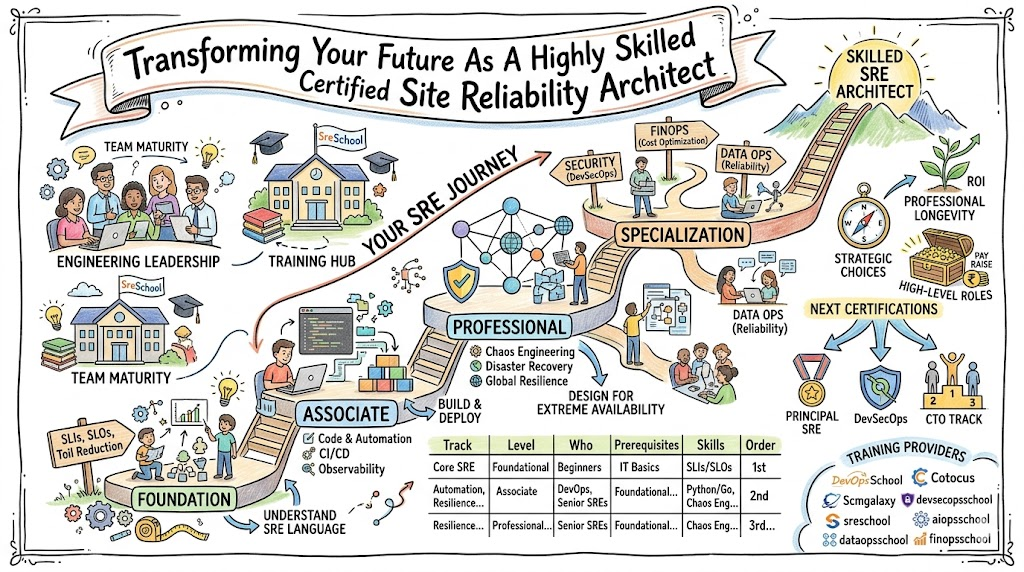
The program follows a logical hierarchy that allows engineers to build their expertise incrementally. The Foundational level establishes the core vocabulary and mindset required for SRE success. The Associate level focuses on the implementation of these ideas through automation and infrastructure management. The Professional and Architect levels challenge you to design and govern entire organizational technical strategies.
Each track offers specific specializations that align with modern job market requirements. You can choose to focus on security integration, financial optimization, or the application of machine learning to operations. This flexibility ensures that your certification journey remains directly relevant to your specific career goals and your company’s technical needs.
Complete Certified Site Reliability Architect Certification Table
| Track | Level | Who it’s for | Prerequisites | Skills Covered | Recommended Order |
| Core Reliability | Foundational | Aspiring SREs | Basic IT Knowledge | SLI/SLO/SLA, Toil Reduction | 1 |
| Core Reliability | Associate | DevOps Engineers | Foundational Cert | IaC, Kubernetes, CI/CD | 2 |
| Core Reliability | Professional | Senior SREs | Associate Cert | Chaos Engineering, Incident Response | 3 |
| Architecture | Advanced | Principal Architects | Professional Cert | Multi-Cloud Design, Governance | 4 |
| Intelligent Ops | Specialty | AIOps Engineers | Professional Cert | ML Model Monitoring, Anomaly Detection | 5 |
| Cost Ops | Specialty | FinOps Managers | Associate Cert | Cloud Cost Control, Budgeting | 5 |
Detailed Guide for Each Certified Site Reliability Architect Certification
Foundational Level
Certified Site Reliability Architect – SRE Foundation
What it is
This certification validates your understanding of the core SRE philosophy and its practical application. It ensures you can communicate effectively using industry-standard reliability metrics and understand the value of a blameless culture.
Who should take it
Juniors, support engineers, and project managers should take this to align their work with SRE principles. It serves as the essential first step for anyone entering the DevOps or SRE space.
Skills you’ll gain
- Mastery of Service Level Objectives and Error Budgets.
- Identification and elimination of operational toil.
- Fundamental understanding of monitoring vs. observability.
- Principles of blameless post-mortems.
Real-world projects you should be able to do
- Define a set of SLIs for a standard three-tier web application.
- Audit a manual workflow and propose an automation strategy to reduce toil.
- Draft a post-mortem report for a simulated service interruption.
Preparation plan
- 7 Days: Absorb the core SRE definitions and the history of the discipline.
- 30 Days: Complete the self-paced foundational modules and pass practice exams.
- 60 Days: Participate in community forums and explain SRE concepts to a peer.
Common mistakes
- Focusing too much on specific tools while ignoring the underlying principles.
- Underestimating the importance of cultural change in SRE.
Best next certification after this
- Same-track: SRE Associate
- Cross-track: DevOps Associate
- Leadership: Technical Product Management
Associate Level
Certified Site Reliability Architect – SRE Associate
What it is
This level confirms your technical ability to build and maintain automated infrastructure. It tests your hands-on skills in deploying scalable services and ensuring they remain observable.
Who should take it
Active DevOps engineers and system administrators who want to formalize their automation skills. It suits those who manage production workloads daily.
Skills you’ll gain
- Advanced Infrastructure as Code (IaC) implementation.
- Management of containerized applications at scale.
- Setup of distributed tracing and log aggregation systems.
- Implementation of automated canary and blue-green deployments.
Real-world projects you should be able to do
- Build a fully automated CI/CD pipeline with integrated health checks.
- Provision a multi-node Kubernetes cluster using Terraform.
- Configure a centralized dashboard that tracks error budget consumption.
Preparation plan
- 7 Days: Refresh your knowledge of YAML, JSON, and basic shell scripting.
- 30 Days: Build and destroy complex cloud environments to master IaC.
- 60 Days: Implement a full monitoring stack in a staging environment.
Common mistakes
- Neglecting security best practices in the rush to automate deployment.
- Failing to document the automation scripts properly for team use.
Best next certification after this
- Same-track: SRE Professional
- Cross-track: Cloud Security Specialist
- Leadership: Team Lead Track
Professional/Specialty Level
Certified Site Reliability Architect – Architect Level
What it is
This prestigious certification proves you can lead the technical strategy for an entire enterprise. It validates your expertise in designing systems that recover automatically from catastrophic failures.
Who should take it
Principal engineers and lead architects who hold responsibility for critical business systems. It is the final step for those aiming for executive technical leadership.
Skills you’ll gain
- Design of disaster recovery plans for multi-region cloud setups.
- Advanced Chaos Engineering and hypothesis-driven testing.
- Capacity planning for hyper-scale traffic events.
- Mastery of service mesh and complex networking architectures.
Real-world projects you should be able to do
- Design a system that automatically fails over to a secondary region without data loss.
- Lead a “Game Day” exercise to test team response to a database failure.
- Create a 12-month scaling roadmap based on historical traffic data.
Preparation plan
- 7 Days: Analyze major public cloud outages and their root causes.
- 30 Days: Practice designing complex high-availability diagrams for varied industries.
- 60 Days: Perform a deep-dive audit of a complex production system’s bottlenecks.
Common mistakes
- Creating overly complex designs that the team cannot maintain.
- Forgetting to account for the latency introduced by multi-region synchronization.
Best next certification after this
- Same-track: AIOps Specialty
- Cross-track: FinOps Practitioner
- Leadership: Director of Engineering / CTO
Choose Your Learning Path
DevOps Path
This path emphasizes the continuous integration and delivery of software. You focus on breaking down silos between developers and operations to ensure a smooth flow of code. It attracts those who enjoy optimizing the developer experience and streamlining release cycles.
DevSecOps Path
The DevSecOps journey places security at the center of every architectural decision. You learn to automate vulnerability scanning and compliance checks within the deployment pipeline. This path suits professionals who want to protect systems from both failure and external threats.
SRE Path
The SRE path focuses strictly on engineering for reliability and scalability. You spend your time writing code to manage infrastructure and refining the metrics that define success. It appeals to engineers who love deep technical troubleshooting and system optimization.
AIOps Path
Engineers on the AIOps path use artificial intelligence to solve operational problems. You implement machine learning models to predict failures before they happen and automate root cause analysis. This path represents the cutting edge of intelligent system management.
MLOps Path
The MLOps path specializes in the operational needs of machine learning pipelines. You ensure that data models remain accurate, accessible, and performant in production environments. It bridges the gap between data science and traditional system reliability.
DataOps Path
The DataOps path focuses on the reliability and flow of data across an organization. You apply SRE principles to data pipelines to ensure high-quality data reaches the people who need it. This path is vital for companies that rely on real-time data for decision-making.
FinOps Path
The FinOps path centers on the financial accountability of cloud spending. You learn how to optimize resources to achieve the best performance-to-cost ratio. It is a critical path for architects who need to prove the business value of their technical decisions.
Role → Recommended Certified Site Reliability Architect Certifications
| Role | Recommended Certifications |
| DevOps Engineer | SRE Foundation, SRE Associate |
| SRE | SRE Associate, SRE Professional, CSRA |
| Platform Engineer | SRE Associate, SRE Professional |
| Cloud Engineer | SRE Foundation, SRE Associate |
| Security Engineer | DevSecOps Specialty, SRE Associate |
| Data Engineer | DataOps Specialty, SRE Foundation |
| FinOps Practitioner | FinOps Specialty, SRE Foundation |
| Engineering Manager | SRE Foundation, CSRA (Architect Level) |
Next Certifications to Take After Certified Site Reliability Architect
Same Track Progression
Advancing within the same track involves seeking out the most specialized certifications available. You might pursue advanced deep-dives into specific observability tools or niche performance tuning workshops. Staying on this track solidifies your reputation as a premier technical expert in system reliability.
Cross-Track Expansion
Broadening your expertise into FinOps or DevSecOps makes you a more versatile leader. By understanding the financial and security implications of your architectural designs, you can provide more value to the business. This cross-track expansion is often the fastest way to move into senior management roles.
Leadership & Management Track
If you wish to transition into people management or executive leadership, focus on certifications that emphasize strategy and communication. These programs teach you how to build teams, manage large budgets, and align technical goals with business outcomes. Your technical background as a CSRA will give you the credibility needed to lead effectively.
Training & Certification Support Providers for Certified Site Reliability Architect
- DevOpsSchool maintains a massive library of resources and hands-on labs for aspiring SREs. They offer personalized mentorship and structured bootcamps that help students navigate the complexities of modern cloud architectures. Their alumni network provides excellent opportunities for career growth and professional networking across the tech industry.
- Cotocus specializes in high-level corporate training and technical consultancy for Fortune 500 companies. They deliver intensive workshops that focus on solving real-world production challenges faced by large-scale enterprises. Their instructors bring decades of experience to the table, ensuring that students learn practical, battle-tested strategies.
- Scmgalaxy offers a community-driven learning platform with a focus on automation and configuration management. They provide hundreds of tutorials and webinars that help engineers master the tools of the trade. Their practical approach makes them a favorite among developers who want to expand their operational knowledge.
- BestDevOps focuses on delivering high-quality, up-to-date training for the most in-demand cloud and SRE skills. They offer flexible learning paths that cater to both beginners and experienced professionals. Their certification programs prioritize hands-on project work, ensuring that students can immediately apply what they learn.
- devsecopsschool.com provides a specialized curriculum that integrates security into every aspect of the DevOps lifecycle. They teach engineers how to build secure, resilient systems that can withstand modern cyber threats. This provider is a top choice for those looking to excel in the critical field of DevSecOps.
- sreschool.com serves as the primary hub for the Certified Site Reliability Architect program, offering specialized courses and assessments. Their platform is designed specifically for SRE professionals, providing the tools and knowledge needed to master the discipline. They maintain the highest standards for reliability engineering education.
- aiopsschool.com leads the way in training engineers to use artificial intelligence for IT operations. Their courses cover everything from automated incident response to predictive maintenance using ML models. They prepare students for the future of automated system management.
- dataopsschool.com addresses the unique challenges of managing reliable data pipelines at scale. They apply SRE principles to the world of data engineering, ensuring that data is consistently available and accurate. This is an essential resource for companies that rely on big data for their core operations.
- finopsschool.com teaches the art of cloud financial management, helping architects balance performance with cost. Their training programs are designed to help professionals maximize the business value of every dollar spent on cloud resources. They are the leading authority on the growing discipline of FinOps.
Frequently Asked Questions
1. Does the Certified Site Reliability Architect certification expire?
Most professional certifications require renewal every two to three years to ensure your skills remain current with the latest technology shifts.
2. Can I take the exam without prior work experience?
You can start with the Foundational level, but the Professional and Architect levels demand real-world experience to navigate the practical scenarios.
3. Which programming language should I learn for SRE?
Python and Go are the most popular choices in the SRE community due to their strong support for automation and cloud-native libraries.
4. Does the exam include a practical lab portion?
Yes, the higher-level certifications require you to complete hands-on tasks in a simulated environment to prove your technical competence.
5. How does this certification help my salary in India?
SRE roles in India command some of the highest salaries in the tech industry, and this certification helps you reach the upper echelons of those brackets.
6. Is the curriculum updated for multi-cloud environments?
The CSRA curriculum focuses heavily on cloud-agnostic principles that work across AWS, GCP, and Azure simultaneously.
7. What is the difference between a DevOps Engineer and an SRE?
DevOps is a set of cultural philosophies, while SRE is the specific implementation of those philosophies using engineering and software practices.
8. How much time should I dedicate daily to preparation?
Most successful candidates dedicate one to two hours daily over a two-month period to master the extensive curriculum.
9. Do I need to be a Kubernetes expert?
While you don’t need to be an expert on day one, the program will teach you the deep architectural knowledge required to manage Kubernetes at scale.
10. Are the training providers mentioned available for online learning?
Yes, all mentioned providers offer robust online learning platforms that include video lectures, labs, and community support.
11. Does the certification cover incident management?
Yes, incident response and the subsequent blameless post-mortem process are core components of the SRE Professional level.
12. Can I skip levels and go straight to Architect?
SreSchool generally recommends following the levels in order, but those with significant verified experience may sometimes apply for higher levels directly.
FAQs on Certified Site Reliability Architect
1. How does the Certified Site Reliability Architect handle the concept of Chaos Engineering?
Chaos Engineering forms a major part of the Architect curriculum, teaching you how to intentionally inject failure into systems to verify their resilience.
2. Will this certification help me move into a Lead Architect role?
The CSRA provides the specific governance and high-level design skills that hiring managers look for when filling Lead Architect positions.
3. How does the program address the financial aspect of reliability?
Through the FinOps track and integrated modules, the program teaches you to evaluate the cost-benefit ratio of different high-availability strategies.
4. Is there a focus on serverless and microservices?
The certification covers the architectural shifts required to maintain reliability in modern serverless and microservice-oriented environments.
5. Does the certification require knowledge of networking and security?
Deep networking knowledge and integrated security (DevSecOps) are essential components of the SRE Associate and Professional levels.
6. How are the assessments graded?
SreSchool uses a combination of automated laboratory scoring and peer-reviewed architectural designs for the higher-level certifications.
7. Can this certification be used for internal team training?
Many corporations use the CSRA framework to standardize the reliability skills across their entire engineering and operations departments.
8. What happens if I fail the exam on the first attempt?
Most providers offer a retake policy that allows you to study your weak areas and attempt the assessment again after a cooling-off period.
Final Thoughts: Is Certified Site Reliability Architect Worth It?
Choosing to pursue the Certified Site Reliability Architect designation represents a significant milestone in your professional journey. It signals to the industry that you possess the discipline, technical depth, and strategic vision required to manage the world’s most complex systems. As digital transformation continues to accelerate, the demand for architects who can guarantee uptime while supporting rapid change will only increase. This investment in your knowledge ensures that you remain at the forefront of the engineering world, ready to tackle the challenges of tomorrow. Reliable systems are the foundation of modern society, and by mastering this craft, you become an essential builder of that future.
