Introduction
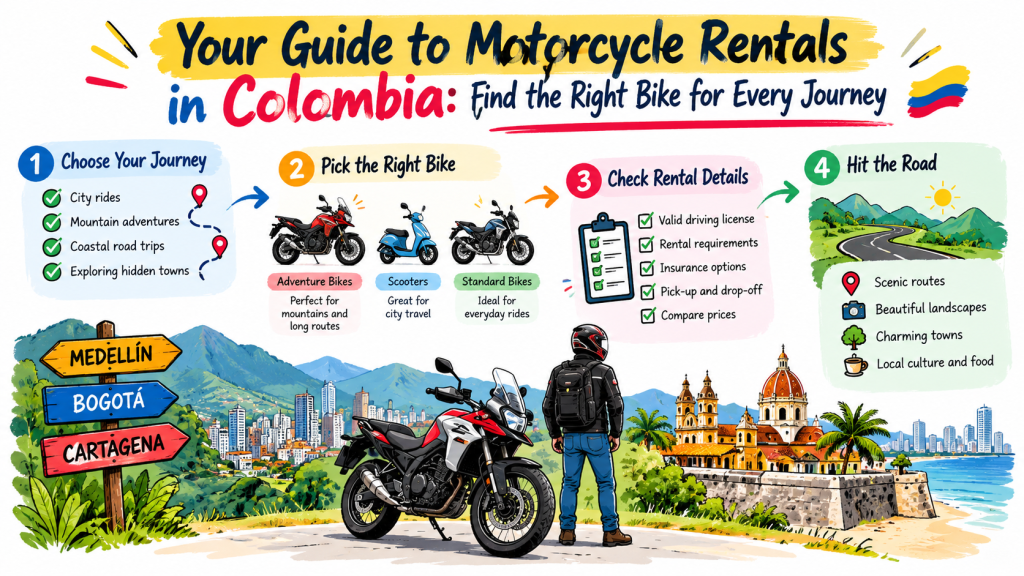
Colombia offers plenty of opportunities for travelers who want to explore beyond the usual tourist stops. You might spend a few days discovering Medellín, enjoy the historic streets of Cartagena, or plan a longer journey through mountain towns and countryside roads. A motorcycle can provide flexibility, but the right rental depends on how you intend to travel.
Before choosing a bike, consider the distance you plan to cover, your riding experience, the roads you expect to encounter, and your budget. A lightweight motorcycle may work well for short city trips, while longer journeys may call for better comfort, luggage capacity, and suitable road performance.
Travelers arranging motorcycle rental in Colombia should also understand licence requirements, insurance terms, security deposits, and vehicle inspection procedures. These details can affect both the cost and practicality of a trip.
This guide explains how to choose a motorcycle, compare rental agreements, prepare for Colombian road conditions, and avoid common mistakes. If you want to explore rental options, MotoShare.co can be a starting point for your search. Always confirm current availability and rental conditions before booking.
1. Decide How You Will Use the Motorcycle
Start with your itinerary. The motorcycle that suits a short urban journey may not provide the comfort or capabilities you need for several days on the road.
City sightseeing and everyday transportation
For short journeys between attractions, restaurants, accommodation, and shopping areas, consider a lightweight commuter motorcycle or a suitable scooter.
Smaller vehicles can be easier to maneuver and park. However, you should still evaluate their handling, braking performance, and suitability for local traffic.
Before choosing a city motorcycle, consider:
- The distance between your planned stops.
- Traffic conditions during your travel hours.
- Parking arrangements at your accommodation.
- Whether you will carry a passenger.
- The storage space available for personal belongings.
- Your confidence when riding on unfamiliar roads.
A compact motorcycle may work well for local transportation, but it may not provide enough comfort for a long day of riding.
Intercity travel
Journeys between Colombian destinations can involve steep climbs, winding roads, rain, traffic, and changing temperatures.
Choose a motorcycle that supports your planned daily distance. A comfortable riding position, suitable suspension, reliable brakes, and appropriate tires can improve the practicality of a longer trip.
Do not focus exclusively on engine size. A larger motorcycle may offer more power, but it can also require greater physical effort during parking and low-speed maneuvers.
Rural exploration
Rural routes can introduce gravel, potholes, uneven surfaces, steep gradients, and limited access to fuel or repair services.
An adventure motorcycle may suit some of these journeys. However, not every adventure model can handle every surface, especially in poor weather.
Check the specific motorcycle’s capabilities and ask the rental provider whether your planned route is permitted. Avoid unfamiliar terrain that exceeds your riding experience.
2. Compare Motorcycle Categories Before Booking
Understanding motorcycle types can help you avoid paying for features you do not need.
| Motorcycle category | Best potential use | Limitation to consider |
|---|---|---|
| Commuter motorcycle | Everyday travel and short city trips | May offer limited luggage space |
| Lightweight street bike | Urban travel and selected intercity routes | Comfort varies by model |
| Touring motorcycle | Longer paved-road journeys | Can be heavier and more expensive |
| Adventure motorcycle | Suitable paved and selected unpaved routes | Requires appropriate skills and route planning |
| Sport motorcycle | Sport-oriented riding | Riding position may become tiring |
| Scooter | Short urban journeys and sightseeing | Some models may lack suitable power for longer routes |
These descriptions are general. Actual performance depends on the motorcycle’s design, maintenance, tires, suspension, and load.
When is a commuter motorcycle a good choice?
A commuter motorcycle may offer practical transportation for short journeys. Its manageable size can make parking and low-speed handling easier.
However, consider the terrain and passenger load before selecting a small model. Steep roads or longer journeys may require different capabilities.
When should you choose a touring motorcycle?
A touring motorcycle may provide greater comfort for extended rides. Some models also support luggage systems and offer features designed for long-distance travel.
The main trade-offs include weight, rental price, and maneuverability. Make sure you can handle the motorcycle confidently before accepting it.
Is an adventure motorcycle right for your trip?
An adventure motorcycle may suit travelers who want to combine paved roads with suitable rural routes.
Before renting one, check its ground clearance, tires, suspension, and weight. Confirm that the provider permits your planned route and that your experience matches the motorcycle’s demands.
3. Match the Motorcycle to Your Riding Experience
Your experience should guide your choice more than the motorcycle’s appearance or engine capacity.
A heavy motorcycle can become difficult to control when you stop on a slope, make a tight turn, or move through a crowded parking area. A powerful engine can also demand more precise control on unfamiliar roads.
Before accepting a motorcycle, ask yourself:
- Can I balance it comfortably while stationary?
- Am I familiar with its weight and power?
- Can I make controlled turns at low speeds?
- Have I ridden in wet conditions or on steep roads?
- Can I manage the motorcycle with a passenger and luggage?
If you have limited experience, choose a manageable model and begin with a short journey. Avoid challenging mountain routes until you feel comfortable with the motorcycle and local riding conditions.
Passenger and luggage weight also affect braking, acceleration, and balance. Follow the manufacturer’s load limits and the provider’s passenger requirements.
A motorcycle that matches your abilities will usually serve you better than one chosen simply for its power or appearance.
4. Confirm Licence and Rental Requirements
Before booking motorcycle rental in Colombia, verify the applicable legal requirements and the provider’s conditions.
Requirements may vary according to your circumstances, licence category, motorcycle type, and residency status. Do not assume that a licence accepted in your home country automatically authorizes every motorcycle rental in Colombia.
Verify your driving licence
Confirm that your licence covers the motorcycle category you intend to ride.
International visitors should check whether they need an international driving permit, a translation, or other supporting documents. Ask the relevant Colombian authority or rental provider which requirements apply to your situation.
An international driving permit does not automatically replace your original licence or guarantee acceptance.
Resolve any uncertainty before paying a deposit or making a non-refundable booking.
Check age and experience conditions
Rental providers may impose minimum-age rules or require experience with certain motorcycle types.
Ask about these conditions before booking. If someone else will ride the motorcycle, confirm whether the provider must approve that person separately.
Prepare your documents
Depending on the rental arrangement, you may need:
- A valid licence for the relevant motorcycle category.
- A passport or another accepted identification document.
- Booking confirmation.
- An accepted payment method.
- A suitable payment method for the security deposit, if required.
Ask whether the provider requires original documents and confirm all requirements before collection.
5. Calculate the Complete Rental Cost
The lowest daily rate does not always represent the best value. Additional charges, insurance conditions, and deposit rules can change the total expense.
Motorcycle rental prices in Colombia vary by destination, season, model, rental duration, and provider. Request a complete quotation for your planned dates.
Identify additional charges
Ask whether the quoted price includes or excludes:
- Insurance or required vehicle coverage.
- A security deposit.
- Helmets and protective equipment.
- Mileage allowances and excess-mileage charges.
- Delivery or collection fees.
- Additional-rider charges.
- Late-return fees.
- Cleaning or damage-related charges.
- Cancellation and booking-change fees.
Not every rental includes these charges. Check the actual agreement instead of assuming that all providers follow the same pricing structure.
Compare rental periods
A longer rental may offer a lower average daily price, but it can increase your total spending if your plans change.
For a short visit, calculate how many days you genuinely need the motorcycle. For a longer trip, compare the full cost of one extended rental with several shorter bookings.
Ask about extensions and early returns before choosing the rental period. Confirm whether the provider can accommodate changes and what extra charges might apply.
Understand the security deposit
The security deposit may cover certain costs under the rental agreement. The amount, payment method, and refund process depend on the provider.
Before paying, confirm:
- The deposit amount and currency.
- The conditions for deductions.
- The expected refund process.
- How the provider records vehicle damage.
- How you can dispute an incorrect charge.
Keep your rental agreement, payment records, and inspection photographs until the deposit has been settled.
6. Review Insurance and Damage Responsibilities
Insurance can affect your financial responsibility after an accident, theft, or damage to the motorcycle.
Never assume that a rental includes complete protection for every situation. Read the terms and ask the provider to explain anything unclear.
Pay particular attention to these questions:
- Which risks does the policy cover?
- Does it cover damage to the rented motorcycle?
- Does it include theft protection?
- What coverage applies to third-party property damage?
- What deductible or excess might you need to pay?
- Which exclusions or restrictions apply?
- What steps must you follow after an accident?
- Does the coverage permit your planned route and authorized riders?
Distinguish compulsory vehicle-related coverage from optional insurance products and personal travel insurance. They may cover different risks.
If you intend to ride outside urban areas, confirm that your rental agreement and coverage permit your planned use.
Request written clarification before accepting conditions you do not understand.
7. Inspect the Motorcycle Before Departure
A careful inspection helps you identify existing damage and visible mechanical problems before they interrupt your trip.
Whenever possible, inspect the motorcycle with the provider present.
Check the main components
Review these items before leaving:
- Tires: Look for cuts, unusual wear, and visible damage.
- Brakes: Check the controls and report any concerns.
- Lights: Test the headlight, brake light, and indicators.
- Mirrors: Ensure they provide useful visibility.
- Controls: Check the throttle, clutch, and other controls.
- Visible leaks: Look for fluid around the motorcycle.
- Chain and drivetrain: Check for obvious damage where applicable.
- Documents: Confirm that the required vehicle documents are available.
- Protective equipment: Check the fit and condition of the helmet and other supplied gear.
Do not ride a motorcycle with a serious mechanical concern. Ask the provider to fix the issue or offer a suitable replacement.
Record existing damage
Photograph scratches, dents, cracked panels, damaged mirrors, and other visible defects.
Take pictures from several angles and share them with the provider. Ask for written confirmation that the inspection record includes the existing damage.
Keep the photographs until the rental ends and any deposit has been settled.
8. Prepare for Different Colombian Destinations
Colombia’s regions have different road conditions, traffic patterns, and climates. Prepare for the destination rather than treating the entire country as one uniform riding environment.
Motorcycle rental in Medellín
Medellín has steep streets, busy intersections, and changing traffic conditions. Visitors unfamiliar with the city should plan routes carefully and choose a motorcycle they can control at low speeds.
If you intend to explore the surrounding mountains, allow extra time and check the weather before leaving.
Motorcycle rental in Medellín may suit certain itineraries, but your experience and route should determine whether it is the right option.
Motorcycle rental in Bogotá
Bogotá presents traffic congestion, complex intersections, and changing weather. Rain and reduced visibility can make unfamiliar roads more challenging.
Wear suitable clothing, review your route, and allow time for delays. If you have limited experience with local traffic, begin with a short journey rather than a demanding cross-city trip.
Motorcycle rental in Cartagena
Cartagena’s coastal conditions can bring heat, humidity, pedestrian activity, and sudden rain.
A suitable motorcycle or scooter may work for short sightseeing journeys. Consider hydration, secure parking, protective equipment, and the distance between stops.
Before traveling outside the city, check road conditions and fuel availability. Confirm that your rental agreement permits the planned route.
Plan rural and mountain journeys carefully
Before starting a longer motorcycle road trip in Colombia, review:
- Current road conditions and possible closures.
- Weather forecasts along your route.
- Fuel stations and rest stops.
- Accommodation and emergency contacts.
- Mobile coverage limitations.
- Rental restrictions on rural or unpaved roads.
- Alternative routes if conditions change.
Do not estimate travel time from distance alone. Mountain curves, traffic, rain, and roadworks can significantly delay your arrival.
9. Carry Protective Equipment and Emergency Supplies
Your motorcycle is only one part of your preparation. Appropriate equipment and a plan for unexpected events also matter.
Wear a properly fitting helmet that meets applicable requirements. Consider protective gloves, suitable riding clothing, sturdy footwear, and rain gear.
Ask which items the provider supplies. Check their condition before departure and bring your own equipment if the supplied items do not fit properly.
For longer journeys, consider carrying:
- Drinking water.
- A charged mobile phone and power bank.
- Identification and rental documents.
- Emergency contact details.
- Basic first-aid supplies.
- Cash for situations where digital payments are unavailable.
Before leaving, confirm the provider’s breakdown procedure. Ask how to request assistance, arrange recovery, and handle repair costs.
If the motorcycle develops a potentially dangerous fault, stop riding when it is safe and contact the provider.
10. Common Motorcycle Rental Mistakes to Avoid
Choosing a motorcycle based only on price
The cheapest option may not suit your route, luggage, comfort needs, or riding ability.
How to avoid it: Compare the total cost, mechanical condition, rental terms, and vehicle suitability.
Booking without checking documents
A licence or eligibility problem can disrupt your plans at collection.
How to avoid it: Confirm your licence category and required documents before paying.
Overlooking insurance exclusions
You may face unexpected expenses if you misunderstand the coverage.
How to avoid it: Review exclusions, deductibles, and accident procedures in writing.
Skipping the inspection
Unrecorded damage can lead to disagreements when you return the motorcycle.
How to avoid it: Photograph existing damage and request a written inspection record.
Planning unrealistic daily distances
Mountain roads, rain, traffic, and fatigue can extend your journey.
How to avoid it: Set realistic daily distances and allow time for breaks and delays.
Ignoring route restrictions
A motorcycle may not suit every road, and the rental agreement may restrict certain routes.
How to avoid it: Confirm permitted use with the provider and check road conditions before departure.
11. Important Considerations Before Booking
Before making a booking, evaluate the complete rental arrangement rather than focusing on the motorcycle alone.
First, confirm that you meet the applicable legal requirements and provider conditions. Next, choose a motorcycle that matches your riding ability, luggage, passenger needs, and itinerary.
Compare the complete price, including insurance, deposits, equipment, and other applicable charges. Review cancellation rules, collection arrangements, return times, fuel policies, and extension options.
Consider alternative transport as well. A motorcycle may suit solo travelers exploring selected destinations, while a car may work better for families or groups carrying substantial luggage. Public transport or guided tours may be more practical for certain city visits.
To explore rental options, visit MotoShare.co as a starting point for your search. Check current vehicle listings, availability, provider details, and booking conditions before making a commitment.
Frequently Asked Questions (FAQs)
1. What type of motorcycle is best for traveling around Colombia?
The best option depends on your route, experience, and luggage. A commuter motorcycle may suit city travel, while a suitable touring or adventure model may work better for longer journeys.
2. Can international tourists rent motorcycles in Colombia?
Tourists may be able to rent motorcycles if they satisfy applicable legal requirements and the provider’s conditions. Confirm licence eligibility, identification, age restrictions, and other requirements before booking.
3. Do I need an international driving permit in Colombia?
Requirements depend on your circumstances and applicable rules. Check with the relevant Colombian authority and rental provider. An international driving permit does not automatically replace your original licence.
4. How much does motorcycle rental in Colombia cost?
Prices vary by destination, motorcycle model, season, rental duration, insurance, and provider. Request a complete quotation in Colombian pesos and check for deposits, equipment costs, and additional fees.
5. Is motorcycle rental in Medellín suitable for tourists?
It may suit visitors with appropriate riding experience and valid documentation. However, steep streets, traffic, and changing weather require careful route planning.
6. Can I rent a motorcycle in Bogotá for city travel?
A motorcycle may suit certain urban journeys. Consider congestion, road layouts, rain, visibility, parking, and your familiarity with local traffic before deciding.
7. Is a scooter suitable for exploring Cartagena?
A suitable scooter may work for short urban journeys and sightseeing. Check its performance, passenger limits, and road suitability before planning longer trips.
8. Does motorcycle rental in Colombia include insurance?
Coverage depends on the provider and rental agreement. Confirm the risks covered, exclusions, deductibles, and accident procedures before collecting the motorcycle.
9. Can I ride a rental motorcycle on unpaved roads?
That depends on the motorcycle, road conditions, and rental agreement. Confirm whether your intended route is permitted, especially if it includes gravel or other unpaved surfaces.
10. What should I check before collecting a rental motorcycle?
Inspect the tires, brakes, lights, mirrors, controls, and visible condition. Check the documents and protective equipment, photograph existing damage, and report mechanical concerns before departure.
11. What should I do if my rental motorcycle breaks down?
Stop riding if a fault creates a safety concern. Contact the provider and follow its breakdown procedure. Confirm assistance arrangements and repair responsibilities before starting your journey.
12. Should I rent a motorcycle or a car for a road trip in Colombia?
A motorcycle may suit solo travelers or couples who enjoy riding and can manage the route. A car may provide more passenger space, luggage capacity, and weather protection. Compare costs, experience, and travel needs before deciding.
Conclusion
Choosing a motorcycle rental in Colombia starts with understanding your travel plans. Your destination, riding experience, budget, and luggage needs should guide your decision.
Before booking, confirm your licence eligibility, review insurance conditions, calculate the complete rental cost, and understand the deposit rules. Inspect the motorcycle carefully and record any existing damage.
Prepare for changing weather, mountain roads, city traffic, and unexpected delays. If a route exceeds your experience or the motorcycle’s capabilities, choose a more suitable option.
A well-planned rental can help you avoid unnecessary expenses and make your journey more manageable. Compare your options, confirm the important details with the provider, and choose a motorcycle that fits your plans for exploring Colombia.
