Introduction
In the current era of digital transformation, the cloud is no longer just a place where companies host applications. It has become the operating foundation for modern business, software delivery, customer experience, analytics, automation, and security. Every growing organization now depends on cloud platforms to move faster, scale globally, and release software more often. At the same time, this speed has introduced a new level of responsibility for engineers and managers. Systems are more distributed, architectures are more dynamic, and risks are more serious. A small security mistake in a cloud environment can affect customer trust, regulatory compliance, and business continuity. That is why modern technical careers are no longer built only on coding or infrastructure knowledge. They are built on the ability to connect delivery, operations, automation, and security into one strong, reliable practice. This guide is written for working engineers, software engineers, and managers who want to grow in that direction, especially through the AWS DevOps Engineer – Professional path while understanding the career value of the AWS Certified Security – Specialty certification.
What is AWS Certified Security – Specialty
The AWS Certified Security – Specialty certification is a high-level validation for professionals who safeguard workloads in the AWS cloud. It focuses on your ability to design and enforce strong access controls, apply robust encryption and key management, and secure networks and applications across varied, multi-account setups. The exam also evaluates how well you plan and implement continuous monitoring, build effective logging strategies, and use threat detection services to spot and respond to suspicious activity. Earning this credential shows that you can help organizations run sensitive, regulated, and mission-critical systems on AWS with a strong, well-structured security posture.
Why It Matters in Today’s Software, Cloud, and Automation Ecosystem
Today’s software ecosystem runs on rapid releases, automation pipelines, infrastructure as code, container platforms, observability systems, and managed cloud services. In such a fast-moving environment, security can no longer sit at the end of the process as a separate approval gate. It must be designed into the system from the start. That is why the market increasingly rewards professionals who understand not only CI/CD and operations, but also identity and access control, encryption, secure networking, incident response, logging, monitoring, and compliance automation. AWS remains one of the most important cloud platforms in the world, and organizations want engineers who can build secure delivery systems on it. For managers, this matters because secure engineering reduces business risk, supports governance, and improves the long-term reliability of teams. For engineers, it matters because the industry is clearly shifting toward hybrid roles where DevOps, cloud, platform engineering, reliability, and security overlap. Certifications such as AWS DevOps Engineer – Professional and AWS Certified Security – Specialty help validate that you can operate effectively in this new environment.
Why Choose DevOpsSchool?
DevOpsSchool is valuable because it focuses on practical capability, not only exam preparation. Many professionals can read documentation and watch videos, but they still struggle when they need to implement secure cloud architectures in real production environments. DevOpsSchool helps close that gap by combining conceptual clarity with hands-on work, guided learning, and real-world scenarios. Learners get exposure to cloud automation, security thinking, operational best practices, and exam-focused preparation in a structured way. This is important because certifications create the strongest career impact when they are backed by real skill. A training partner that emphasizes practical labs, real use cases, and implementation depth can help engineers and managers move from theoretical understanding to actual job readiness. For those targeting AWS security and DevOps growth, that kind of learning model is far more valuable than surface-level certification coaching.
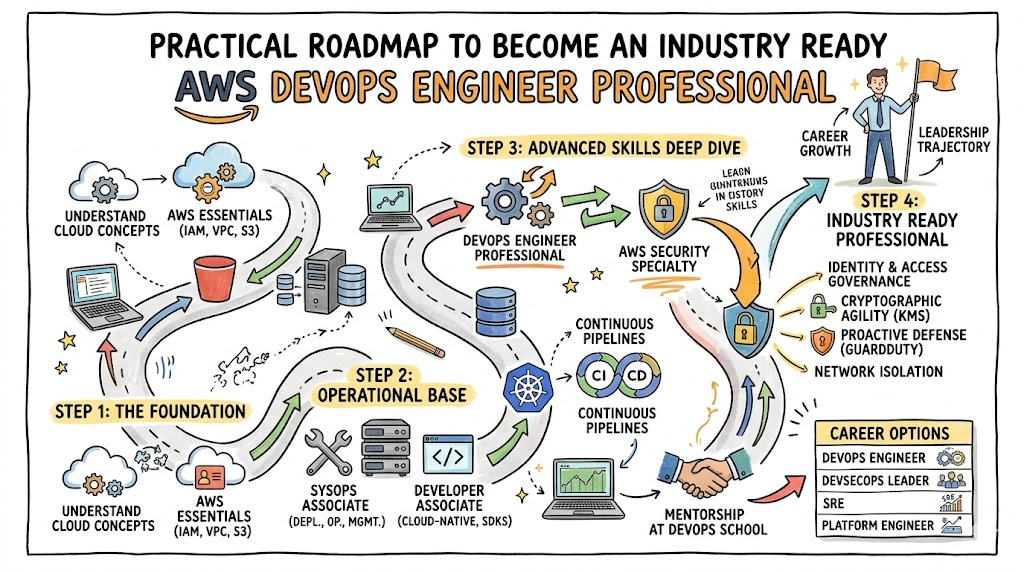
AWS Certified Security – Specialty Roadmap
| Track | Level | Who it’s for | Prerequisites | Skills covered | Recommended order |
|---|---|---|---|---|---|
| Security | Specialty | Security professionals, Cloud Engineers, DevOps professionals | Strong AWS foundation and security understanding | IAM, encryption, monitoring, logging, incident response, infrastructure security | After Associate level |
| DevOps | Professional | DevOps Engineers, SREs, Platform Engineers | Strong AWS operations and development background | CI/CD, automation, monitoring, high availability, operations excellence, infrastructure delivery | After SysOps or Developer level |
| Solutions Architecture | Professional | Architects, Senior Cloud Engineers, Technical leads | Solid AWS architecture experience | Complex system design, migration, resilience, cost optimization | After Solutions Architect Associate |
| SysOps | Associate | System Administrators, Operations Engineers | Cloud fundamentals | Deployment, operations, monitoring, troubleshooting, AWS administration | Early career AWS step |
| Developer | Associate | Software Developers, Cloud Developers | Cloud fundamentals and application knowledge | Developing on AWS, SDK usage, deployment, service integration | Early career AWS step |
Deep Dive: AWS Certified Security – Specialty
What it is
AWS Certified Security – Specialty is a focused certification for professionals who want to prove advanced knowledge in securing AWS environments. It validates your understanding of how to protect data, manage access, monitor events, respond to incidents, secure infrastructure, and align cloud operations with business and compliance requirements. For engineers already working in AWS, it acts as a specialization that can make their profile stronger, sharper, and more future-ready.
Who should take it
- Security Engineers who want deeper AWS-focused cloud security knowledge
- DevOps Engineers who want to strengthen the security side of CI/CD and infrastructure automation
- Cloud Engineers who are responsible for building and maintaining secure AWS environments
- SREs who handle production reliability, incident management, and operational resilience
- Platform Engineers working with multi-account AWS environments and shared infrastructure
- Cloud Architects who must design systems with strong identity, network, and data protection controls
- Software Engineers building cloud-native applications that depend on IAM, encryption, and secure service integration
Skills you’ll gain
- Advanced IAM understanding, including policy design, permission boundaries, cross-account access, and least-privilege thinking
- Data protection knowledge, including encryption at rest, encryption in transit, AWS KMS concepts, and secure key usage
- Infrastructure security capability, including VPC design, security groups, network segmentation, and secure connectivity patterns
- Threat detection and monitoring skills, including AWS logging, audit trails, security visibility, and alerting workflows
- Incident response readiness, including automated response patterns and isolation strategies for compromised resources
- Compliance and governance thinking, including how cloud controls support auditability and policy enforcement
- Security architecture maturity, especially in multi-service and multi-account AWS environments
Real-world projects you should be able to do after it
- Design a secure multi-account AWS environment with centralized logging, delegated access, and controlled permissions
- Build a secure CI/CD pipeline where roles, secrets, approvals, and artifact protection are handled correctly
- Implement centralized audit logging across multiple AWS accounts for compliance and incident analysis
- Set up automated threat detection workflows using AWS-native security services and automated remediation patterns
- Create encryption-first architectures for applications handling sensitive data in storage, databases, and network communication
- Design secure VPC networking models with private subnets, controlled ingress, service access isolation, and traffic visibility
- Create incident response playbooks for suspicious API usage, compromised instances, and misconfiguration-based exposure
- Secure secrets and credentials management for cloud applications, automation tools, and operational systems
Preparation plan
- 7–14 Days: Fast Track
- Focus on the core AWS security domains and revise them intensely
- Review IAM deeply because it appears across many scenarios
- Spend time on KMS, logging, monitoring, GuardDuty, Config, and network security basics
- Use practice questions daily and review why each answer is correct or wrong
- Best for professionals already using AWS security services in their day-to-day work
- 30 Days: Standard Track
- Week 1: Identity, access management, policy logic, cross-account design
- Week 2: Encryption, data protection, key management, secure storage and transport
- Week 3: Logging, monitoring, threat detection, incident response design
- Week 4: Infrastructure security, practice tests, and full revision
- Spend steady daily time and combine reading with hands-on work
- 60 Days: Deep Dive Track
- Month 1: Build a strong AWS foundation if your security depth is still developing
- Month 2: Move into scenario-heavy services, architecture questions, labs, and troubleshooting
- Create your own notes for IAM, KMS, CloudTrail, GuardDuty, VPC security, and incident response
- Use mock exams after you understand the services, not before
- Best for engineers transitioning from general cloud or DevOps roles into security-focused work
Common mistakes
- Treating it like a basic AWS exam instead of a deep specialty certification
- Underestimating IAM, especially policy evaluation logic and permission design
- Skipping hands-on labs and depending too much on theory or memorized notes
- Ignoring AWS service FAQs and behavior details, especially for security services
- Focusing only on service names rather than understanding real production scenarios
- Neglecting logging and monitoring architecture, which is central to security operations
- Studying too broadly without mastering core services such as IAM, KMS, CloudTrail, GuardDuty, and VPC security
Best next certification after this
- Same-track option: AWS Solutions Architect – Professional to connect deep security knowledge with large-scale architecture design
- Cross-track option: AWS DevOps Engineer – Professional to automate the security practices you have learned and apply them in delivery pipelines
- Leadership option: A recognized leadership-oriented security certification path that supports governance, risk thinking, and strategic decision-making for management roles
Choose Your Path
- DevOps Path
- Build strength in CI/CD, infrastructure as code, automation tooling, deployment strategies, and observability
- Add AWS DevOps Engineer – Professional as your core milestone
- Pair it with security knowledge to stay relevant in modern engineering teams
- DevSecOps Path
- Start with security-first thinking and embed controls into build, test, release, and runtime layers
- Combine AWS Certified Security – Specialty with delivery automation and policy-based governance skills
- Ideal for engineers who want to own both speed and protection
- SRE Path
- Focus on reliability engineering, monitoring, alerting, incident management, and recovery workflows
- Add security knowledge to create resilient systems that can also handle threats and misconfigurations
- Strong for engineers working in high-availability environments
- AIOps/MLOps Path
- Move toward intelligent operations, ML-driven monitoring, model pipelines, and automation at scale
- Security still matters because data, models, and environments need strong protection
- Best for engineers interested in the future of platform intelligence and operational automation
- DataOps Path
- Focus on data movement, data quality, governance, lineage, and secure data platform operations
- AWS security knowledge becomes important for protecting pipelines, storage, and access layers
- Suitable for cloud data engineers and modern analytics professionals
- FinOps Path
- Focus on cloud cost visibility, governance, optimization, and business-aware engineering decisions
- Security and financial control often work together through better policy, access, and operational discipline
- Good for engineers and managers who want a stronger strategic cloud role
Role → Recommended Certifications Mapping
| Role | Primary recommended certification | Secondary / specialty recommendation |
|---|---|---|
| DevOps Engineer | AWS DevOps Engineer – Professional | AWS Certified Security – Specialty |
| SRE | AWS SysOps Administrator – Associate or AWS DevOps Engineer – Professional | AWS Certified Security – Specialty |
| Platform Engineer | AWS Solutions Architect – Professional | Kubernetes or AWS security specialization |
| Cloud Engineer | AWS Solutions Architect – Associate | AWS SysOps Administrator – Associate |
| Security Engineer | AWS Certified Security – Specialty | AWS architecture or DevOps certification |
| Data Engineer | AWS data-focused certification path | Security specialization for cloud data protection |
| FinOps Practitioner | AWS cloud fundamentals and architecture path | FinOps-oriented certification track |
| Engineering Manager | AWS Cloud Practitioner or architecture path for strategic understanding | Security and DevOps awareness for team leadership |
Next Certifications to Take
- Same track: AWS Solutions Architect – Professional if you want to combine secure design with enterprise architecture depth
- Cross track: AWS DevOps Engineer – Professional if you want to automate secure delivery and become stronger in platform execution
- Leadership track: A management-oriented security or cloud governance certification if you want to grow into technical leadership, architecture review, or team direction roles
Top Training and Certification Providers for AWS Certified Security – Specialty
- DevOpsSchool
- Known for practical, hands-on learning focused on real implementation
- Strong choice for professionals who want both certification preparation and job-relevant cloud security capability
- Especially useful for those who want guided learning with real-world scenarios
- Cotocus
- Offers support for professionals and enterprises looking for practical training alignment
- Useful for learners who want training connected with implementation outcomes and business needs
- Can help bridge the gap between technical theory and enterprise application
- Scmgalaxy
- Helpful for structured technical learning and broader DevOps ecosystem understanding
- Good for learners who want access to technical guidance, tutorials, and certification-oriented preparation
- Useful as a support platform for deeper concept reinforcement
- BestDevOps
- Strong on DevOps and security integration learning models
- Suitable for professionals who want implementation-driven preparation instead of only exam-level study
- Good option for strengthening secure automation capability
- devsecopsschool.com
- Focused on the development, security, and operations intersection
- Relevant for learners who want a stronger DevSecOps mindset after AWS security training
- Useful for extending certification learning into pipeline security and secure delivery practices
- sreschool.com
- Valuable for professionals building expertise in reliability, observability, and incident response
- Complements AWS security learning well because operational resilience and security often overlap
- Strong fit for SREs and platform-focused engineers
- aiopsschool.com
- Useful for engineers looking toward AI-driven operations and future automation patterns
- Adds long-term relevance for those interested in operational intelligence at scale
- Helpful when building a modern cloud operations career beyond traditional DevOps
- dataopsschool.com
- Relevant for data engineers and analytics platform professionals who need secure pipeline and platform thinking
- Supports cloud data lifecycle understanding along with operational practices
- Useful when security knowledge must be extended into data environments
- finopsschool.com
- Helpful for professionals focusing on cloud financial accountability and governance
- Security and financial control often reinforce each other in enterprise cloud environments
- Valuable for managers and practitioners who want business-aware cloud decision-making skills
General Career and Certification FAQs
1. How difficult is AWS Certified Security – Specialty compared to Associate-level AWS certifications?
It is significantly more advanced. Associate-level certifications usually help you understand the purpose and usage of AWS services, but the Security Specialty exam expects you to think more deeply about implementation risk, architecture decisions, and service behavior in real scenarios. It rewards practical judgment, not just memorization.
2. How much time should I plan for preparation?
That depends on your current AWS exposure. Engineers already working with IAM, KMS, VPC security, CloudTrail, and GuardDuty may prepare faster. Professionals coming from a general cloud or DevOps background usually need more time because this certification requires deeper security understanding, not just operational familiarity.
3. Are there strict prerequisites before taking this exam?
There is no strict exam lock that forces you to complete another AWS certification first, but it is strongly recommended that you already have a good AWS foundation. Without that, the exam can feel overwhelming because it assumes you understand how AWS services interact in production environments.
4. What certification sequence makes the most career sense?
A practical sequence for many professionals is to build foundational AWS understanding first, then move into architecture or operations knowledge, and then add the Security Specialty. After that, AWS DevOps Engineer – Professional becomes a strong next step because it helps you operationalize secure cloud practices at scale.
5. Does this certification really help with career growth?
Yes. Security remains one of the strongest areas for salary growth and role expansion in cloud careers. It also improves your credibility because it shows that you understand business risk, not only technical deployment. That matters for both engineering and leadership progression.
6. Is this certification useful only for security-focused roles?
No. It is also highly useful for DevOps Engineers, SREs, Platform Engineers, Cloud Engineers, and even Software Engineers working in cloud-native environments. Modern engineering roles increasingly require security awareness because infrastructure, applications, and identity systems are tightly connected.
7. Is hands-on practice necessary, or can I pass by studying theory?
You may answer some questions through theoretical preparation, but real confidence comes from practice. Without hands-on exposure, it is difficult to understand why one secure design is better than another. In interviews and real projects, hands-on understanding becomes even more important than the exam result.
8. Is this certification relevant in India as well as global markets?
Yes. The demand is strong in both India and global markets because cloud adoption, compliance pressure, fintech growth, data governance needs, and platform modernization are all increasing. Security specialization continues to be one of the safest and strongest career bets in cloud engineering.
9. Can Software Engineers benefit from AWS Certified Security – Specialty?
Absolutely. Software Engineers who understand IAM, encryption, secure service integration, secrets handling, and cloud access patterns become much more effective in cloud-native teams. This knowledge helps them write more secure applications and collaborate better with DevOps and platform teams.
10. How does this certification support management growth?
Managers who understand cloud security can make better decisions about risk, architecture trade-offs, team direction, and platform investment. Technical leadership today requires the ability to balance speed, cost, security, and reliability, so this knowledge becomes increasingly valuable at higher levels.
11. Is AWS Certified Security – Specialty enough by itself?
It is powerful, but it becomes much more valuable when paired with hands-on implementation, project work, and at least one adjacent area such as DevOps, architecture, SRE, or platform engineering. The strongest career profiles are usually built through combinations, not isolated certifications.
12. What is the long-term value of combining AWS Security Specialty with AWS DevOps Engineer – Professional?
This combination makes you highly relevant to modern cloud organizations. It shows that you can automate delivery, improve reliability, and secure systems at the same time. That balance is rare, and professionals who can deliver it often move faster into trusted technical roles.
AWS Certified Security – Specialty FAQs
1. What major domains should I expect in the AWS Certified Security – Specialty exam?
You should expect strong focus on threat detection, logging and monitoring, infrastructure security, identity and access management, and data protection. The exam tests your ability to connect these domains in realistic AWS scenarios.
2. How important is IAM in this certification?
IAM is extremely important. Many questions either directly test identity and access management or depend on your ability to reason through permissions, roles, account boundaries, trust relationships, and policy behavior.
3. Do I need coding knowledge for this exam?
You do not need to be a full-time developer, but you should be comfortable reading JSON policies, understanding automation patterns, and following service-level logic. Basic scripting familiarity can also help you think through practical implementation scenarios.
4. How important is KMS for the exam?
KMS is one of the most important services to understand. You should know how encryption design works in AWS, how keys are used, and how key policies and access decisions affect secure system behavior.
5. How much focus should I give to VPC security?
A lot. Secure networking remains a core part of AWS security. You should understand subnet design, security groups, network access control, private access patterns, and visibility mechanisms that help monitor traffic and isolate risk.
6. What is the best way to prepare for incident response topics?
The best approach is to understand how AWS services help you detect, investigate, and respond to suspicious events. Focus on how alerts are generated, what logs tell you, and how automation can help isolate or remediate affected resources.
7. Is this exam only about memorizing AWS security services?
No. It is more about judgment than memorization. You need to understand when and why a service should be used, what the secure design trade-offs are, and how multiple services work together in a real environment.
8. Should I take this exam before AWS DevOps Engineer – Professional or after it?
Both sequences can work, but for many professionals this certification is a strong specialization step after building a solid AWS foundation. If your current role already includes security exposure, taking the Security Specialty first can be a very smart move.
Conclusion
AWS Certified Security – Specialty is more than a certification for passing an exam. It is a serious career signal that you understand how modern cloud systems must be protected, monitored, and governed. When you combine that knowledge with the broader delivery and automation strengths of the AWS DevOps Engineer – Professional path, you become far more valuable to employers. You are no longer seen only as someone who can deploy systems quickly. You are seen as someone who can build them responsibly, operate them safely, and support business growth without increasing hidden risk. That is the kind of profile that earns trust in technical teams and leadership circles. For engineers and managers who want durable career growth in India and global markets, this is one of the strongest directions to pursue.
