Introduction
Engineers today face a rapidly shifting cloud landscape that demands high-level design proficiency rather than simple administrative skills. This comprehensive guide explores the Azure Solutions Architect Expert program, which serves as a definitive benchmark for professionals aiming to lead technical transformations. By pursuing this path, you move beyond basic execution and begin drafting the blueprints for resilient, scalable, and secure cloud environments. Organizations globally rely on DevOpsSchool to provide the rigorous training necessary to bridge the gap between intermediate engineering and expert-level architecture. We designed this roadmap to help you navigate the complexities of modern platform engineering and make informed decisions about your professional growth trajectory.
What is the Azure Solutions Architect Expert?
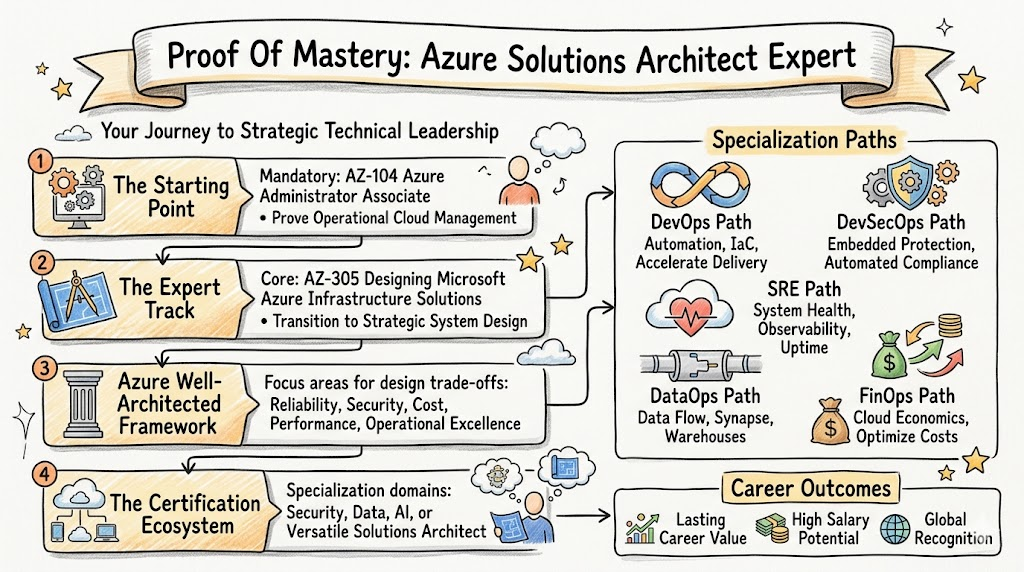
The Azure Solutions Architect Expert represents the highest tier of technical validation for professionals working within the Microsoft cloud ecosystem. This credential confirms that an individual possesses the advanced capability to translate complex business requirements into reliable, scalable, and secure technical solutions. Unlike associate-level certifications that focus on day-to-day management, this expert-level designation emphasizes the overarching strategy of system design. It requires a deep understanding of how various components—compute, storage, network, and security—interact to support enterprise-grade applications.
Choosing this path demonstrates a commitment to mastering production-focused learning rather than just memorizing theoretical concepts. The certification forces engineers to think critically about infrastructure as a whole, ensuring every design choice aligns with the Microsoft Azure Well-Architected Framework. In modern engineering workflows, the Solutions Architect acts as a bridge between the development team and the business stakeholders. By mastering this domain, you ensure that the cloud infrastructure remains robust enough to handle high-traffic production workloads while maintaining cost efficiency and operational excellence.
Who Should Pursue Azure Solutions Architect Expert?
Cloud professionals who currently manage infrastructure but want to transition into leadership or design-heavy roles will find this certification most beneficial. This includes Senior Systems Administrators, Cloud Engineers, and Site Reliability Engineers who have already spent significant time working with virtual machines, networking, and identity management. If you frequently find yourself making decisions about data residency, hybrid cloud connectivity, or disaster recovery strategies, this certification validates those high-stakes responsibilities.
Beyond engineers, Technical Leads and Engineering Managers who oversee large-scale digital transformations also benefit from this knowledge base. It provides them with the technical vocabulary and strategic framework necessary to evaluate the feasibility of cloud projects. This path holds immense relevance for professionals in major tech hubs across India and the global market, where companies are moving away from simple “lift-and-shift” migrations toward cloud-native architectures. Whether you are a beginner looking for a long-term goal or an experienced veteran seeking formal validation, this expert track provides a clear path forward.
Why Azure Solutions Architect Expert is Valuable
Enterprise adoption of Azure continues to grow at an unprecedented rate, creating a permanent demand for architects who can navigate its increasing complexity. This certification holds long-term value because it focuses on core architectural principles that remain relevant even as specific service features evolve over time. By mastering high-level design, you insulate your career against the rapid turnover of individual tools and technologies. Organizations prioritize hiring experts who can guarantee the longevity and stability of their cloud investments, ensuring a high return on your personal career investment.
Professionals who earn this designation often see a significant impact on their career trajectory, moving into roles with higher responsibility and better compensation packages. The ability to design systems that optimize costs while maintaining high availability is a rare skill set that saves companies millions of dollars annually. As enterprises increasingly focus on governance, compliance, and security, the architect becomes a central figure in the organizational hierarchy. This certification ensures you remain at the forefront of the industry, capable of leading complex migrations and building innovative solutions that drive business growth.
Azure Solutions Architect Expert Certification Overview
The program follows a structured approach that assesses a candidate’s ability to design identity, governance, and monitoring solutions while managing data and infrastructure. It utilizes a combination of scenario-based questions and case studies that mimic real-world architectural challenges. This practical focus ensures that anyone holding the certification can immediately contribute to production environments.
The ownership of the certification lies with Microsoft, but the training providers ensure you understand the practical application of every concept. The assessment approach moves beyond simple recall, requiring you to justify why one service is better than another for a specific business case. This structure mirrors the actual day-to-day work of a Solutions Architect, where you must balance performance, security, and cost. By following this path, you gain a holistic view of the Azure ecosystem and the confidence to lead enterprise-level projects from conception to completion.
Azure Solutions Architect Expert Certification Tracks & Levels
The journey toward becoming an expert involves a logical progression through multiple learning tiers. It starts with the Foundation level, where you learn the basic vocabulary and services of the cloud. From there, you move to the Associate level, where you gain hands-on experience in implementing and managing resources. The final step is the Expert level, which focuses on the strategic design and integration of those resources. This multi-level approach ensures that you build a solid foundation before taking on the responsibility of whole-system architecture.
Specialization tracks allow professionals to tailor their learning path toward specific domains like SRE, DevOps, or Data Science. However, the Solutions Architect Expert remains the most comprehensive track, covering the broadest range of Azure services. This alignment with career progression means that each certification you earn adds tangible value to your resume while preparing you for the next level of seniority. By following this structured growth ladder, you ensure that your skills remain deep in your core area and broad enough to understand the entire technical landscape.
Complete Azure Solutions Architect Expert Certification Table
| Track | Level | Who it’s for | Prerequisites | Skills Covered | Recommended Order |
| Operations | Associate | Cloud Administrators | Azure Fundamentals | Resource Management, Security, Networking | 1 |
| Architecture | Expert | Solutions Architects | Administrator Associate | Design Strategy, Data, Infrastructure | 2 |
| Optimization | Specialty | FinOps Practitioners | Architecture Level | Cost Management, Governance, Efficiency | 3 |
| Intelligence | Specialty | AI/ML Engineers | Associate Level | Cognitive Services, Model Deployment | 4 |
| Reliability | Specialty | SRE Professionals | Expert Level | Observability, HA/DR, Performance | 5 |
Detailed Guide for Each Azure Solutions Architect Expert Certification
Azure Solutions Architect Expert – AZ-104 (Microsoft Azure Administrator)
What it is
The AZ-104 certification validates your ability to manage, implement, and monitor an organization’s Azure environment. It serves as the essential prerequisite that confirms your practical skills in handling cloud resources before you move into architectural design.
Who should take it
This exam targets IT professionals with at least six months of hands-on experience in cloud administration. It is perfect for those who want to prove they can manage identity, governance, storage, compute, and virtual networks effectively.
Skills you’ll gain
- Mastery of Azure Active Directory and identity governance.
- Implementation of secure and scalable storage solutions.
- Management of virtual machines, containers, and serverless compute.
- Configuration of complex virtual networking and load balancing.
- Execution of resource monitoring and backup strategies.
Real-world projects you should be able to do
- Designing and deploying a global virtual private cloud with multiple subnets.
- Configuring high-availability web apps using Azure App Service and Traffic Manager.
- Implementing automated backup and disaster recovery for SQL databases.
Preparation plan
- 7–14 days: Focus on Microsoft Learn modules and set up a free tier account for hands-on practice.
- 30 days: Take multiple practice exams and dive deep into networking and identity management scenarios.
- 60 days: Conduct full-scale lab deployments and participate in community study groups to solve complex troubleshooting cases.
Common mistakes
- Relying solely on the Azure Portal and ignoring PowerShell or CLI commands.
- Neglecting the nuances of subnetting and network security group rules.
Best next certification after this
- Same-track option: AZ-305 (Solutions Architect Expert).
- Cross-track option: AZ-500 (Azure Security Engineer).
- Leadership option: Project Management Professional (PMP).
Azure Solutions Architect Expert – AZ-305 (Designing Microsoft Azure Infrastructure Solutions)
What it is
The AZ-305 certification confirms your expertise in designing high-level infrastructure solutions. It focuses on the strategic choice of services to meet specific performance, security, and cost requirements.
Who should take it
This expert-level exam is for senior cloud professionals who have already earned their Administrator Associate credential. It suits those who want to move into a role where they define technical strategy and system architecture.
Skills you’ll gain
- Designing robust identity and security governance frameworks.
- Selecting appropriate data storage solutions based on workload needs.
- Architecting high-availability and business continuity solutions.
- Designing infrastructure strategies for compute, network, and application layers.
- Developing migration plans for moving on-premises workloads to the cloud.
Real-world projects you should be able to do
- Creating an end-to-end architecture for a global e-commerce platform.
- Designing a hybrid cloud network that connects on-premises data centers to Azure.
- Implementing a governance model for a multi-national corporation using Azure Policy.
Preparation plan
- 7–14 days: Deep dive into the Azure Well-Architected Framework and its core pillars.
- 30 days: Study case studies focused on decision-making and architectural trade-offs.
- 60 days: Participate in design workshops and perform complex migration simulations in a lab environment.
Common mistakes
- Focusing on configuration details instead of architectural principles.
- Ignoring the cost implications of choosing premium service tiers unnecessarily.
Best next certification after this
- Same-track option: Azure Stack Hub Specialty.
- Cross-track option: AZ-400 (Azure DevOps Engineer).
- Leadership option: ITIL 4 Managing Professional.
Choose Your Learning Path
- DevOps Path: This path focuses on the automation of infrastructure and the acceleration of software delivery cycles. Architects learn to integrate Azure DevOps and GitHub Actions into their designs to create seamless CI/CD pipelines. You will master infrastructure as code using ARM templates and Terraform, ensuring that environments remain consistent and repeatable across development, staging, and production tiers. This is the ideal track for those who want to combine architectural design with modern engineering velocity.
- DevSecOps Path: The DevSecOps path prioritizes security at every stage of the design process. You will learn to embed security controls into your Azure architecture, utilizing services like Azure Key Vault, Sentinel, and Defender for Cloud. This path teaches you how to automate compliance checks and threat detection within your deployment pipelines. It is essential for architects working in highly regulated industries where data privacy and protection are the top architectural requirements.
- SRE Path: Site Reliability Engineering focuses on the operational health and resilience of cloud systems. This path teaches you how to design for observability and reliability using Azure Monitor and Log Analytics. You will learn to architect self-healing systems that can survive component failures without impacting the user experience. This track is perfect for those who want to ensure that their designs meet strict service level agreements and provide a stable platform for users.
- AIOps Path: This path leverages artificial intelligence to enhance infrastructure management and troubleshooting. Architects learn how to use machine learning models to analyze telemetry data and predict potential system failures before they occur. You will integrate AI-driven insights into your architectural designs to automate incident response and resource optimization. This forward-thinking track is designed for those who want to reduce manual operational overhead through intelligent, data-driven automation strategies.
- MLOps Path: The MLOps path is dedicated to the lifecycle management of machine learning models in production. You will design scalable architectures that support the training, deployment, and monitoring of AI models using Azure Machine Learning. This path bridges the gap between data science and IT operations, ensuring that models remain performant and secure. It is a highly specialized track for architects who support data-driven decision-making and large-scale artificial intelligence initiatives.
- DataOps Path: This path centers on the design and management of complex data pipelines and storage solutions. You will master the architecture of data lakes, warehouses, and real-time processing systems using Azure Synapse and Data Factory. The focus is on ensuring data quality, accessibility, and security across the entire organization. This track is vital for architects who build the foundation for analytics and business intelligence, turning raw data into actionable enterprise insights.
- FinOps Path: The FinOps path addresses the financial responsibility of cloud architecture. You will learn to design systems with cost-efficiency as a primary goal, using tools like Azure Cost Management to track and influence cloud spend. This path involves rightsizing resources and selecting the most cost-effective service tiers for every workload. It is a critical skill set for senior architects who must demonstrate the business value and return on investment of their cloud designs.
Role → Recommended Azure Solutions Architect Expert Certifications
| Role | Recommended Certifications |
| DevOps Engineer | AZ-104, AZ-400, AZ-305 |
| SRE | AZ-104, AZ-305, AZ-700 |
| Platform Engineer | AZ-104, AZ-305, AZ-400 |
| Cloud Engineer | AZ-104, AZ-305 |
| Security Engineer | AZ-500, AZ-104, AZ-305 |
| Data Engineer | DP-203, AZ-104, AZ-305 |
| FinOps Practitioner | AZ-104, AZ-305, FinOps Certified |
| Engineering Manager | AZ-900, AZ-104, AZ-305 |
Next Certifications to Take After Azure Solutions Architect Expert
- Same Track Progression: After achieving the Expert status, you should pursue deep specialization in specific Azure domains. Consider the Azure Stack Hub Specialty or the Azure Virtual Desktop Specialty to prove you can handle niche, high-value enterprise requirements. These certifications allow you to take your broad architectural knowledge and apply it to specific business challenges that demand specialized expertise. Staying on this track ensures you remain the primary technical authority for complex Azure environments.
- Cross-Track Expansion: To become a more versatile professional, you should explore certifications in related domains like security or data. Earning the Azure Security Engineer Associate (AZ-500) or the Azure DevOps Engineer Expert (AZ-400) provides a more holistic view of the cloud ecosystem. Understanding how architecture interacts with security protocols and deployment pipelines makes you a more effective leader. This broadening of skills allows you to design solutions that are not just scalable, but also secure and easily maintainable.
- Leadership & Management Track: If you aim for executive roles like CTO or VP of Engineering, you should focus on certifications that emphasize business strategy and team leadership. Look into the ITIL 4 framework for service management or the PMP for project governance. Combining your expert technical knowledge with formal management training prepares you to lead large departments and define the technical vision for an entire organization. This track is essential for those who want to transition from individual contribution to strategic organizational leadership.
Training & Certification Support Providers for Azure Solutions Architect Expert
- DevOpsSchool
DevOpsSchool stands as a global leader in providing deep technical training for cloud aspirants. They offer a comprehensive curriculum that covers every aspect of the Azure architect path, from basic administration to expert-level design. Their programs emphasize hands-on mastery, ensuring that students gain the practical confidence needed to handle real-world production environments. With a focus on modern engineering methodologies like SRE and DevSecOps, they prepare candidates for the complexities of the current IT landscape. Their expert instructors provide personalized guidance, making them a top choice for serious professionals.
- Cotocus
Cotocus delivers specialized corporate and individual training programs that focus on the integration of cloud services and DevOps tools. They provide a structured learning environment where students can work on real-world projects and case studies. Their Azure Solutions Architect program is designed to help professionals master the decision-making process required for high-level design. By offering flexible learning options and a strong focus on practical application, they help candidates build a solid foundation for their architectural careers. Their commitment to quality education ensures that every student is well-prepared for certification success.
- Scmgalaxy
Scmgalaxy offers a unique learning experience by combining formal training with a massive repository of community-driven resources. They provide technical blogs, workshops, and study guides that cover the latest trends in Azure and DevOps. Their training programs are highly interactive, encouraging students to solve complex problems through collaboration and community support. For an Azure Solutions Architect, this platform provides a wealth of information on infrastructure as code and automation best practices. Their focus on continuous learning makes them an invaluable partner for professionals looking to stay updated in a fast-paced industry.
- BestDevOps
BestDevOps focuses on providing high-impact training that translates directly into career advancement. Their Azure programs are built around the most in-demand skills in the industry, ensuring that students remain competitive in the job market. They offer extensive practice exams and mock interview sessions to help candidates build the confidence needed to clear the expert-level certification. Their curriculum is updated frequently to reflect the latest Microsoft exam standards, providing a reliable path for certification. By focusing on operational excellence and best practices, they help students become elite cloud professionals.
- devsecopsschool.com
devsecopsschool.com provides specialized training for architects who want to master the intersection of cloud design and security. Their programs cover everything from identity management to automated threat detection on Azure. They emphasize the importance of “security by design,” teaching students how to build resilient infrastructures that can withstand modern cyber threats. For an Azure Solutions Architect, this specialized knowledge is critical for protecting enterprise data and maintaining compliance. Their expert-led sessions provide deep insights into the security features of the Microsoft cloud, making them a premier choice for security-conscious engineers.
- sreschool.com
sreschool.com focuses on the principles of Site Reliability Engineering and their application within the Azure ecosystem. They offer training that helps architects design for high availability, observability, and fault tolerance. Students learn how to use Azure’s monitoring tools to create robust feedback loops and ensure system reliability. Their curriculum is designed for engineers who want to bridge the gap between design and operations. By teaching students how to build self-healing systems, they provide the essential skills needed to manage large-scale, production-grade cloud environments effectively and with minimal downtime.
- aiopsschool.com
aiopsschool.com addresses the growing demand for artificial intelligence in cloud management and operations. They provide training that helps architects integrate machine learning models into their infrastructure strategies. Students learn how to use Azure AI tools to automate incident response and optimize resource allocation. This forward-thinking approach prepares candidates for the future of IT, where manual intervention is replaced by intelligent automation. Their courses offer a perfect blend of architectural design and data science, making them ideal for professionals who want to lead the next wave of technical innovation in the cloud.
- dataopsschool.com
dataopsschool.com focuses on the architecture of data management and analytics within the Azure environment. They offer deep-dive training on Azure Synapse, Data Factory, and Data Lake solutions. Their programs teach architects how to design scalable and secure data pipelines that can support enterprise-wide business intelligence. By focusing on data quality and lifecycle management, they ensure that candidates can build the foundation for data-driven organizations. Their expert-led training provides the technical depth required to master the complexities of modern data architecture, making them a vital resource for data-focused professionals.
- finopsschool.com
finopsschool.com provides the specialized training needed to manage the financial aspects of cloud architecture. They teach the core principles of the FinOps framework and how to apply them to Azure services. Students learn how to track cloud spend, optimize resource usage, and demonstrate the business value of their technical designs. For a Solutions Architect, being able to balance technical performance with cost-efficiency is a key differentiator in the enterprise market. Their courses provide the practical skills needed to lead cost-optimization initiatives and drive financial accountability across the organization’s cloud infrastructure.
Frequently Asked Questions (General)
1. How long does the Azure Solutions Architect Expert certification remain valid?
Microsoft grants this certification for one year, but you can renew it for free through a non-proctored online assessment before it expires.
2. Is it possible to take the AZ-305 exam without passing the AZ-104 first?
You can sit for the AZ-305 exam at any time, but Microsoft will not award the “Expert” certification until you also clear the AZ-104 prerequisite.
3. What is the main difference between an Associate and an Expert level certification?
Associate certifications focus on implementation and administrative tasks, while Expert certifications focus on high-level design, strategy, and service selection to meet business goals.
4. How much should I expect to pay for the Azure architect exams?
Standard pricing for these professional exams is $165 USD each, although the cost varies by region and may be lower in countries like India.
5. Does this certification require prior knowledge of other cloud platforms like AWS?
No, the curriculum focuses exclusively on Azure, though understanding general cloud principles from other platforms can help you grasp the concepts more quickly.
6. How many questions typically appear on the AZ-305 exam?
You will usually encounter between 40 and 60 questions, including multiple-choice, drag-and-drop, and several detailed case studies that require critical analysis.
7. Can I earn this certification if I don’t have a background in software development?
Yes, you can succeed as an architect without being a developer, provided you understand how applications interact with infrastructure, networking, and data services.
8. Is there a specific passing score for the Azure expert exams?
Microsoft requires a minimum score of 700 out of 1000 to pass, which is a scaled score based on the difficulty of the questions.
9. Are the exams proctored, and can I take them from home?
Yes, both exams are proctored and can be taken at a physical testing center or from your home through a secure online proctoring service.
10. What study materials are best for the Solutions Architect path?
Microsoft Learn is the primary resource, but you should supplement it with hands-on labs from providers like DevOpsSchool and practice exams for better preparation.
11. How does this certification impact my salary in India?
Certified architects in India often see substantial salary increases, with many senior roles offering packages between ₹25 Lakhs and ₹50 Lakhs annually.
12. Do I need to be an expert in PowerShell to pass these exams?
While you don’t need to be a developer, you must understand the syntax of PowerShell and Azure CLI to solve automation-related questions on the exam.
FAQs on Azure Solutions Architect Expert
1. What specific role does the Well-Architected Framework play in the AZ-305 exam?
The framework provides the evaluation criteria for almost every question. You must choose solutions that specifically optimize for reliability, security, cost, performance efficiency, and operational excellence as defined by Microsoft.
2. How does the exam test your knowledge of data storage solutions?
Questions often present a scenario with specific latency, consistency, and volume requirements, requiring you to choose between Azure SQL, Cosmos DB, or Data Lake storage appropriately.
3. Why is identity management such a large part of the architect certification?
Identity is the modern security perimeter in the cloud. An architect must know how to design secure access using Microsoft Entra ID, Conditional Access, and Role-Based Access Control.
4. Can an Azure Solutions Architect Expert also work as a DevOps Engineer?
Yes, the architectural knowledge gained is highly transferable. Many architects successfully pivot into DevOps or SRE roles because they understand the underlying infrastructure so deeply.
5. How important are the case studies in the AZ-305 exam?
Case studies are critical because they test your ability to handle conflicting requirements. You must be able to read through extensive business details and identify the technical constraints.
6. Does the certification cover third-party tool integrations?
While the focus is on Azure-native services, the exam does touch upon how Azure integrates with common third-party solutions for networking, security, and hybrid cloud connectivity.
7. What is the best way to handle the scenario-based design questions?
The best strategy involves identifying the primary constraint first—whether it is cost, uptime, or security—and then eliminating services that do not meet that specific requirement.
8. How often does Microsoft update the exam content for the architect track?
Microsoft updates the exam skills outline every few months to reflect new service releases and retirements, so you must always check the latest documentation before your test.
Final Thoughts: Is Azure Solutions Architect Expert Worth It?
Investing in the Azure Solutions Architect Expert certification is a decisive step for anyone serious about a long-term career in cloud technology. This journey demands more than just technical memorization; it requires a fundamental shift in how you perceive and solve technical challenges. By mastering the art of high-level design, you position yourself as a strategic asset to any organization, capable of steering complex projects toward success. The program forces you to consider the business implications of every technical choice, which is the hallmark of a true industry leader.
While the preparation is rigorous and the exams are challenging, the rewards far outweigh the effort. You gain a prestigious credential that is recognized by top-tier employers worldwide and a deep, practical understanding of the most advanced cloud platform in the enterprise market. This certification is not just a badge; it is a testament to your ability to build the future of digital infrastructure. If you are ready to move beyond the basics and take ownership of the technical vision, this expert-level path provides the most reliable route to achieving your professional goals. Reach out to a mentor and start your architectural journey today.
