Introduction
Modern IT infrastructure has evolved into a hyper-complex ecosystem. With the rapid adoption of cloud-native architectures, containerization via Kubernetes, and distributed microservices, the sheer volume of telemetry data generated daily has surpassed human capacity for manual analysis. Enterprises frequently find themselves drowning in a sea of alerts, struggling to identify root causes amidst the noise, and facing prolonged mean time to resolution (MTTR) during critical incidents.
This is where the paradigm shift toward AIOps becomes non-negotiable. By leveraging Artificial Intelligence for IT Operations, teams can move from reactive firefighting to proactive, automated management. As this field matures, the demand for professionals who can bridge the gap between AI, data science, and infrastructure operations has skyrocketed. Whether you are an SRE, a DevOps engineer, or a technical leader, mastering these skills is essential for staying competitive. At AIOpsSchool, we focus on bridging this knowledge gap through specialized training designed for the real-world demands of enterprise environments.
Featured Snippet
What Is AIOps?
AIOps (Artificial Intelligence for IT Operations) is the application of machine learning, big data, and analytics to automate and improve IT operations. It ingests vast amounts of operational data from diverse sources to detect anomalies, correlate events, identify root causes, and automate incident resolution, significantly reducing alert fatigue and enhancing system reliability.
Understanding AIOps
What Is Artificial Intelligence for IT Operations?
AIOps acts as the “brain” of your observability stack. It connects the dots between disparate logs, metrics, and traces, turning raw data into actionable intelligence.
Why Traditional IT Operations Are No Longer Enough
Traditional monitoring relies on static, human-defined thresholds. When your system scales, these rules fail, leading to alert storms where critical signals are lost in the noise of false positives.
How AI and Machine Learning Improve Operations
ML models establish dynamic baselines for “normal” behavior. When an anomaly occurs, the system automatically correlates it with related events across the stack, accelerating the investigation.
Evolution from Monitoring to Intelligent Operations
| Traditional Operations | AIOps-Driven Operations |
|---|---|
| Static, manual threshold alerts | Dynamic, machine-learned baselines |
| Reactive troubleshooting | Proactive incident prevention |
| Siloed tool management | Unified observability platform |
| Manual root cause analysis | Automated root cause identification |
Why AIOps Skills Are Becoming Essential
Growth of Cloud-Native Infrastructure
The transition to cloud-native platforms requires an elastic approach to operations that manual human oversight cannot maintain at scale.
Rise of Distributed Systems
In a microservices architecture, a failure in one service often triggers cascading effects. AIOps is essential for tracing these failures across complex service meshes.
Demand for Reliability Engineering
SREs require data-driven insights to manage Service Level Objectives (SLOs) effectively. AIOps provides the predictive capability to stay ahead of error budgets.
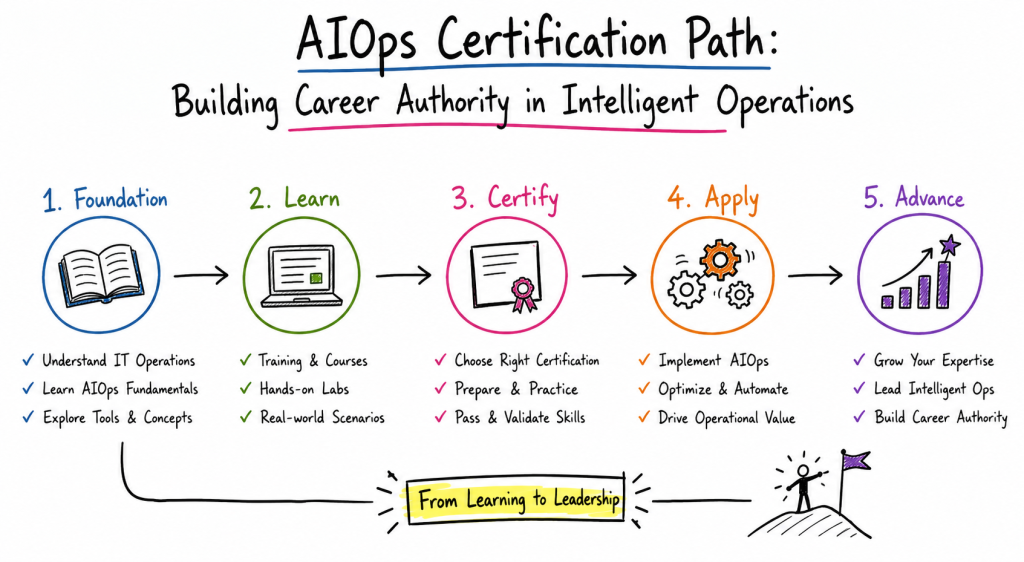
AIOps Certification Explained
What Is an AIOps Certification?
A professional certification validates a practitioner’s ability to architect, implement, and optimize AI-driven operational workflows.
Benefits of Professional Certification
- Career Advancement: Proof of specialized, high-demand skills.
- Standardized Methodology: Adopting industry best practices.
- Employer Trust: Demonstrating expertise in complex system architecture.
Who Should Pursue AIOps Certification?
- DevOps/SREs: To automate incident response.
- Monitoring Specialists: To evolve from dashboards to intelligence.
- IT Managers: To lead digital transformation initiatives.
AIOps Training and Courses
What Learners Typically Study
Effective training focuses on Event Correlation, where the system ignores duplicate alerts and focuses on the underlying issue. Furthermore, students master Predictive Analytics—using historical data to forecast capacity needs before a crash occurs.
AIOps Engineer Career Roadmap
Required Technical Skills
- Infrastructure: Kubernetes, Cloud (AWS/Azure/GCP).
- Coding: Python for automation and data manipulation.
- Observability: OpenTelemetry standards and ELK/Prometheus stacks.
Learning Sequence
- Master Observability: Understand logs, metrics, and traces.
- Study Data Patterns: Learn how ML identifies deviations in time-series data.
- Implement Automation: Connect AIOps insights to CI/CD pipelines.
AI Observability Training
What Is AI Observability?
It is the practice of using AI to understand the internal state of a system based on its external outputs.
Monitoring vs. Observability
| Monitoring | Observability |
|---|---|
| Tells you if the system is healthy | Tells you why it is unhealthy |
| Focused on dashboards | Focused on deep-dive diagnostics |
AIOps for SRE and DevOps Engineers
Reducing Alert Fatigue
AIOps clusters related events into single incidents, ensuring SREs only work on high-signal problems.
Improving Incident Response
By automatically pinpointing the suspected service or code commit, AIOps slashes investigation time.
Enterprise AIOps Consulting and Implementation
Organizations often struggle with “Data Overload.” AIOps consulting provides a roadmap to clean, ingest, and analyze data efficiently. The implementation lifecycle follows a structured path: Assessment -> Design -> Integration -> Automation -> Optimization.
Real-World Enterprise Use Cases
- Banking: Detecting fraudulent transaction spikes as operational anomalies.
- SaaS: Predicting server exhaustion during high-traffic marketing events.
- Healthcare: Ensuring 100% uptime for patient record systems through proactive health checks.
FAQ SECTION
- What is AIOps Certification?
It is a professional credential verifying your expertise in applying AI to IT operations. - Who should learn AIOps?
DevOps, SREs, and IT infrastructure managers. - What skills are required?
Infrastructure knowledge, Python, and observability tools. - How does AIOps help DevOps?
By automating root cause analysis and reducing manual toil. - What is AI Observability?
Applying AI to deeply inspect system states. - What is OpenTelemetry?
An open-source framework for collecting telemetry data. - How long does it take to learn?
Typically 3–6 months depending on existing experience. - What are AIOps Implementation Services?
Professional guidance for deploying AI-driven monitoring stacks. - Is AIOps a good career?
Yes, it is one of the fastest-growing niches in IT. - What is the future?
Self-healing, autonomous IT systems.
FINAL SUMMARY
AIOps is no longer a luxury; it is the backbone of modern, resilient engineering. By embracing certification and structured training, professionals can transition from reactive support to proactive architects. As infrastructure complexity grows, the ability to automate intelligence will define the next generation of IT leaders. Explore the programs at AIOpsSchool to start your journey today.
