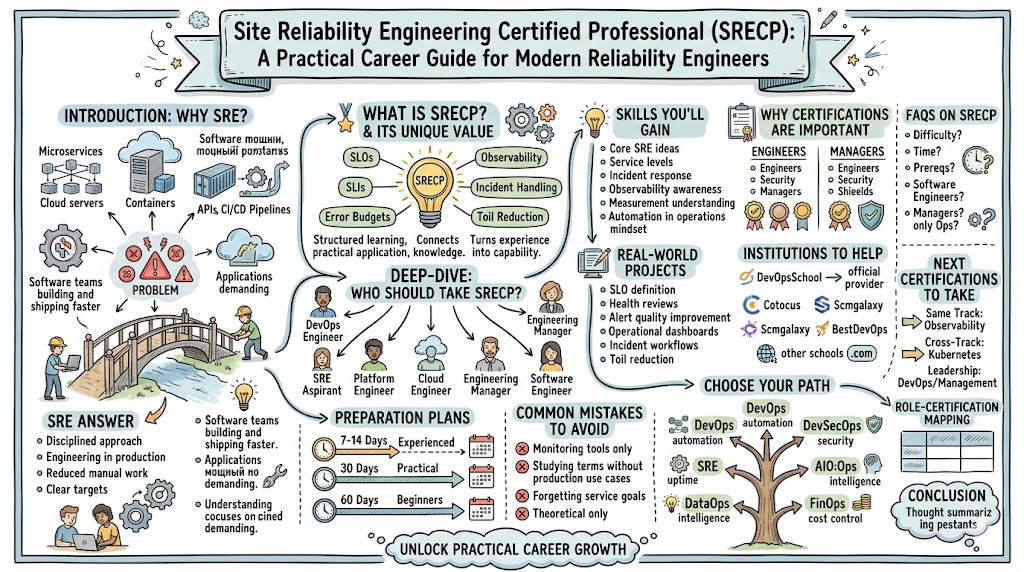
Software teams are building and shipping faster than ever. Applications are now spread across cloud platforms, containers, APIs, automation pipelines, and distributed services. This has made software more powerful, but it has also made operations more demanding. A small issue in one place can quickly affect performance, uptime, user experience, and business trust.
That is why Site Reliability Engineering has become so important.
Site Reliability Engineering is not just a new name for operations. It is a disciplined way of making systems dependable, scalable, observable, and easier to manage. It brings engineering practices into production operations so teams can reduce manual work, define clear service targets, respond better to incidents, and improve system behavior over time.
For working engineers and managers, this is now a very relevant skill area. Companies do not only want people who can deploy systems. They want professionals who can keep systems healthy, measurable, resilient, and efficient in real-world conditions. Reliability is no longer only a backend concern. It is directly connected to customer satisfaction, product quality, team productivity, and business continuity.
This is where the Site Reliability Engineering Certified Professional, or SRECP, becomes valuable.
SRECP is designed for professionals who want structured learning in reliability engineering. It helps learners understand how modern teams think about service reliability, incident handling, observability, automation, and operational maturity. More importantly, it gives them a practical way to connect these ideas to real engineering work.
This guide explains what SRECP is, why it matters, who should take it, how it supports career growth, what you can learn from it, how to prepare for it, and what next steps make sense after completing it.
What is Site Reliability Engineering Certified Professional (SRECP)?
Site Reliability Engineering Certified Professional is a professional certification focused on helping engineers and managers understand the real practice of reliability engineering. It is built for people who want to improve how software systems behave in production and how teams manage service quality at scale.
In simple terms, SRECP teaches you how to think about reliability in a structured and measurable way.
Many professionals work with parts of reliability every day. They may monitor systems, handle incidents, create dashboards, support deployments, or manage infrastructure. But many times, that knowledge stays fragmented. One person understands alerts. Another understands automation. Another handles outages. Another works on infrastructure. SRECP helps connect all those parts into one complete model.
That is what makes it useful.
Instead of looking at uptime as a random outcome, SRE teaches professionals to define service goals, measure user-facing behavior, reduce unnecessary toil, and improve recovery and prevention practices. It helps teams move from reactive support to intentional engineering.
The certification is especially relevant for professionals who want a more mature understanding of how modern systems should be operated. It brings together areas such as service reliability, monitoring, incident response, observability, automation, performance thinking, and cloud-native operational practices.
Why It Matters in Today’s Software, Cloud, and Automation Ecosystem
The modern software world is complex.
Teams are working with microservices, Kubernetes, CI/CD pipelines, infrastructure as code, observability platforms, cloud services, APIs, and multi-layer application stacks. Releases happen frequently. Production environments change constantly. Dependencies grow larger. Failure patterns become harder to track.
In older environments, operations often meant responding to issues after they appeared. That model is not enough anymore. Fast-moving systems need a more intelligent and engineering-driven way of handling reliability.
SRE provides that.
It helps organizations answer practical questions such as:
What level of reliability should a service provide?
How do we measure whether users are getting a good experience?
How much risk can we accept in order to ship faster?
Which alerts matter and which ones only create noise?
How do we reduce repetitive operational work?
How do we recover from incidents quickly and learn from them properly?
These are not small questions. They directly affect product trust, engineering efficiency, customer retention, and business stability.
For engineers, SRE matters because it improves the way systems are designed, measured, supported, and automated. It makes production work more thoughtful and less reactive.
For managers, SRE matters because it creates a language for discussing service health, risk, engineering trade-offs, and operational maturity. It helps teams stop treating reliability as vague and start treating it as something measurable and manageable.
That is why SRE has become one of the most practical and respected domains in modern engineering.
Why Certifications Are Important for Engineers and Managers
Real experience is always important. There is no replacement for learning from actual systems, real incidents, and production challenges. But experience alone is not always enough to create a complete understanding.
Many professionals learn only the part of the system they touch every day. They may become strong in one tool or one area but never build a full reliability mindset. Certifications can help fix that problem.
A strong certification brings order to learning.
It shows professionals what to study, what matters most, how different concepts connect, and where their knowledge gaps may be. It creates a roadmap instead of leaving learning scattered across random topics.
For engineers, certification can help in a few important ways.
It builds confidence. Many engineers already do reliability-related work, but they may not have formal clarity around SLOs, SLIs, error budgets, observability, or incident strategy. Certification helps organize that knowledge.
It improves focus. Instead of studying only tools, engineers can study principles and then understand how tools support those principles.
It strengthens career visibility. A recognized certification can help communicate seriousness, discipline, and career direction to employers and hiring managers.
For managers, certification has another kind of value.
Managers need frameworks. They need shared language across teams. They need a better way to discuss uptime, service quality, operational readiness, engineering risk, and platform maturity. A certification helps managers understand how reliability work should be planned, evaluated, and supported.
So the value of certification is not only the certificate itself. The real value is that it turns unstructured experience into clearer capability.
Why Choose DevOpsSchool?
A certification is only as useful as the quality of its learning approach. That is why the training provider matters.
DevOpsSchool is often chosen by professionals who want learning that feels practical and job-oriented. For a topic like Site Reliability Engineering, this is especially important. Reliability cannot be learned properly through definitions alone. It needs context, examples, hands-on thinking, and a clear connection to live environments.
One reason many learners prefer DevOpsSchool is that its programs are designed around real engineering roles. This makes the content more relevant for people already working in DevOps, cloud, infrastructure, operations, platform engineering, or software delivery.
Another reason is that learners often want training that balances theory and practical understanding. In reliability engineering, both matter. You need concepts such as service objectives and error budgets, but you also need to understand how these ideas influence deployment safety, observability, alerting, incident handling, and system behavior.
DevOpsSchool is also a suitable option for both engineers and managers. Some programs are too technical for leadership roles, while others stay too high-level to help engineers. SRECP sits in a useful middle ground. It supports technical depth while still being understandable and relevant for decision-makers.
For professionals looking to move into reliability-focused careers, or for managers trying to build stronger reliability practices inside teams, that balance is very useful.
Certification Deep-Dive: Site Reliability Engineering Certified Professional (SRECP)
What is this certification?
SRECP is a professional certification designed to help learners understand the principles and practices of Site Reliability Engineering in a practical and career-relevant way.
It is not only about keeping systems running. It is about learning how to make systems reliable by design, measurable in operation, and sustainable over time.
This certification introduces a structured way to think about production systems, service quality, operational workload, automation, incident response, and engineering responsibility in modern environments.
Who should take this certification?
This certification is a good fit for a wide range of professionals.
It is useful for DevOps engineers who want to shift into more reliability-focused work.
It is valuable for SRE aspirants who want structured and guided learning.
It suits platform engineers who manage shared services and production stability.
It is relevant for cloud engineers who own uptime, performance, and support readiness.
It can also help operations professionals who want to move from manual support to engineering-led operations.
Engineering managers can benefit as well, especially if they are responsible for service quality, platform reliability, incident readiness, or operational maturity across teams.
Even software engineers can find it valuable if they work closely with backend services, cloud platforms, production systems, or release pipelines.
Certification Overview Table
Certification Name Track Level Who it’s for Prerequisites Skills Covered Recommended Order Link
Site Reliability Engineering Certified Professional (SRECP) SRE Professional DevOps engineers, SRE aspirants, platform engineers, cloud engineers, operations professionals, engineering managers Basic understanding of Linux, cloud, CI/CD, monitoring, and system operations is helpful Reliability engineering, observability, incident response, service objectives, automation, operational maturity, production support thinking Strong starting point for the SRE track https://www.devopsschool.com/certification/sre-certified-professional-srecp.html
Site Reliability Engineering Certified Professional (SRECP)
What it is
SRECP is a structured certification path for professionals who want to understand how reliable systems are built, operated, measured, and improved in modern environments.
It helps learners move from task-based operations work to principle-driven reliability engineering.
Who should take it
DevOps engineers can take it to strengthen production depth.
SRE aspirants can take it to enter the reliability domain with a proper foundation.
Platform engineers can use it to improve the stability and support quality of internal systems.
Cloud engineers can use it to think more clearly about uptime, resilience, and observability.
Managers can use it to understand how reliability should be managed at a team and service level.
Skills you’ll gain
Understanding of core Site Reliability Engineering ideas
Clarity around service-level thinking
Better incident response mindset
Stronger observability awareness
Improved understanding of reliability measurement
Ability to think about automation in operations
Better alignment between engineering work and service health
Stronger production support and operational decision-making
Awareness of how stability and release speed should be balanced
Better understanding of how to reduce manual operational effort
Real-world projects you should be able to do after it
Define reliability goals for an internal or customer-facing service
Build a simple service health review process
Improve alert quality to reduce unnecessary noise
Design dashboards that support operational decision-making
Create basic incident handling workflows
Review recurring failures and identify preventable toil
Improve operational readiness for releases
Support reliability practices in cloud-native or container-based systems
Align engineering changes with measurable service expectations
Build a stronger reliability culture inside a delivery team
Preparation plan
7–14 days
This study plan is best for professionals who already work in DevOps, cloud, or platform roles. In this shorter window, focus on concept revision, role-based understanding, and topic mapping. Spend time on reliability fundamentals, service-level thinking, incident handling, automation goals, and observability basics. This period works best if you already have hands-on industry exposure and only need focused preparation.
30 days
This is the most practical plan for working professionals. Use the first part to build concept clarity around SRE principles. Use the middle phase for practical understanding of monitoring, alerting, incidents, dashboards, operational workflow improvement, and service reliability. Keep the last phase for revision and scenario-based preparation. This path gives enough time to connect ideas rather than simply memorizing them.
60 days
This plan is ideal for beginners or professionals moving from a general IT role into modern reliability engineering. Start with Linux basics, cloud concepts, system operations, CI/CD, containers, and monitoring. Then move into core SRE ideas, observability, incident response, service objectives, and automation. Use the final stage for mini-projects, revision, and deeper understanding of how SRE fits into real engineering work.
Common mistakes
Thinking SRE is only about monitoring tools
Studying terms without understanding production use cases
Ignoring the value of service goals and operational discipline
Learning tools without connecting them to reliability outcomes
Focusing only on outages and not on prevention
Treating automation as a side topic instead of a core habit
Forgetting the business side of uptime and service trust
Preparing only theoretically without practical thinking
Best next certification after this
The best next step depends on your direction.
If you want to grow deeper in reliability and service visibility, an observability-focused certification is a natural move.
If you want stronger cloud-native production depth, a Kubernetes-related certification makes sense.
If your goal is broader engineering leadership, DevOps or management-oriented certifications can help you expand beyond service reliability into cross-team delivery and operational strategy.
Choose Your Path
DevOps Path
This path is for professionals focused on automation, releases, CI/CD, infrastructure, and platform delivery. SRECP adds the reliability layer that many DevOps professionals eventually need. It helps them move from building delivery systems to improving the long-term health and trustworthiness of the services those systems support.
DevSecOps Path
This path is suitable for professionals who care about security in the software lifecycle. SRECP strengthens this path by improving operational resilience, incident response maturity, and stability thinking. Secure systems still need to be reliable, measurable, and recoverable.
SRE Path
This is the most direct path for those who want to specialize in service reliability, uptime, observability, incident response, and operational improvement. SRECP is an excellent anchor point for this direction and can help build the right mindset for long-term growth in the SRE field.
AIOps/MLOps Path
This path is ideal for people working with intelligent automation, machine learning systems, or AI-supported operations. SRECP brings valuable discipline here because automated systems still need reliable infrastructure, measurable service behavior, and strong production oversight.
DataOps Path
Data platforms also need reliability. Pipeline failures, unstable workloads, broken dependencies, and poor operational visibility can harm business outcomes quickly. SRECP supports DataOps professionals by helping them think about reliability in the same structured way as service teams.
FinOps Path
FinOps is about cost awareness, resource efficiency, and cloud value management. SRECP complements this path because unreliable systems often create waste, emergency effort, poor resource usage, and repeated recovery costs. Better reliability often supports better efficiency.
Role → Recommended Certifications Mapping
Role Recommended Certifications
DevOps Engineer SRECP, DevOps-focused certifications, Kubernetes-related certifications
SRE SRECP first, then observability and advanced reliability learning
Platform Engineer SRECP plus Kubernetes, Terraform, and platform engineering certifications
Cloud Engineer SRECP plus cloud operations or cloud architecture certifications
Security Engineer DevSecOps-focused certifications first, then SRECP for resilience depth
Data Engineer DataOps-oriented learning plus SRECP for operational reliability
FinOps Practitioner FinOps learning plus SRECP for efficiency and stability alignment
Engineering Manager SRECP plus leadership-oriented DevOps, SRE, or platform strategy certifications
Next Certifications to Take
Same track
An observability-focused certification is a smart next move after SRECP. Once you understand reliability thinking, the next layer is stronger visibility into metrics, logs, traces, dashboards, and service behavior. This helps deepen operational judgment and supports more mature reliability practice.
Cross-track
A Kubernetes-related certification is a strong cross-track option. Many modern services run in container-based or orchestrated environments. Stronger Kubernetes knowledge helps professionals support real production systems more confidently and connect reliability ideas to modern infrastructure patterns.
Leadership
A DevOps or engineering-management-oriented certification is a useful leadership step. This path is well suited to professionals who want to move from hands-on reliability work into platform leadership, delivery strategy, operational governance, or cross-team engineering management.
Institutions That Help in Training cum Certifications for Site Reliability Engineering Certified Professional (SRECP)
DevOpsSchool
DevOpsSchool is the direct provider of the SRECP program and is the most closely aligned option for learners who want focused training around this certification. It is a suitable choice for working engineers, managers, and teams that want structured guidance in Site Reliability Engineering. It is especially useful for learners who want practical and career-oriented understanding instead of only theoretical content.
Cotocus
Cotocus is often seen by learners who want support around technical training and implementation-oriented learning. It can be useful for professionals looking to strengthen their cloud, automation, and engineering exposure while building a stronger practical foundation for modern IT roles.
Scmgalaxy
Scmgalaxy is widely associated with technology learning in areas such as automation, DevOps, and tooling. It can be a helpful option for learners who want to improve engineering basics before moving deeper into specialized reliability work. Its value is often stronger for professionals building broad technical foundations.
BestDevOps
BestDevOps is commonly recognized in the wider training ecosystem for DevOps and cloud learning. It can be relevant for professionals exploring training and certification support across operations, automation, infrastructure, and reliability-adjacent areas. It is especially useful for learners who want exposure to broader engineering topics along with role-specific growth.
devsecopsschool.com
This platform is more useful for professionals who want to combine reliability learning with strong security awareness. It can support engineers and managers who are working in secure delivery environments and want to understand how production resilience and security discipline fit together in modern systems.
sreschool.com
SRESchool is naturally relevant for learners who want a more focused path in reliability engineering. It is useful for professionals who are serious about service health, observability, operational readiness, alert quality, and engineering-led production support. For someone planning a long-term SRE career, it can be a meaningful support option.
aiopsschool.com
AIOpsSchool can be a good option for professionals interested in the future of operations, especially where automation, analytics, and AI-supported decision-making are involved. It is suitable for learners who want to combine reliability fundamentals with more advanced operational intelligence.
dataopsschool.com
DataOpsSchool is useful for those working in data engineering and data platform operations. It can support professionals who want to improve the reliability, quality, and repeatability of data workflows. For learners operating in data-heavy environments, it complements reliability thinking well.
finopsschool.com
FinOpsSchool is relevant for professionals focused on cloud cost governance, financial visibility, and platform efficiency. It is especially valuable for learners who want to understand the connection between service stability, operational waste, and cloud optimization. For professionals balancing cost and reliability, it can be a strong complementary learning area.
Frequently Asked Questions
- Is SRECP a hard certification?
It is best described as a professional-level certification, so it is not very basic. For people already working in DevOps, platform engineering, cloud support, or operations, it becomes much easier because many ideas will already feel familiar.
- How much time does preparation usually take?
For most working professionals, a 30-day plan is a practical target. If you already have hands-on experience, you may need less time. If you are new to cloud, monitoring, or operations, a 60-day path is usually safer.
- Are there any prerequisites for SRECP?
Formal prerequisites may not always be strict, but basic knowledge of Linux, cloud platforms, monitoring, CI/CD, and system operations will help a lot. Without these basics, the concepts may still be understandable, but progress will feel slower.
- Is SRECP useful for software engineers?
Yes. Software engineers who work on backend systems, APIs, cloud applications, release processes, or production support can gain a lot from learning how reliability is defined and improved in real systems.
- Is this certification only for operations teams?
No. That is one of the biggest misunderstandings about SRE. It is relevant not only for operations people, but also for DevOps engineers, platform engineers, cloud engineers, and even software developers who work near production systems.
- Will SRECP help in career growth?
Yes. It can strengthen your profile for SRE, DevOps, platform, cloud operations, and reliability-focused engineering roles. It is especially useful when combined with real project work and practical understanding.
- Can managers benefit from SRECP too?
Yes. Managers benefit because SRE teaches a better way to talk about service health, uptime expectations, incident readiness, and operational maturity. It helps leadership decisions become more concrete and measurable.
- Is SRECP only about monitoring and alerts?
No. Monitoring is only one part of the picture. SRE also includes service-level thinking, observability, incident management, automation, reliability improvement, and reduction of manual operational work.
- What should I study before starting SRECP?
It is a good idea to review Linux basics, cloud concepts, containers, CI/CD, monitoring, and production support practices. These topics help create a strong base for understanding reliability engineering properly.
- Should I take Kubernetes certification before or after SRECP?
That depends on your current job. If your role is already focused on service reliability and operational ownership, SRECP can come first. If your daily work is deeply Kubernetes-centered, both paths can support each other well.
- What kind of jobs align well with this certification?
Roles such as Site Reliability Engineer, DevOps Engineer, Platform Engineer, Cloud Operations Engineer, Production Engineer, and reliability-focused engineering manager align well with SRECP.
- Is SRECP worth it for someone already working in DevOps?
Yes. Many DevOps professionals eventually reach a point where they need more depth in production reliability, service quality, and operational discipline. SRECP helps provide that next level of clarity.
FAQs on Site Reliability Engineering Certified Professional (SRECP)
- What does SRECP stand for?
SRECP stands for Site Reliability Engineering Certified Professional.
- What is the main goal of this certification?
Its main goal is to help professionals understand and apply Site Reliability Engineering practices in real production environments.
- Is SRECP suitable for beginners?
Yes, but beginners should usually follow a longer preparation plan so they can build the right foundations before moving into deeper reliability concepts.
- Is it good for DevOps engineers?
Yes. It is one of the best growth options for DevOps professionals who want to become stronger in service reliability, observability, and operational maturity.
- Does it help managers too?
Yes. It helps managers understand reliability in a more structured way and supports better decision-making around operational health and service goals.
- Is SRECP relevant in cloud-native systems?
Very much. Modern cloud-native environments are exactly the kind of systems where strong reliability thinking becomes essential.
- What makes this certification different from general operations learning?
It focuses on engineering-led reliability rather than only support activity. It helps learners think in terms of measurable service quality and long-term system behavior.
- What is the biggest career value of SRECP?
It helps professionals move from general production support or DevOps work into more mature, reliability-centered engineering roles with clearer business relevance.
Conclusion
Site Reliability Engineering Certified Professional is a strong certification choice for people who want to build serious capability in modern reliability engineering. It is valuable because it does not stay limited to one tool, one platform, or one narrow operations task. Instead, it helps professionals understand how service quality, observability, incident handling, automation, and system stability come together in real engineering environments. That makes it highly relevant for DevOps engineers, SRE aspirants, platform teams, cloud professionals, and engineering managers. In a world where software is expected to be fast, stable, and always available, reliability is no longer optional. SRECP helps professionals build the mindset and structure needed to contribute meaningfully in that world and grow into stronger, more trusted technical roles.
