Introduction
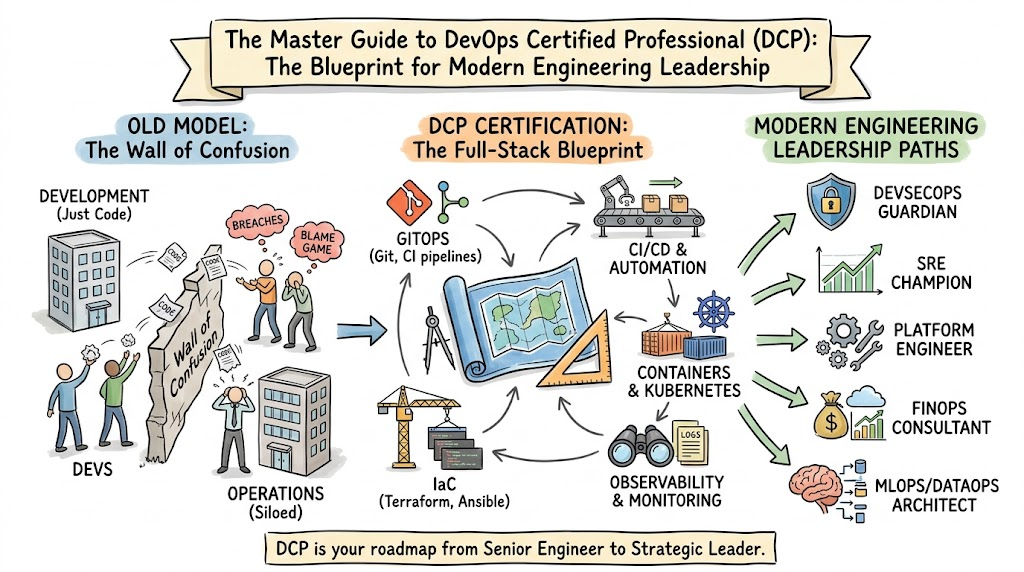
If you’ve been in the industry for more than a few years, you remember the “Wall of Confusion.” Developers wrote code and threw it over a wall to Operations. Operations tried to deploy it, it broke, and the blame game began. That model is dead.
The global tech ecosystem has moved past the era of “siloed” engineering. In the current market—spanning from the tech hubs of Bangalore and Hyderabad to the innovation centers of Silicon Valley and London—the role of a Software Engineer has evolved. It is no longer enough to “just code.” To survive and thrive, you must understand the infrastructure, the security, the cost, and the reliability of the systems you build.
What is DevOps Certified Professional (DCP)?
The DevOps Certified Professional (DCP)is a comprehensive professional-grade certification that validates a candidate’s ability to design, implement, and manage a full-stack DevOps ecosystem. It is not a “tool-specific” badge. While you will learn tools like Docker or Terraform, the DCP focuses on the architectural orchestration of these tools. It proves that you understand how to weave Version Control, CI/CD, Containerization, Orchestration, and Observability into a single, high-performing engine.
Why it Matters in Today’s Software, Cloud, and Automation Ecosystem
We are currently navigating the “Third Wave” of cloud computing, a transformative era defined by cloud-native automation that follows the earlier stages of simple hosting and virtualization. This shift is driven largely by the inherent complexity of microservices; as organizations dismantle monoliths into hundreds of individual services, manual management becomes impossible, making the framework provided by the DevOps Certified Professional (DCP) essential for maintaining control. Central to this evolution is the “Shift Left” movement, which integrates security and testing at the very inception of the development cycle, positioning DCP practitioners as the primary architects of this proactive strategy. Furthermore, the rise of platform engineering has led organizations to develop Internal Developer Platforms (IDPs), and the DCP certification offers the foundational expertise necessary to build these sophisticated, self-service environments.
Why Certifications are Important for Engineers and Managers
In an era defined by “Resume Inflation,” a certification functions as a vital, verified technical audit of an individual’s actual capabilities. For engineers, these credentials offer a structured learning path that replaces the fragmented nature of self-teaching with a proven industry roadmap; furthermore, they serve as a powerful salary lever during annual appraisals or career transitions. From a management perspective, certification is a strategic tool for reducing “Technical Debt,” as teams adhering to DCP standards produce cleaner code and more stable pipelines, leading to a significant drop in Mean Time to Recovery (MTTR). Ultimately, these credentials help standardize the hiring process, saving leadership hours of basic technical screening by providing immediate assurance of a candidate’s foundational expertise.
Why Choose DevOpsSchool?
Securing a professional certification requires a depth of engagement that far exceeds simply reading a textbook; it demands a practical mastery of the tools and culture involved. DevOpsSchool has established itself as a frontrunner in this space by treating DevOps as a specialized craft rather than a mere academic subject. This philosophy is embedded in their production-grade labs, which move beyond basic exercises to simulate real-world traffic and complex failure scenarios. Rather than focusing solely on syntax, their outcome-oriented learning ensures that practitioners understand why a specific command matters for broader business objectives. Furthermore, their extensive global network and massive footprint in the Indian market have turned their certification into a recognized “currency” that carries significant weight with recruiters worldwide.
DevOps Certified Professional (DCP)
What it is
The DevOps Certified Professional (DCP) is an elite-level validation of an engineer’s ability to automate the entire software delivery pipeline. It bridges the gap between high-level architectural theory and “hands-on-keyboard” implementation.
Who should take it
This program is designed for Senior Software Engineers, Cloud Architects, System Administrators, QA Leads, and IT Managers who are responsible for the speed and quality of software releases.
Skills You’ll Gain
- Advanced GitOps: Implementing pull-request-based workflows for infrastructure changes.
- Pipeline Orchestration: Building “Smart Pipelines” that perform automated rollbacks if health checks fail.
- Container Security: Learning how to sign images, scan for vulnerabilities, and manage secrets in Kubernetes.
- Infrastructure as Code (IaC): Mastering Terraform and Ansible to manage multi-cloud environments.
- Logging & Distributed Tracing: Using tools like ELK and Jaeger to find the “needle in the haystack” during production outages.
- Site Reliability Principles: Implementing SLIs, SLOs, and Error Budgets to balance feature velocity with system stability.
Real-World Projects You Should Be Able to Do
- Multi-Region Failover: Set up an automated system that redirects traffic to a different global region if the primary data center goes offline.
- Hybrid Cloud CI/CD: Build a pipeline that builds code on-premise but deploys to AWS/Azure seamlessly.
- Automated Scaling for Peak Load: Configure an EKS/GKE cluster to scale from 10 to 1000 nodes during a “Big Billion Day” or “Black Friday” event.
- Zero-Trust Security Pipeline: Integrate Vault and OPA (Open Policy Agent) to ensure that only authorized code can reach production.
The Master Certification Matrix
| Track | Level | Who it’s for | Prerequisites | Primary Skills | Order |
| DevOps | Professional | Engineers & Architects | Linux/Git Basics | CI/CD, K8s, Terraform | 1st |
| DevSecOps | Specialized | Security/Ops Engineers | DCP Foundation | Sast/Dast, Vault, Compliance | 2nd |
| SRE | Advanced | Reliability Engineers | DevOps Expertise | SLIs/SLOs, Chaos Eng | 2nd |
| AIOps/MLOps | Specialized | Data/ML Engineers | Python + DevOps | ML Pipelines, Model Ops | 3rd |
| DataOps | Specialized | Data Engineers/DBAs | SQL + Cloud | Data Orchestration, ETL | 3rd |
| FinOps | Management | Finance/Tech Leads | Cloud Awareness | Cloud Economics, Tagging | 2nd |
Strategic Preparation Plan for DCP Success
Success in the DCP exam requires a blend of conceptual understanding and muscle memory. Choose the path that matches your current experience level.
7–14 Days: The “Sprint” (For Seasoned DevOps Practitioners)
- Days 1-4: Focus strictly on the “Gaps.” If you use AWS, study Azure integration. If you use Jenkins, study GitLab CI.
- Days 5-10: Deep dive into Kubernetes networking (Ingress, CNI, Service Mesh). This is often the hardest part of the exam.
- Days 11-14: Practice “Time-Boxed” labs. Can you set up a monitoring stack in under 30 minutes? If not, keep practicing.
30 Days: The “Marathon” (For Software Engineers)
- Week 1: Master the Command Line. If you can’t pipe commands, grep logs, and manage SSH keys comfortably, the tools will overwhelm you.
- Week 2: Infrastructure as Code. Spend 2 hours daily writing Terraform modules. Learn how to manage “State” and “Locks.”
- Week 3: Containers and Orchestration. Move beyond
docker run. Learn how to manage volumes, namespaces, and RBAC in Kubernetes. - Week 4: Integration. Spend this week building a project that connects every tool you’ve learned into one cohesive flow.
60 Days: The “Transformation” (For Beginners & Career Switchers)
- Month 1: Focus on “The Linux Way.” Understand how the kernel, memory, and networking work. You cannot automate what you do not understand.
- Month 2: The “Tools of the Trade.” Dedicate 10 days each to CI/CD, Containers, and Cloud. Use the final 10 days for mock exams and peer reviews.
Common Pitfalls to Avoid
- Being a “Tool Collector”: Don’t try to learn 50 tools. Master the principles using one tool, and the others will be easy to learn.
- Ignoring Documentation: In the real world, you don’t memorize; you search. Learn how to navigate official documentation quickly.
- Manual Overrides: If you find yourself clicking in a GUI (Console), you are failing the DevOps mindset. Everything must be in code.
Specialized Career Paths: Where Do You Go Next?
The DCP is your foundation. Once you have it, you should specialize in one of these six high-growth domains:
- The DevOps Generalist: Focuses on the “Internal Developer Platform.” You make other developers’ lives easier by building self-service tools.
- The DevSecOps Guardian: You are the architect of the “Security Sandbox.” You ensure that the speed of DevOps doesn’t come at the cost of vulnerability.
- The SRE Champion: You live for uptime. You use Chaos Engineering to break things on purpose to ensure they never break in production.
- The MLOps Specialist: You bridge the gap between Data Scientists and Production. You automate the training and deployment of AI models.
- The DataOps Architect: You treat data like code. You automate the flow of petabytes of data while ensuring quality and lineage.
- The FinOps Consultant: You are the hero of the C-suite. You show the company exactly how to cut their cloud bill by 40% without losing performance.
Role → Recommended Certification Mapping
| Role | Foundation | Intermediate | Advanced / Expert |
| Platform Engineer | DCP | HashiCorp Terraform Associate | CKA (Certified Kubernetes Administrator) |
| Cloud Architect | DCP | Solutions Architect Associate | AWS/Azure Solutions Architect Professional |
| Security Engineer | DCP | DevSecOps Professional | Certified Ethical Hacker (CEH) |
| Data Engineer | DCP | DataOps Certification | Google Professional Data Engineer |
| Engineering Manager | DCP | FinOps Certified | Agile Coach Certification |
| QA Automation | DCP | Selenium / Cypress Certification | DevSecOps (Security Testing) |
Next Steps: Elevating Your Credentials
- Vertical Depth (The Specialist): Deep dive into Kubernetes with the CKA (Certified Kubernetes Administrator). This is the natural evolution for anyone who wants to be a top-tier DevOps Engineer.
- Horizontal Breadth (The Hybrid): Take a DevSecOps or SRE certification. This makes you indispensable because you can handle security and reliability—the two biggest “pain points” for modern companies.
- The Leadership Pivot (The Strategic): Aim for the FinOps Certified Practitioner. As cloud costs skyrocket, the ability to manage the “Business of the Cloud” is what gets you promoted to Director or VP levels.
Top Training Institutions for DCP Excellence
DevOpsSchool
This provider is a leader in the DevOps education space, offering deep technical bootcamps and certification support for a global audience. They focus on providing hands-on labs that simulate real-world production environments, ensuring that students gain practical experience. Their instructors are seasoned industry veterans who provide mentorship beyond the curriculum, helping engineers solve actual work challenges during the training process.
Cotocus
A specialized training and consulting firm that focuses on high-end engineering practices and digital transformation. They provide tailored learning paths for enterprises and individuals looking to master complex toolchains. Their approach is highly practical, emphasizing the integration of security tools within existing workflows to achieve a true DevSecOps culture in large-scale organizations.
Scmgalaxy
As one of the largest communities for DevOps and SCM professionals, this provider offers a wealth of resources, including free tutorials and premium certification support. They are known for their community-driven approach to learning, where professionals can share insights and stay updated on the latest trends in software configuration and security automation.
BestDevOps
This platform offers curated training programs designed to help engineers move from foundational knowledge to advanced architectural mastery. They emphasize the career impact of certifications, providing students with the technical skills and the professional guidance needed to secure top-tier roles in the tech industry globally.
devsecopsschool.com
This is the official platform for the Certified DevSecOps Engineer program, offering direct access to the curriculum and certification exams. It provides a comprehensive ecosystem for learners, including study materials, practice labs, and official documentation. The site serves as the primary hub for professionals looking to validate their expertise through a recognized industry standard.
sreschool.com
Focusing on the intersection of reliability and security, this provider offers specialized training for Site Reliability Engineers. Their modules cover how to build resilient systems that can withstand both traffic spikes and security incidents. They provide deep dives into observability and automated response, which are critical for maintaining modern distributed systems.
aiopsschool.com
This provider is at the forefront of the AIOps movement, teaching engineers how to leverage artificial intelligence for IT operations. Their curriculum includes using AI to detect security threats and automate operational decision-making. It is an ideal resource for those looking to stay ahead of the curve in automated system management.
dataopsschool.com
A dedicated training site for data professionals who need to implement security and operations best practices within their data pipelines. They cover the unique challenges of securing large-scale data environments and ensuring compliance with global data protection laws through automation and rigorous testing.
finopsschool.com
This platform provides training on cloud financial management, helping professionals optimize their cloud spend while maintaining a secure infrastructure. They teach the essential skills of balancing cost, speed, and security, which is a growing requirement for modern cloud-native enterprises looking to maximize their ROI.
FAQs: Career Outcomes & Strategy
1. Is the DCP certification worth the investment in 2026?
Absolutely. As companies move toward “AI-Augmented DevOps,” having a verified professional credential is the only way to prove you understand the underlying architecture that the AI is managing.
2. How long does the average engineer take to clear the DCP?
While the preparation plan says 30-60 days, most engineers with 2-3 years of experience can clear it in 4 weeks of dedicated weekend study.
3. Does this certification help with remote jobs?
Yes. Global companies looking for remote talent use certifications as a primary filtering mechanism. DCP is recognized as a global standard for competency.
4. Can I jump straight to SRE or DevSecOps without DCP?
You can, but it’s not recommended. Without the “DevOps Foundation” that DCP provides, you will struggle with the basic automation concepts required for specialized tracks.
5. What is the impact on salary in the Indian market?
A DCP certified engineer in India typically sees a 30% to 50% salary jump when moving from a traditional “Software Engineer” or “Admin” role into a “DevOps/SRE” role.
6. Does it cover the “Human” side of DevOps?
Yes. One of the core pillars of the DCP curriculum is Culture and Collaboration. It teaches you how to break down silos and implement Agile and Scrum within a DevOps context.
7. How do I keep my certification relevant?
The DevOps world moves fast. We recommend renewing or “up-stacking” your certification every 24 months to ensure you are current with the latest versions of K8s, Terraform, and Cloud providers.
8. Is the exam lab-based or multiple choice?
It is a hybrid. You will face scenario-based multiple-choice questions that require you to have actually performed the tasks in a lab environment to know the answer.
9. Can a manual QA professional transition using this certificate?
Absolutely. QA professionals often excel in DevOps because they already possess a quality-first mindset; the DCP simply provides the automation toolkit to scale that mindset.
10. How much of a salary hike is typical after certification?
While it varies by region, certified professionals often see a 30% to 50% increase in total compensation due to the critical shortage of skilled platform engineers.
11. Is the exam conducted in a live lab environment?
The exam consists of complex, multi-step technical scenarios that require you to identify the correct architectural decisions and command-line solutions used in production.
12. Does the DCP cover “Shift Left” security practices?
Yes. A core component of the DCP is integrating security scans, secret management, and compliance checks directly into the automated pipeline.
FAQs: Specifics of the DCP Program
1. Who is the governing body for the DCP?
The DCP is a professional certification program managed by DevOpsSchool, which sets the standards for the curriculum and the examination.
2. Is there any negative marking in the exam?
Usually, there is no negative marking, but the passing threshold is high (typically 70% or above) to ensure professional quality.
3. Can I get a refund if I don’t pass?
Policies vary by training provider, but most (like DevOpsSchool) offer a “Second Attempt” or “Free Retraining” if you fail to clear it on your first try.
4. Does the certification include Cloud training?
Yes, the DCP is cloud-agnostic but includes practical modules on how to implement DevOps on AWS, Azure, or Google Cloud.
5. Are the labs provided during training accessible after the course?
Most providers offer extended lab access (3-6 months) so you can continue to practice and build your portfolio after getting certified.
6. What is the biggest benefit for a Manager taking the DCP?
The ability to estimate timelines accurately. If you don’t understand the automation effort required, you cannot manage a modern engineering team effectively.
7. How do I verify my certificate?
Every DCP certificate comes with a unique ID and a verification URL on the DevOpsSchool portal, making it easy for employers to validate your credentials.
8. When should I consider moving to specialized tracks like DevSecOps or SRE?
You should pursue specialized certifications only after securing your DCP.
Conclusion
The transition to a DevOps Certified Professional (DCP) is more than just a career move—it is a mindset shift. The industry has reached a tipping point where “DevOps” is no longer a separate team; it is the way we build software.
By earning your DCP, you are signaling to the market that you are ready to handle the complexity of modern, cloud-native, high-velocity engineering. Whether you are aiming for that “Senior” title, a higher salary, or the opportunity to work on cutting-edge global projects, the DCP is your roadmap.