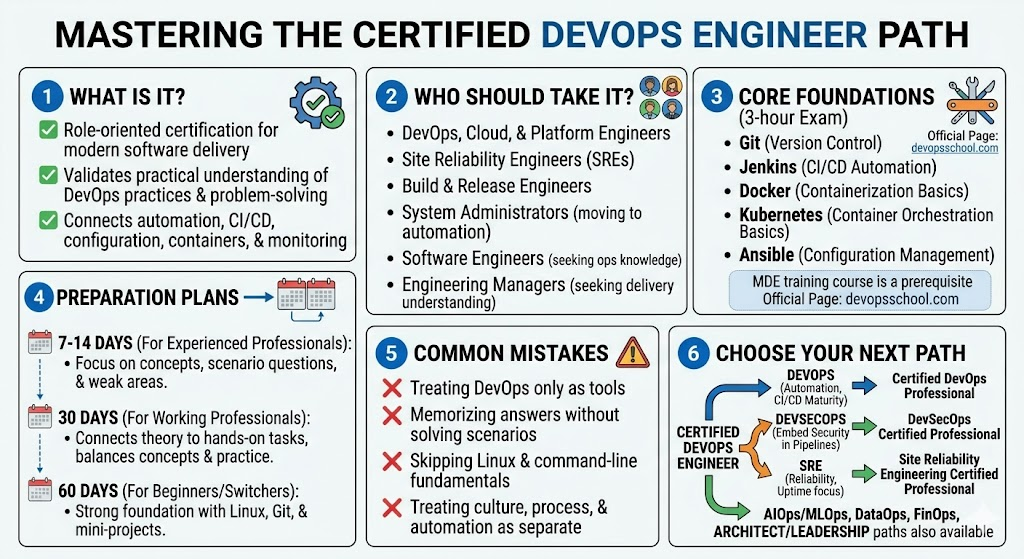
DevOps is no longer just a trending word in software teams. It has become a practical way of building, testing, releasing, and operating software faster and with fewer mistakes. For working engineers and managers, that shift has created a real need for structured learning. The Certified DevOps Engineer program from DevOpsSchool is designed to validate that kind of practical understanding. The official page describes it as a 3-hour exam-focused certification that checks knowledge in CI/CD pipelines, infrastructure automation, configuration management, monitoring, and cloud-native implementation.
This matters because many professionals know individual tools, but they do not always know how the full delivery system fits together. A DevOps engineer is expected to connect version control, build automation, containers, deployment flow, monitoring, collaboration, and reliability into one working model. The official certification also names Jenkins, Docker, Kubernetes, Git, and Ansible among the core foundations expected from candidates.
This guide is written for software engineers, cloud professionals, platform teams, and engineering managers who want a clearer understanding of where this certification fits. It explains the certification itself, how to prepare for it, which roles benefit most, what you should be able to do after it, and what certification path can come next. The broader certification reference from Gurukul Galaxy also places Certified DevOps Engineer within a larger learning ecosystem that includes DevOps, DevSecOps, SRE, AIOps, MLOps, DataOps, and FinOps paths.
Why This Certification Deserves Attention
Most software teams want faster releases, better quality, fewer manual steps, and stronger visibility into production systems. That is exactly where DevOps creates value. But in interviews and real projects, companies often look beyond buzzwords. They want people who understand delivery pipelines, automation, release safety, configuration consistency, collaboration, and operational feedback.
The Certified DevOps Engineer program is useful because it is not positioned as a general awareness badge. The official page frames it as a certification for professionals who want to validate expertise in core DevOps practices and real-world problem solving. It also lists DevOps Engineers, Cloud Engineers, and SREs among the intended audience.
For managers, this certification helps in a different way. Even if a manager is not writing pipeline code every day, understanding DevOps helps in planning team workflows, reducing delivery friction, and improving communication between developers, QA, operations, and security teams. For individual contributors, it provides a cleaner path toward platform engineering, cloud operations, SRE, DevSecOps, and architecture roles.
Certification Overview
| Certification | Provider | Track | Level | Who it’s for | Prerequisites | Skills covered | Recommended order |
|---|---|---|---|---|---|---|---|
| Certified DevOps Engineer | DevOpsSchool | DevOps | Engineer | DevOps Engineers, Cloud Engineers, SREs, software professionals | Strong foundation in Jenkins, Docker, Kubernetes, Git, Ansible; official page also lists the MDE training course as a prerequisite for the exam path | CI/CD, infrastructure automation, configuration management, monitoring, cloud-native delivery | Start here for the core DevOps track |
The official page states that the certification program is a 3-hour online-proctored exam with multiple-choice and multiple-select questions, while the related training program is listed separately. It also notes the MDE training course as the prerequisite on the page.
What It Is
Certified DevOps Engineer is a role-oriented certification that helps professionals prove they understand how modern software delivery works. It focuses on the practical side of DevOps, not just vocabulary.
In simple words, it is for people who want to show that they can connect automation, CI/CD, configuration, containers, monitoring, and collaboration into real engineering workflows. The official description specifically highlights real-world problem solving and cloud-native technologies as part of the assessment focus. (DevOps School)
Who Should Take It
This certification is a good fit for professionals such as:
- DevOps Engineers
- Cloud Engineers
- Site Reliability Engineers
- Platform Engineers
- Build and Release Engineers
- System Administrators moving into automation
- Software Engineers who want stronger deployment and operations knowledge
- Engineering Managers who want practical delivery understanding
The official certification page directly identifies DevOps Engineers, Cloud Engineers, and SREs as target candidates, and the broader topic list on the page makes it clear that adjacent engineering roles can also benefit.
Skills You’ll Gain
- Understanding of DevOps principles and delivery flow
- CI/CD pipeline design basics
- Practical use of Git-based collaboration
- Jenkins-driven automation thinking
- Docker and container workflow awareness
- Kubernetes exposure for modern deployment environments
- Configuration management concepts with tools like Ansible
- Monitoring and feedback loop understanding
- Infrastructure automation mindset
- Better coordination between development and operations teams
These skill areas align with the official program description and agenda, which mentions CI/CD, automation, monitoring, Git, Jenkins, Docker, Kubernetes, Ansible, SDLC models, DevSecOps, SRE, and microservices-related topics.
Real-World Projects You Should Be Able to Do After It
- Build a basic CI/CD workflow for application delivery
- Automate build, test, and deployment stages
- Containerize an application for consistent deployment
- Manage code movement through Git-based workflows
- Support configuration consistency across environments
- Assist with Kubernetes-based deployment preparation
- Add basic monitoring and operational visibility into delivery flow
- Reduce manual handoffs between development and operations teams
These projects are not listed word for word on the page, but they are reasonable practical outcomes based on the tools, agenda, and competencies described in the official certification details.
Preparation Plan
7–14 Days
This path is best for professionals who already work with DevOps tools or delivery environments.
Spend the first few days revising DevOps concepts, SDLC, Agile flow, CI/CD, and collaboration principles. After that, review Git, Jenkins, Docker, Kubernetes, and Ansible. In the final stretch, focus on scenario-based questions, troubleshooting logic, and end-to-end delivery flow. This shorter plan works only when you already have strong practical exposure.
30 Days
This is the most balanced option for working professionals.
Use the first week for DevOps principles, software delivery models, and automation basics. Spend the second week on Git, Jenkins, and CI/CD. Use the third week for Docker, Kubernetes, and configuration management. Keep the last week for monitoring, revision, and practice questions. This path gives enough time to connect theory with hands-on tasks.
60 Days
This is ideal for beginners, career switchers, or professionals coming from support, testing, or traditional admin roles.
Start with Linux basics, command-line confidence, networking fundamentals, and software delivery concepts. Then move to Git and Jenkins. After that, learn containers, Kubernetes basics, and Ansible. In the last phase, study monitoring, cloud-native flow, and practice real mini-projects. The official agenda on the DevOpsSchool page supports this broader foundation because it includes SDLC models, Agile, DevOps, DevSecOps, SRE, Ubuntu, SSH, command line work, and microservices context in addition to core tools. (DevOps School)
Common Mistakes
- Studying tool names without understanding workflow
- Treating DevOps as only Jenkins or Docker
- Ignoring monitoring and feedback loops
- Memorizing answers instead of solving scenarios
- Skipping Linux and command-line fundamentals
- Moving to advanced certifications too early
- Focusing on theory without building small practical exercises
- Missing the connection between culture, process, and automation
This matters because the official agenda clearly goes beyond one or two tools and includes culture, adoption, risks, software development models, microservices, and implementation thinking.
Best Next Certification After This
The best next step depends on the kind of career you want.
If you want to stay in the same track and go deeper, Certified DevOps Professional is the most natural next move. If you want a cross-track option, DevSecOps Certified Professional or Site Reliability Engineering Certified Professional make sense. If you are moving toward leadership, Certified DevOps Architect or Certified DevOps Manager are stronger choices.
The Gurukul Galaxy reference lists all of these as part of the broader certification landscape for software engineers, alongside cloud, Kubernetes, AIOps, MLOps, DataOps, and FinOps certifications.
Choose Your Path
DevOps
Choose this path if your goal is automation, release engineering, CI/CD maturity, infrastructure workflow, and faster delivery. This is the core path for platform-minded engineers.
DevSecOps
Choose this when security becomes part of your daily delivery work. It is ideal for professionals who want to shift security left and embed checks into the pipeline.
SRE
Choose this if you care more about uptime, reliability, observability, alerting, incident response, and service quality in production systems.
AIOps / MLOps
Choose this if your work involves intelligent operations, model lifecycle management, automation at scale, or data-driven operational platforms.
DataOps
Choose this when your role is centered around data pipelines, orchestration, data quality, analytics platform delivery, and repeatable movement of data across systems.
FinOps
Choose this when cloud cost, optimization, accountability, budgeting, and value-driven engineering decisions matter in your role.
These paths are supported by the certification list in the Gurukul Galaxy article, which includes DevOps, DevSecOps, SRE, AIOps, MLOps, DataOps, and FinOps certifications as parallel and connected learning routes.
Role → Recommended Certifications
| Role | Recommended certifications |
|---|---|
| DevOps Engineer | Certified DevOps Engineer → Certified DevOps Professional → Certified DevOps Architect |
| SRE | Certified DevOps Engineer → Site Reliability Engineering Certified Professional → Certified Site Reliability Engineer |
| Platform Engineer | Certified DevOps Engineer → Kubernetes / cloud DevOps path → Certified DevOps Architect |
| Cloud Engineer | Certified DevOps Engineer → Azure DevOps Engineer Expert or GCP Professional Cloud DevOps Engineer |
| Security Engineer | Certified DevOps Engineer → DevSecOps Certified Professional → Certified DevSecOps Engineer |
| Data Engineer | Certified DevOps Engineer → DataOps path or cloud data engineering path |
| FinOps Practitioner | Certified DevOps Engineer → Certified FinOps Engineer → Certified FinOps Professional |
| Engineering Manager | Certified DevOps Engineer → Certified DevOps Manager → architect or leadership path |
This mapping is based on the certification families listed in the Gurukul Galaxy source, especially the DevOps, DevSecOps, SRE, cloud, DataOps, and FinOps entries.
Next Certifications to Take
Same Track
Certified DevOps Professional is the best option if you want deeper capability in DevOps implementation, process maturity, and practical delivery expertise.
Cross-Track
DevSecOps Certified Professional is a smart choice if you want to bring security into delivery. Site Reliability Engineering Certified Professional is better if you want stronger reliability and production depth.
Leadership
Certified DevOps Architect or Certified DevOps Manager fit professionals who are growing into platform design, delivery governance, engineering transformation, and team leadership.
Top Institutions Which Help in Training cum Certifications
DevOpsSchool
DevOpsSchool is the direct provider of the Certified DevOps Engineer program. The official page presents both training and certification options and highlights industry-recognized certification, online delivery, accredited courseware, and practical training emphasis. It is the strongest choice when you want a direct path aligned with the certification itself.
Cotocus
Cotocus appears in the mentor information on the official DevOpsSchool page through leadership association. That makes it relevant in the wider ecosystem around enterprise delivery, architecture, and professional mentoring support. (DevOps School)
ScmGalaxy
ScmGalaxy is widely associated with technical learning support, tutorials, and practical knowledge building for software professionals. It is helpful for learners who want additional exposure to real tool usage and broader engineering topics.
BestDevOps
BestDevOps is commonly recognized for structured training support in modern engineering tracks. It is useful for professionals who want practical orientation and certification guidance in DevOps-aligned domains.
devsecopsschool.com
This is a natural next stop for learners who want to extend DevOps into application security, compliance, and secure release engineering.
sreschool.com
This platform is relevant for engineers who want stronger focus on reliability, service health, incident response, and production excellence.
aiopsschool.com
This is useful for professionals interested in intelligent operations, event-driven automation, and AI-assisted platform decision making.
dataopsschool.com
This is a solid fit for engineers working with data workflows, orchestration, governance, and delivery of analytics platforms.
finopsschool.com
This is best for cloud and platform professionals who want to connect engineering work with cloud cost visibility, efficiency, and optimization.
FAQs on Certified DevOps Engineer
1. Is Certified DevOps Engineer difficult?
It is moderately challenging. Professionals with exposure to Git, Jenkins, Docker, Kubernetes, Linux, and CI/CD usually find it manageable. Beginners need more time because DevOps combines process, tooling, and practical thinking.
2. How much time should I spend preparing?
That depends on your background. An experienced engineer may revise in 7 to 14 days. A working professional with limited daily study time may need 30 days. A fresher or career switcher may be more comfortable with a 60-day plan.
3. Do I need prerequisites before starting?
Yes, a foundation helps. The official page says candidates should be strong in Jenkins, Docker, Kubernetes, Git, and Ansible, and it also lists the MDE training course as a prerequisite on the certification page.
4. Is this certification valuable for software engineers?
Yes. It helps software engineers understand how code moves from development to production, how automation reduces manual work, and how deployment becomes safer and more repeatable.
5. Should I learn DevOps before DevSecOps or SRE?
Usually yes. DevOps gives you the base for pipeline thinking, automation, release management, and team collaboration. After that, moving to DevSecOps or SRE becomes more logical.
6. What kind of roles can this help me get?
It can support movement toward DevOps Engineer, Platform Engineer, Cloud Engineer, SRE, Release Engineer, or automation-oriented infrastructure roles. It can also strengthen your profile for internal role changes.
7. Is hands-on practice necessary?
Absolutely. DevOps is not a purely theoretical field. Without practice, it is difficult to understand pipeline failures, container issues, deployment flow, and monitoring decisions.
8. What should I do after passing this certification?
Pick your next move based on your role. Go deeper into DevOps, shift to DevSecOps, specialize in SRE, or move toward architecture and leadership. The right answer depends on where you want your career to go next.
Conclusion
Certified DevOps Engineer is a strong starting point for professionals who want a practical and respected DevOps foundation. It helps you understand more than just tools. It teaches how modern software delivery works as a connected system across development, automation, infrastructure, deployment, and monitoring. That is why it is useful for engineers, cloud teams, SREs, platform professionals, and even managers who want clearer delivery understanding. Once you complete it, you do not just earn a certification. You build a base that can lead into DevSecOps, SRE, AIOps, MLOps, DataOps, FinOps, architecture, or engineering leadership with much more confidence.