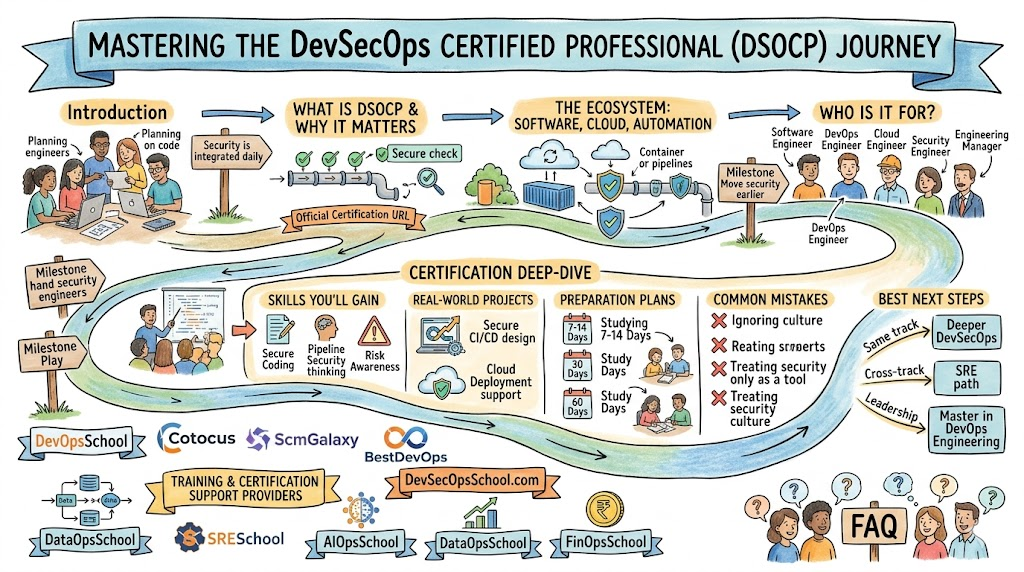
Introduction
Software teams today are expected to move fast, build safely, and release with confidence. That sounds simple, but in real work it is not easy. Most teams are already dealing with cloud platforms, CI/CD pipelines, infrastructure automation, containers, compliance pressure, and rising security risks. In this kind of environment, security cannot sit at the end of the delivery cycle. It has to become part of daily engineering work.
This is where DevSecOps becomes important. DevSecOps is not only a technical trend. It is a practical way of building software where security is included from the start. It becomes part of planning, coding, testing, deployment, infrastructure, monitoring, and team culture. Instead of waiting for late-stage reviews, teams build safer systems through regular engineering practices.
The DevSecOps Certified Professional, also called DSOCP, is designed for professionals who want to grow in this direction. It helps software engineers, DevOps professionals, cloud engineers, security professionals, platform teams, and technical managers understand how secure software delivery works in real-world environments.
This guide is written for working engineers and managers in India and across the global software industry. The goal is simple: help people clearly understand what DSOCP is, why it matters, who should take it, and how it can support long-term career growth.
What is DevSecOps Certified Professional (DSOCP)
DevSecOps Certified Professional is a professional certification focused on secure software delivery. It is designed for people who want to understand how development, operations, automation, and security should work together in a modern engineering setup.
In many organizations, DevOps improved delivery speed, automation, and collaboration. But speed alone is not enough. When security is weak, fast delivery can create faster risk. DSOCP helps solve that problem by giving professionals a structured path to learn how security should be built into software delivery pipelines, cloud systems, infrastructure automation, and release workflows.
The certification is useful because it brings together multiple ideas that are often learned separately. Engineers may know CI/CD. Security teams may know controls and policy. Cloud teams may know infrastructure. DSOCP helps connect these areas into one practical model.
Why It Matters in Today’s Software, Cloud, and Automation Ecosystem
The software ecosystem has changed in a major way. Applications are now released faster. Cloud environments scale quickly. Containers and Kubernetes are common. APIs connect everything. Infrastructure is managed through code. Teams are expected to deliver new features without slowing the business.
This speed creates opportunity, but it also creates risk.
A small mistake in a pipeline can expose secrets. A weak permission setup can create access issues. A vulnerable dependency can affect production systems. An insecure image can move through delivery pipelines before anyone notices. A poor approval flow can increase compliance risk.
That is why DevSecOps matters so much today. It helps teams move security earlier into the process. Instead of asking security teams to check everything at the end, DevSecOps encourages engineering teams to build secure habits directly into the workflow.
This matters for engineers because it changes how they build systems. It matters for managers because it changes how teams are organized, measured, and guided. It matters for organizations because secure delivery is now directly linked to customer trust, audit readiness, service quality, and business continuity.
In simple terms, DevSecOps matters because modern software delivery is too fast and too complex to leave security behind.
Why Certifications Are Important for Engineers and Managers
Many professionals learn by doing, and that is valuable. Real projects teach lessons that no classroom can fully replace. But project-based learning is often uneven. One engineer may know pipelines well but know little about secure coding. Another may know cloud infrastructure but not security automation. A manager may understand delivery pressure but not secure release practices.
A certification helps bring structure to learning.
For engineers, certifications help in several ways. They create a roadmap. They reduce confusion. They build confidence. They show employers and clients that the professional has invested in formal skill development. They also help when moving from one track to another, such as from DevOps into DevSecOps or from engineering into leadership.
For managers, certifications are useful because they create a common language. It becomes easier to plan team capability, define learning goals, and design internal career progression. A manager with some certification understanding is often better equipped to support the growth of engineers working in cloud, automation, reliability, and security-heavy environments.
Certifications also help professionals stay relevant. Technology changes quickly. Structured learning makes it easier to keep pace with new practices and expectations.
Why Choose DevOpsSchool?
DevOpsSchool is known for its focus on practical, role-oriented learning in DevOps and related domains. For professionals looking at DSOCP, one major advantage is that the provider does not treat DevSecOps as an isolated topic. It places DevSecOps inside a wider engineering ecosystem that includes DevOps, SRE, AIOps, DataOps, and FinOps.
That matters because most real careers do not stay inside one narrow box. A DevOps engineer may move into DevSecOps. A platform engineer may later work in SRE. A cloud engineer may grow into cost governance or reliability leadership. A provider with connected learning paths supports this kind of career development better.
Another strong reason to choose DevOpsSchool is the practical value of its certification direction. The DSOCP program is aimed at working professionals, not just students. That means the learning focus is closer to delivery pipelines, engineering workflows, cloud operations, and security integration that professionals actually deal with in projects.
For many learners, that balance between structured certification and real-world relevance is the biggest advantage.
Certification Deep-Dive: DevSecOps Certified Professional (DSOCP)
What is this certification?
DSOCP is a professional certification for people who want to understand secure delivery in a modern software environment. It focuses on the integration of security into development, testing, deployment, infrastructure, and operations.
It is not limited to one tool or one platform. Instead, it is based on the larger idea that software delivery must be secure across the full lifecycle.
Who should take this certification?
This certification is well suited for:
- Software Engineers
- DevOps Engineers
- Cloud Engineers
- Platform Engineers
- Security Engineers
- Release Engineers
- Build and Automation Engineers
- Technical Leads
- Engineering Managers
It is especially valuable for professionals who already work with CI/CD, cloud, deployment, infrastructure, automation, or application delivery and now want stronger security understanding.
Certification Overview Table
| Certification Name | Track | Level | Who it’s for | Prerequisites | Skills covered | Recommended order |
|---|---|---|---|---|---|---|
| DevSecOps Certified Professional (DSOCP) | DevSecOps | Professional | Software engineers, DevOps engineers, cloud engineers, security professionals, managers | Basic understanding of Linux, DevOps, CI/CD, cloud, and automation | Secure delivery, DevSecOps practices, CI/CD security thinking, risk awareness, secure engineering workflows | Core certification in DevSecOps path |
| DevOps Certified Professional (DCP) | DevOps | Professional | Engineers working in automation and software delivery | Basic scripting, Linux, Git, CI/CD knowledge | DevOps workflows, automation, delivery pipeline understanding | Before or alongside DSOCP |
| Master in DevOps Engineering (MDE) | DevOps / Leadership | Advanced | Professionals aiming for broader architecture and leadership growth | Prior DevOps exposure and delivery experience | Advanced DevOps, wider engineering depth, platform and transformation thinking | After DSOCP for broader growth |
DevSecOps Certified Professional (DSOCP)
What it is
DSOCP is a career-focused certification for professionals who want to make software delivery more secure, more mature, and more aligned with modern engineering expectations. It helps bring security into daily engineering work instead of leaving it as a late-stage activity.
Who should take it
This certification is ideal for professionals who want to strengthen secure software delivery capability. It is useful for engineers building pipelines, cloud systems, release workflows, or automation. It is also valuable for managers who want better visibility into how modern secure delivery should work.
Skills you’ll gain
- Understanding of DevSecOps fundamentals
- Security-first thinking in delivery pipelines
- Better awareness of risks in cloud and automation workflows
- Stronger understanding of secure CI/CD practices
- Improved collaboration mindset across development, operations, and security
- Awareness of governance and control in engineering systems
- Ability to think beyond tools and focus on process maturity
- Better understanding of secure delivery culture
Real-world projects you should be able to do after it
- Build a secure delivery approach for a small engineering team
- Review CI/CD workflows and identify risk areas
- Add security-focused checks into delivery processes
- Improve pipeline design with better control points
- Support secure cloud deployment practices
- Help teams shift security thinking earlier in the software lifecycle
- Contribute to a DevSecOps adoption roadmap
- Improve collaboration between delivery and security teams
Preparation plan
7–14 days
This preparation plan works best for experienced DevOps or cloud professionals. Focus on DevSecOps principles, secure CI/CD thinking, cloud risk basics, secure development flow, and practical use cases. Use this time for focused revision and concept strengthening.
30 days
This is the most balanced preparation option for working professionals. Spend the first week reviewing DevOps basics. Use the second week for security and risk fundamentals. Use the third week for DevSecOps workflows and delivery models. Use the final week for revision, notes, and practice.
60 days
This path is best for beginners, career switchers, or managers who want deeper clarity. Start with Linux, automation, Git, pipelines, cloud concepts, and delivery flow. Then move into security integration, DevSecOps thinking, and project-oriented scenarios. This slower plan helps build strong understanding.
Common mistakes
- Starting DevSecOps without understanding DevOps basics
- Treating security as only a tool problem
- Focusing only on certification and ignoring project use
- Skipping cloud and container foundations
- Thinking DevSecOps belongs only to security teams
- Ignoring team collaboration and culture
- Learning theory without mapping it to delivery workflows
Best next certification after this
The best next step depends on your goal.
- If you want deeper security specialization, stay in the DevSecOps path.
- If you want stronger reliability and production discipline, move into SRE-focused learning.
- If you want wider architecture and leadership growth, move toward Master in DevOps Engineering.
Choose Your Path
DevOps
Choose this path if your main focus is automation, release speed, CI/CD maturity, and delivery efficiency. DSOCP becomes more powerful here because it adds security depth to existing DevOps capability.
DevSecOps
Choose this path if you want secure software delivery to become your core specialization. DSOCP is one of the best central certifications for this journey because it builds the practical base needed for deeper DevSecOps growth.
SRE
Choose this path if you care most about reliability, resilience, monitoring, incident response, and production excellence. DevSecOps knowledge strengthens SRE work because secure systems are often easier to operate safely and consistently.
AIOps/MLOps
Choose this path if you want to work at the intersection of intelligent systems and IT operations. Before moving into advanced automation and predictive operations, secure engineering discipline from DSOCP creates a stronger base.
DataOps
Choose this path if your work involves data pipelines, analytics systems, governance, and quality controls. Data systems also need secure workflows, controlled automation, and access discipline, so DSOCP adds real value here.
FinOps
Choose this path if your focus is cloud governance, cost awareness, optimization, and accountability. Secure delivery and cost-aware delivery often depend on the same disciplined engineering culture, so DSOCP supports this path too.
Role → Recommended Certifications
| Role | Recommended certifications |
|---|---|
| DevOps Engineer | DCP → DSOCP → MDE |
| SRE | DCP or DSOCP → SRE path → MDE |
| Platform Engineer | DCP → DSOCP → MDE |
| Cloud Engineer | DCP → DSOCP → MDE |
| Security Engineer | DSOCP → deeper DevSecOps specialization |
| Data Engineer | DCP or DSOCP → DataOps path |
| FinOps Practitioner | DevOps basics → DSOCP → FinOps path |
| Engineering Manager | DSOCP → MDE → broader leadership path |
Next Certifications to Take
Same track
Stay in the DevSecOps direction if your goal is deeper security specialization. This is a good choice for professionals who want to work more closely with secure architecture, secure delivery governance, and platform-level security thinking.
Cross-track
Move into the SRE path if you want to combine security with reliability, production operations, resilience, and service quality. This is a strong option for engineers who want wider operational depth.
Leadership
Move into Master in DevOps Engineering if your goal is broader system thinking, platform maturity, team guidance, and engineering leadership. This path works well for professionals growing into senior technical or managerial roles.
Training and Certification Support Providers
DevOpsSchool
DevOpsSchool is the official provider linked to the DSOCP certification page. It is a strong option for professionals who want a structured, role-based, and practical learning path in DevSecOps, DevOps, and related engineering domains. Its wider certification ecosystem also helps learners continue their career journey after one certification.
Cotocus
Cotocus is known for training and consulting support across engineering and technology domains. It can be useful for learners and teams looking for applied learning, structured support, and practical skill-building connected to real project environments.
ScmGalaxy
ScmGalaxy has long been associated with technical training, workshops, and certification-oriented learning. It is useful for professionals who want hands-on exposure and broader understanding in DevOps and software delivery-related areas.
BestDevOps
BestDevOps is another recognized name in the learning and certification support space. It is useful for professionals seeking practical training, technical guidance, and career-focused support in modern engineering workflows.
devsecopsschool.com
DevSecOpsSchool is a domain-specific learning platform for secure software delivery. It is helpful for professionals who want more focused growth in DevSecOps practices, secure engineering culture, CI/CD security thinking, and specialization after or alongside DSOCP.
SRESchool
SRESchool is a specialized learning platform focused on Site Reliability Engineering skills. It is useful for professionals who want to build knowledge in reliability, monitoring, incident response, automation, SLIs, SLOs, and production operations. For learners coming from a DevSecOps background, SRESchool can be a strong next step because it helps connect secure delivery with stable and dependable production systems.
AIOpsSchool
AIOpsSchool is designed for professionals who want to understand how artificial intelligence and machine learning can improve IT operations. It supports learners who are interested in intelligent monitoring, event correlation, anomaly detection, predictive operations, and automated incident handling. For engineers who already know DevOps or DevSecOps, this platform can help expand into modern AI-driven operations.
DataOpsSchool
DataOpsSchool is aimed at learners who want to improve data pipeline delivery, governance, quality, and collaboration across data teams. It is helpful for data engineers, analytics teams, and platform professionals who want to bring automation, security, and reliability into data workflows. For someone pursuing DSOCP, DataOpsSchool can add value when working in data-heavy cloud environments where secure and controlled delivery matters.
FinOpsSchool
FinOpsSchool focuses on cloud financial operations and helps professionals understand cost optimization, cloud usage visibility, budgeting, governance, and cost accountability. It is especially useful for cloud engineers, platform teams, and managers who want to connect technical decisions with financial impact. For learners with DevSecOps knowledge, FinOpsSchool adds a strong business perspective to engineering and operations work.
FAQs
1. Is DSOCP hard to complete?
It depends on your background. For professionals who already know DevOps basics, it is manageable. For beginners, it may feel challenging at first, but a structured study plan helps a lot.
2. How much time should I spend preparing?
Most working professionals can prepare in 2 to 8 weeks depending on their existing knowledge and available study time.
3. Do I need DevOps experience before starting?
Basic DevOps knowledge is strongly helpful. It is easier to understand DevSecOps when you already know pipelines, automation, and software delivery flow.
4. Is DSOCP only for security engineers?
No. It is highly useful for software engineers, DevOps engineers, cloud engineers, platform engineers, and managers too.
5. Can managers benefit from this certification?
Yes. Managers can use it to better understand secure delivery models, team capability, and engineering risk management.
6. Does this certification help in interviews?
Yes. It gives you a structured way to speak about secure delivery, CI/CD risk, cloud security thinking, and DevSecOps practices.
7. What is the value of DSOCP for working professionals?
It helps professionals move beyond basic delivery automation and build stronger credibility in secure software delivery.
8. Is DSOCP useful globally?
Yes. The skills behind DevSecOps are relevant across industries and countries because modern software delivery challenges are similar everywhere.
9. What can I do after completing DSOCP?
You can move deeper into DevSecOps, shift into SRE, or expand toward architecture and leadership through advanced DevOps learning.
10. Is DSOCP practical or theory-heavy?
It is most useful when treated as a practical certification. The real value comes from applying the concepts in delivery workflows and real engineering situations.
11. What roles benefit most from DSOCP?
DevOps Engineer, DevSecOps Engineer, Cloud Engineer, Platform Engineer, Security Engineer, and Engineering Manager roles benefit strongly.
12. Is DSOCP worth it if I already know DevOps?
Yes. In fact, people with DevOps knowledge often gain the most value because they can better understand where security fits into what they already do.
FAQs on DevSecOps Certified Professional (DSOCP)
1. What does DSOCP stand for?
DSOCP stands for DevSecOps Certified Professional.
2. Who provides the DSOCP certification?
The certification is provided through DevOpsSchool.
3. Why should a software engineer consider DSOCP?
Because secure delivery is now a major part of software engineering, not a separate function.
4. Is DSOCP suitable for cloud engineers?
Yes. Cloud engineers benefit because modern cloud delivery requires secure automation and stronger controls.
5. Is it useful for technical managers?
Yes. It helps managers understand team maturity, secure workflows, and delivery risk.
6. Should I take DSOCP before advanced leadership certifications?
Yes, if your role still depends on hands-on engineering understanding. It creates a stronger technical base first.
7. Can DSOCP support career growth?
Yes. It can improve role readiness, credibility, and direction for professionals aiming at secure software delivery roles.
8. What is the strongest reason to take DSOCP?
The strongest reason is that it helps professionals understand how to build software delivery systems that are fast, practical, and secure at the same time.
Conclusion
DevSecOps is no longer optional for modern engineering teams. The software world has become too fast, too automated, and too cloud-driven for security to remain outside the delivery process. That is why DSOCP is such a valuable certification. It helps professionals understand how secure software delivery should work in real environments. It gives engineers a more complete skill set and gives managers a stronger view of team maturity and engineering risk. For professionals who want to stay relevant, grow with confidence, and build secure delivery capability that matches today’s software ecosystem, DSOCP is a smart and practical step forward.