Tag: #DevOpsCareer

  • Site Reliability Engineering Certified Professional (SRECP): A Practical Career Guide for Modern Reliability EngineersIntroduction

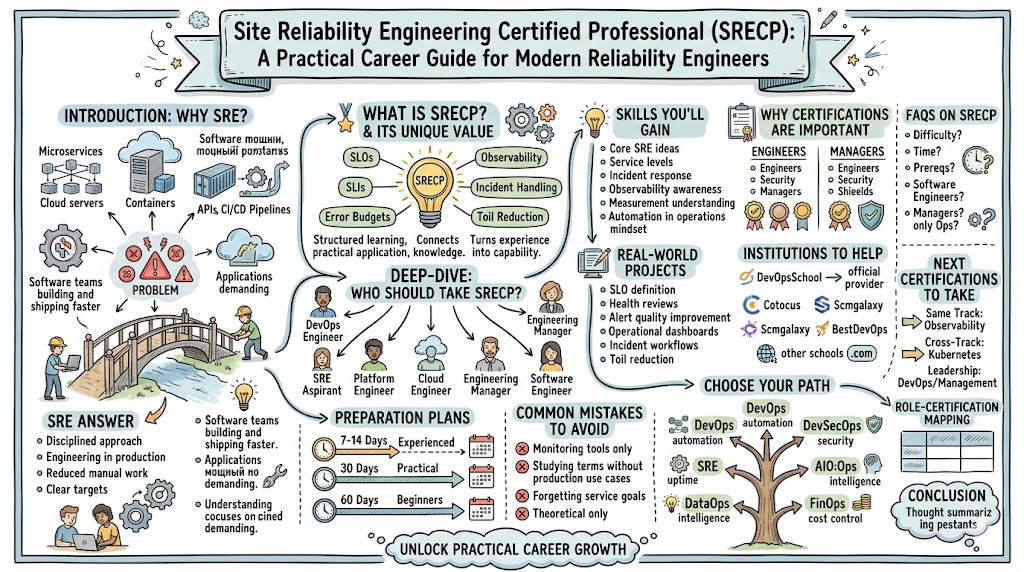
    Software teams are building and shipping faster than ever. Applications are now spread across cloud platforms, containers, APIs, automation pipelines, and distributed services. This has made software more powerful, but it has also made operations more demanding. A small issue in one place can quickly affect performance, uptime, user experience, and business trust.

    That is why Site Reliability Engineering has become so important.

    Site Reliability Engineering is not just a new name for operations. It is a disciplined way of making systems dependable, scalable, observable, and easier to manage. It brings engineering practices into production operations so teams can reduce manual work, define clear service targets, respond better to incidents, and improve system behavior over time.

    For working engineers and managers, this is now a very relevant skill area. Companies do not only want people who can deploy systems. They want professionals who can keep systems healthy, measurable, resilient, and efficient in real-world conditions. Reliability is no longer only a backend concern. It is directly connected to customer satisfaction, product quality, team productivity, and business continuity.

    This is where the Site Reliability Engineering Certified Professional, or SRECP, becomes valuable.

    SRECP is designed for professionals who want structured learning in reliability engineering. It helps learners understand how modern teams think about service reliability, incident handling, observability, automation, and operational maturity. More importantly, it gives them a practical way to connect these ideas to real engineering work.

    This guide explains what SRECP is, why it matters, who should take it, how it supports career growth, what you can learn from it, how to prepare for it, and what next steps make sense after completing it.

    What is Site Reliability Engineering Certified Professional (SRECP)?

    Site Reliability Engineering Certified Professional is a professional certification focused on helping engineers and managers understand the real practice of reliability engineering. It is built for people who want to improve how software systems behave in production and how teams manage service quality at scale.

    In simple terms, SRECP teaches you how to think about reliability in a structured and measurable way.

    Many professionals work with parts of reliability every day. They may monitor systems, handle incidents, create dashboards, support deployments, or manage infrastructure. But many times, that knowledge stays fragmented. One person understands alerts. Another understands automation. Another handles outages. Another works on infrastructure. SRECP helps connect all those parts into one complete model.

    That is what makes it useful.

    Instead of looking at uptime as a random outcome, SRE teaches professionals to define service goals, measure user-facing behavior, reduce unnecessary toil, and improve recovery and prevention practices. It helps teams move from reactive support to intentional engineering.

    The certification is especially relevant for professionals who want a more mature understanding of how modern systems should be operated. It brings together areas such as service reliability, monitoring, incident response, observability, automation, performance thinking, and cloud-native operational practices.

    Why It Matters in Today’s Software, Cloud, and Automation Ecosystem

    The modern software world is complex.

    Teams are working with microservices, Kubernetes, CI/CD pipelines, infrastructure as code, observability platforms, cloud services, APIs, and multi-layer application stacks. Releases happen frequently. Production environments change constantly. Dependencies grow larger. Failure patterns become harder to track.

    In older environments, operations often meant responding to issues after they appeared. That model is not enough anymore. Fast-moving systems need a more intelligent and engineering-driven way of handling reliability.

    SRE provides that.

    It helps organizations answer practical questions such as:

    What level of reliability should a service provide?

    How do we measure whether users are getting a good experience?

    How much risk can we accept in order to ship faster?

    Which alerts matter and which ones only create noise?

    How do we reduce repetitive operational work?

    How do we recover from incidents quickly and learn from them properly?

    These are not small questions. They directly affect product trust, engineering efficiency, customer retention, and business stability.

    For engineers, SRE matters because it improves the way systems are designed, measured, supported, and automated. It makes production work more thoughtful and less reactive.

    For managers, SRE matters because it creates a language for discussing service health, risk, engineering trade-offs, and operational maturity. It helps teams stop treating reliability as vague and start treating it as something measurable and manageable.

    That is why SRE has become one of the most practical and respected domains in modern engineering.

    Why Certifications Are Important for Engineers and Managers

    Real experience is always important. There is no replacement for learning from actual systems, real incidents, and production challenges. But experience alone is not always enough to create a complete understanding.

    Many professionals learn only the part of the system they touch every day. They may become strong in one tool or one area but never build a full reliability mindset. Certifications can help fix that problem.

    A strong certification brings order to learning.

    It shows professionals what to study, what matters most, how different concepts connect, and where their knowledge gaps may be. It creates a roadmap instead of leaving learning scattered across random topics.

    For engineers, certification can help in a few important ways.

    It builds confidence. Many engineers already do reliability-related work, but they may not have formal clarity around SLOs, SLIs, error budgets, observability, or incident strategy. Certification helps organize that knowledge.

    It improves focus. Instead of studying only tools, engineers can study principles and then understand how tools support those principles.

    It strengthens career visibility. A recognized certification can help communicate seriousness, discipline, and career direction to employers and hiring managers.

    For managers, certification has another kind of value.

    Managers need frameworks. They need shared language across teams. They need a better way to discuss uptime, service quality, operational readiness, engineering risk, and platform maturity. A certification helps managers understand how reliability work should be planned, evaluated, and supported.

    So the value of certification is not only the certificate itself. The real value is that it turns unstructured experience into clearer capability.

    Why Choose DevOpsSchool?

    A certification is only as useful as the quality of its learning approach. That is why the training provider matters.

    DevOpsSchool is often chosen by professionals who want learning that feels practical and job-oriented. For a topic like Site Reliability Engineering, this is especially important. Reliability cannot be learned properly through definitions alone. It needs context, examples, hands-on thinking, and a clear connection to live environments.

    One reason many learners prefer DevOpsSchool is that its programs are designed around real engineering roles. This makes the content more relevant for people already working in DevOps, cloud, infrastructure, operations, platform engineering, or software delivery.

    Another reason is that learners often want training that balances theory and practical understanding. In reliability engineering, both matter. You need concepts such as service objectives and error budgets, but you also need to understand how these ideas influence deployment safety, observability, alerting, incident handling, and system behavior.

    DevOpsSchool is also a suitable option for both engineers and managers. Some programs are too technical for leadership roles, while others stay too high-level to help engineers. SRECP sits in a useful middle ground. It supports technical depth while still being understandable and relevant for decision-makers.

    For professionals looking to move into reliability-focused careers, or for managers trying to build stronger reliability practices inside teams, that balance is very useful.

    Certification Deep-Dive: Site Reliability Engineering Certified Professional (SRECP)
    What is this certification?

    SRECP is a professional certification designed to help learners understand the principles and practices of Site Reliability Engineering in a practical and career-relevant way.

    It is not only about keeping systems running. It is about learning how to make systems reliable by design, measurable in operation, and sustainable over time.

    This certification introduces a structured way to think about production systems, service quality, operational workload, automation, incident response, and engineering responsibility in modern environments.

    Who should take this certification?

    This certification is a good fit for a wide range of professionals.

    It is useful for DevOps engineers who want to shift into more reliability-focused work.

    It is valuable for SRE aspirants who want structured and guided learning.

    It suits platform engineers who manage shared services and production stability.

    It is relevant for cloud engineers who own uptime, performance, and support readiness.

    It can also help operations professionals who want to move from manual support to engineering-led operations.

    Engineering managers can benefit as well, especially if they are responsible for service quality, platform reliability, incident readiness, or operational maturity across teams.

    Even software engineers can find it valuable if they work closely with backend services, cloud platforms, production systems, or release pipelines.

    Certification Overview Table
    Certification Name Track Level Who it’s for Prerequisites Skills Covered Recommended Order Link
    Site Reliability Engineering Certified Professional (SRECP) SRE Professional DevOps engineers, SRE aspirants, platform engineers, cloud engineers, operations professionals, engineering managers Basic understanding of Linux, cloud, CI/CD, monitoring, and system operations is helpful Reliability engineering, observability, incident response, service objectives, automation, operational maturity, production support thinking Strong starting point for the SRE track https://www.devopsschool.com/certification/sre-certified-professional-srecp.html
    Site Reliability Engineering Certified Professional (SRECP)
    What it is

    SRECP is a structured certification path for professionals who want to understand how reliable systems are built, operated, measured, and improved in modern environments.

    It helps learners move from task-based operations work to principle-driven reliability engineering.

    Who should take it

    DevOps engineers can take it to strengthen production depth.

    SRE aspirants can take it to enter the reliability domain with a proper foundation.

    Platform engineers can use it to improve the stability and support quality of internal systems.

    Cloud engineers can use it to think more clearly about uptime, resilience, and observability.

    Managers can use it to understand how reliability should be managed at a team and service level.

    Skills you’ll gain
    Understanding of core Site Reliability Engineering ideas
    Clarity around service-level thinking
    Better incident response mindset
    Stronger observability awareness
    Improved understanding of reliability measurement
    Ability to think about automation in operations
    Better alignment between engineering work and service health
    Stronger production support and operational decision-making
    Awareness of how stability and release speed should be balanced
    Better understanding of how to reduce manual operational effort
    Real-world projects you should be able to do after it
    Define reliability goals for an internal or customer-facing service
    Build a simple service health review process
    Improve alert quality to reduce unnecessary noise
    Design dashboards that support operational decision-making
    Create basic incident handling workflows
    Review recurring failures and identify preventable toil
    Improve operational readiness for releases
    Support reliability practices in cloud-native or container-based systems
    Align engineering changes with measurable service expectations
    Build a stronger reliability culture inside a delivery team
    Preparation plan
    7–14 days

    This study plan is best for professionals who already work in DevOps, cloud, or platform roles. In this shorter window, focus on concept revision, role-based understanding, and topic mapping. Spend time on reliability fundamentals, service-level thinking, incident handling, automation goals, and observability basics. This period works best if you already have hands-on industry exposure and only need focused preparation.

    30 days

    This is the most practical plan for working professionals. Use the first part to build concept clarity around SRE principles. Use the middle phase for practical understanding of monitoring, alerting, incidents, dashboards, operational workflow improvement, and service reliability. Keep the last phase for revision and scenario-based preparation. This path gives enough time to connect ideas rather than simply memorizing them.

    60 days

    This plan is ideal for beginners or professionals moving from a general IT role into modern reliability engineering. Start with Linux basics, cloud concepts, system operations, CI/CD, containers, and monitoring. Then move into core SRE ideas, observability, incident response, service objectives, and automation. Use the final stage for mini-projects, revision, and deeper understanding of how SRE fits into real engineering work.

    Common mistakes
    Thinking SRE is only about monitoring tools
    Studying terms without understanding production use cases
    Ignoring the value of service goals and operational discipline
    Learning tools without connecting them to reliability outcomes
    Focusing only on outages and not on prevention
    Treating automation as a side topic instead of a core habit
    Forgetting the business side of uptime and service trust
    Preparing only theoretically without practical thinking
    Best next certification after this

    The best next step depends on your direction.

    If you want to grow deeper in reliability and service visibility, an observability-focused certification is a natural move.

    If you want stronger cloud-native production depth, a Kubernetes-related certification makes sense.

    If your goal is broader engineering leadership, DevOps or management-oriented certifications can help you expand beyond service reliability into cross-team delivery and operational strategy.

    Choose Your Path
    DevOps Path

    This path is for professionals focused on automation, releases, CI/CD, infrastructure, and platform delivery. SRECP adds the reliability layer that many DevOps professionals eventually need. It helps them move from building delivery systems to improving the long-term health and trustworthiness of the services those systems support.

    DevSecOps Path

    This path is suitable for professionals who care about security in the software lifecycle. SRECP strengthens this path by improving operational resilience, incident response maturity, and stability thinking. Secure systems still need to be reliable, measurable, and recoverable.

    SRE Path

    This is the most direct path for those who want to specialize in service reliability, uptime, observability, incident response, and operational improvement. SRECP is an excellent anchor point for this direction and can help build the right mindset for long-term growth in the SRE field.

    AIOps/MLOps Path

    This path is ideal for people working with intelligent automation, machine learning systems, or AI-supported operations. SRECP brings valuable discipline here because automated systems still need reliable infrastructure, measurable service behavior, and strong production oversight.

    DataOps Path

    Data platforms also need reliability. Pipeline failures, unstable workloads, broken dependencies, and poor operational visibility can harm business outcomes quickly. SRECP supports DataOps professionals by helping them think about reliability in the same structured way as service teams.

    FinOps Path

    FinOps is about cost awareness, resource efficiency, and cloud value management. SRECP complements this path because unreliable systems often create waste, emergency effort, poor resource usage, and repeated recovery costs. Better reliability often supports better efficiency.

    Role → Recommended Certifications Mapping
    Role Recommended Certifications
    DevOps Engineer SRECP, DevOps-focused certifications, Kubernetes-related certifications
    SRE SRECP first, then observability and advanced reliability learning
    Platform Engineer SRECP plus Kubernetes, Terraform, and platform engineering certifications
    Cloud Engineer SRECP plus cloud operations or cloud architecture certifications
    Security Engineer DevSecOps-focused certifications first, then SRECP for resilience depth
    Data Engineer DataOps-oriented learning plus SRECP for operational reliability
    FinOps Practitioner FinOps learning plus SRECP for efficiency and stability alignment
    Engineering Manager SRECP plus leadership-oriented DevOps, SRE, or platform strategy certifications
    Next Certifications to Take
    Same track

    An observability-focused certification is a smart next move after SRECP. Once you understand reliability thinking, the next layer is stronger visibility into metrics, logs, traces, dashboards, and service behavior. This helps deepen operational judgment and supports more mature reliability practice.

    Cross-track

    A Kubernetes-related certification is a strong cross-track option. Many modern services run in container-based or orchestrated environments. Stronger Kubernetes knowledge helps professionals support real production systems more confidently and connect reliability ideas to modern infrastructure patterns.

    Leadership

    A DevOps or engineering-management-oriented certification is a useful leadership step. This path is well suited to professionals who want to move from hands-on reliability work into platform leadership, delivery strategy, operational governance, or cross-team engineering management.

    Institutions That Help in Training cum Certifications for Site Reliability Engineering Certified Professional (SRECP)
    DevOpsSchool

    DevOpsSchool is the direct provider of the SRECP program and is the most closely aligned option for learners who want focused training around this certification. It is a suitable choice for working engineers, managers, and teams that want structured guidance in Site Reliability Engineering. It is especially useful for learners who want practical and career-oriented understanding instead of only theoretical content.

    Cotocus

    Cotocus is often seen by learners who want support around technical training and implementation-oriented learning. It can be useful for professionals looking to strengthen their cloud, automation, and engineering exposure while building a stronger practical foundation for modern IT roles.

    Scmgalaxy

    Scmgalaxy is widely associated with technology learning in areas such as automation, DevOps, and tooling. It can be a helpful option for learners who want to improve engineering basics before moving deeper into specialized reliability work. Its value is often stronger for professionals building broad technical foundations.

    BestDevOps

    BestDevOps is commonly recognized in the wider training ecosystem for DevOps and cloud learning. It can be relevant for professionals exploring training and certification support across operations, automation, infrastructure, and reliability-adjacent areas. It is especially useful for learners who want exposure to broader engineering topics along with role-specific growth.

    devsecopsschool.com

    This platform is more useful for professionals who want to combine reliability learning with strong security awareness. It can support engineers and managers who are working in secure delivery environments and want to understand how production resilience and security discipline fit together in modern systems.

    sreschool.com

    SRESchool is naturally relevant for learners who want a more focused path in reliability engineering. It is useful for professionals who are serious about service health, observability, operational readiness, alert quality, and engineering-led production support. For someone planning a long-term SRE career, it can be a meaningful support option.

    aiopsschool.com

    AIOpsSchool can be a good option for professionals interested in the future of operations, especially where automation, analytics, and AI-supported decision-making are involved. It is suitable for learners who want to combine reliability fundamentals with more advanced operational intelligence.

    dataopsschool.com

    DataOpsSchool is useful for those working in data engineering and data platform operations. It can support professionals who want to improve the reliability, quality, and repeatability of data workflows. For learners operating in data-heavy environments, it complements reliability thinking well.

    finopsschool.com

    FinOpsSchool is relevant for professionals focused on cloud cost governance, financial visibility, and platform efficiency. It is especially valuable for learners who want to understand the connection between service stability, operational waste, and cloud optimization. For professionals balancing cost and reliability, it can be a strong complementary learning area.

    Frequently Asked Questions

    1. Is SRECP a hard certification?

    It is best described as a professional-level certification, so it is not very basic. For people already working in DevOps, platform engineering, cloud support, or operations, it becomes much easier because many ideas will already feel familiar.

    1. How much time does preparation usually take?

    For most working professionals, a 30-day plan is a practical target. If you already have hands-on experience, you may need less time. If you are new to cloud, monitoring, or operations, a 60-day path is usually safer.

    1. Are there any prerequisites for SRECP?

    Formal prerequisites may not always be strict, but basic knowledge of Linux, cloud platforms, monitoring, CI/CD, and system operations will help a lot. Without these basics, the concepts may still be understandable, but progress will feel slower.

    1. Is SRECP useful for software engineers?

    Yes. Software engineers who work on backend systems, APIs, cloud applications, release processes, or production support can gain a lot from learning how reliability is defined and improved in real systems.

    1. Is this certification only for operations teams?

    No. That is one of the biggest misunderstandings about SRE. It is relevant not only for operations people, but also for DevOps engineers, platform engineers, cloud engineers, and even software developers who work near production systems.

    1. Will SRECP help in career growth?

    Yes. It can strengthen your profile for SRE, DevOps, platform, cloud operations, and reliability-focused engineering roles. It is especially useful when combined with real project work and practical understanding.

    1. Can managers benefit from SRECP too?

    Yes. Managers benefit because SRE teaches a better way to talk about service health, uptime expectations, incident readiness, and operational maturity. It helps leadership decisions become more concrete and measurable.

    1. Is SRECP only about monitoring and alerts?

    No. Monitoring is only one part of the picture. SRE also includes service-level thinking, observability, incident management, automation, reliability improvement, and reduction of manual operational work.

    1. What should I study before starting SRECP?

    It is a good idea to review Linux basics, cloud concepts, containers, CI/CD, monitoring, and production support practices. These topics help create a strong base for understanding reliability engineering properly.

    1. Should I take Kubernetes certification before or after SRECP?

    That depends on your current job. If your role is already focused on service reliability and operational ownership, SRECP can come first. If your daily work is deeply Kubernetes-centered, both paths can support each other well.

    1. What kind of jobs align well with this certification?

    Roles such as Site Reliability Engineer, DevOps Engineer, Platform Engineer, Cloud Operations Engineer, Production Engineer, and reliability-focused engineering manager align well with SRECP.

    1. Is SRECP worth it for someone already working in DevOps?

    Yes. Many DevOps professionals eventually reach a point where they need more depth in production reliability, service quality, and operational discipline. SRECP helps provide that next level of clarity.

    FAQs on Site Reliability Engineering Certified Professional (SRECP)

    1. What does SRECP stand for?

    SRECP stands for Site Reliability Engineering Certified Professional.

    1. What is the main goal of this certification?

    Its main goal is to help professionals understand and apply Site Reliability Engineering practices in real production environments.

    1. Is SRECP suitable for beginners?

    Yes, but beginners should usually follow a longer preparation plan so they can build the right foundations before moving into deeper reliability concepts.

    1. Is it good for DevOps engineers?

    Yes. It is one of the best growth options for DevOps professionals who want to become stronger in service reliability, observability, and operational maturity.

    1. Does it help managers too?

    Yes. It helps managers understand reliability in a more structured way and supports better decision-making around operational health and service goals.

    1. Is SRECP relevant in cloud-native systems?

    Very much. Modern cloud-native environments are exactly the kind of systems where strong reliability thinking becomes essential.

    1. What makes this certification different from general operations learning?

    It focuses on engineering-led reliability rather than only support activity. It helps learners think in terms of measurable service quality and long-term system behavior.

    1. What is the biggest career value of SRECP?

    It helps professionals move from general production support or DevOps work into more mature, reliability-centered engineering roles with clearer business relevance.

    Conclusion

    Site Reliability Engineering Certified Professional is a strong certification choice for people who want to build serious capability in modern reliability engineering. It is valuable because it does not stay limited to one tool, one platform, or one narrow operations task. Instead, it helps professionals understand how service quality, observability, incident handling, automation, and system stability come together in real engineering environments. That makes it highly relevant for DevOps engineers, SRE aspirants, platform teams, cloud professionals, and engineering managers. In a world where software is expected to be fast, stable, and always available, reliability is no longer optional. SRECP helps professionals build the mindset and structure needed to contribute meaningfully in that world and grow into stronger, more trusted technical roles.
  • Certified DevOps Architect: The Next Big Step for Delivery-Focused Professionals

    Software teams are under more pressure than before. Businesses want faster releases, fewer failures, stronger security, better cloud usage, smoother automation, and stable systems that can support growth. In this environment, companies do not only need engineers who know tools. They need professionals who can design the bigger delivery system that keeps everything connected and working well.

    That is where the Certified DevOps Architect certification becomes valuable.

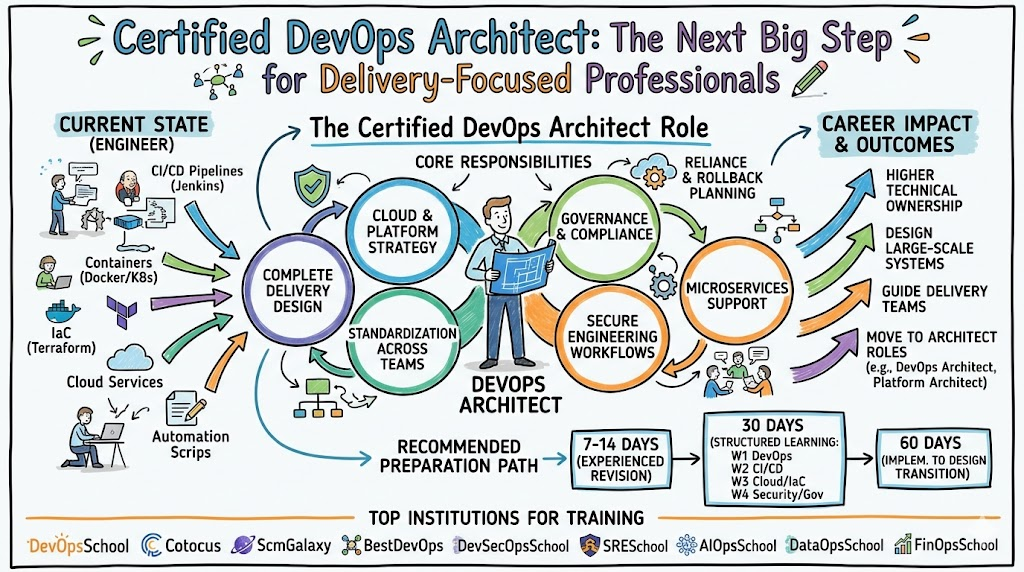
    This certification is built for professionals who want to move from doing DevOps work to designing DevOps environments. It is not limited to writing pipelines, managing containers, or automating infrastructure. It is about understanding how cloud platforms, delivery processes, security controls, release standards, monitoring practices, and engineering workflows should be planned as one complete model.

    For engineers, this certification can support the move toward higher technical ownership. For managers, it can improve understanding of how modern delivery platforms should be designed. For cloud and platform professionals, it creates a solid bridge into architecture-driven roles.

    This guide explains the certification in a fresh and practical way. It covers the certification overview, who it is meant for, the skills it can build, project outcomes, preparation strategies, mistakes to avoid, future certification options, role-based paths, learning directions, institution support, and important FAQs.

    The provider is DevOpsSchool, and the official certification page is the reference point for the program details.


    Certification Overview

    CertificationProviderLevelBest For
    Certified DevOps ArchitectDevOpsSchoolAdvanced / ArchitectSenior DevOps engineers, platform engineers, cloud engineers, technical leads, infrastructure professionals, engineering managers

    Certification Table

    TrackLevelWho it’s forPrerequisitesSkills coveredRecommended order
    DevOpsArchitectSenior DevOps Engineers, Platform Engineers, Cloud Engineers, Infrastructure Engineers, Technical Leads, Engineering ManagersGood understanding of DevOps, CI/CD, automation, cloud, containers, and infrastructure workflowsDevOps architecture, release design, infrastructure as code, cloud planning, microservices support, governance, reliability, security-aware delivery, platform consistencyAfter DevOps fundamentals and professional-level experience

    What Is Certified DevOps Architect?

    Certified DevOps Architect is an advanced certification for professionals who want to design complete DevOps systems for modern software teams. It is intended for people who already understand delivery pipelines, cloud basics, infrastructure, and automation, and now want to step into broader technical planning.

    This certification is important because architecture-level DevOps is much more than using tools. It is about building a full delivery model where engineering workflows, automation, cloud infrastructure, release controls, security practices, and operational stability work together in a consistent way.

    A DevOps Architect is not only responsible for making deployments happen. A DevOps Architect is responsible for making delivery repeatable, scalable, safe, and easier to manage across teams.


    Why This Certification Is Important

    Many professionals already have experience with Jenkins, Docker, Kubernetes, Terraform, Git, cloud services, and automation tools. That is useful, but businesses usually need more than separate technical skills. They need someone who can combine these elements into one practical operating model.

    That is the main value of this certification.

    It helps professionals think about:

    • complete delivery design
    • scalable CI/CD systems
    • release governance and control
    • cloud and infrastructure planning
    • resilience and rollback readiness
    • standardization across teams
    • secure engineering workflows
    • architecture decisions tied to business needs

    For senior engineers and managers, this certification also helps create a wider view of how software delivery should support speed, quality, cost control, and long-term stability.


    Certified DevOps Architect

    What it is

    Certified DevOps Architect is a senior-level certification for experienced technical professionals who want to design large-scale DevOps systems and guide software delivery from an architecture perspective.

    It focuses on delivery design, automation planning, cloud strategy, infrastructure structure, governance, and reliable operational thinking. That makes it a strong fit for professionals moving into high-responsibility technical roles.

    Who should take it

    • Senior DevOps Engineers
    • Platform Engineers
    • Cloud Engineers
    • Infrastructure Engineers
    • Technical Leads
    • Release and Automation Leaders
    • DevOps Consultants
    • Solution Architects with delivery experience
    • Engineering Managers with technical ownership
    • Professionals aiming to become DevOps Architects

    Skills you’ll gain

    • DevOps architecture planning
    • CI/CD structure for larger teams
    • infrastructure as code strategy
    • cloud platform design awareness
    • automation planning across environments
    • secure delivery workflow design
    • governance and compliance thinking
    • resilience and recovery planning
    • microservices support in delivery design
    • engineering standardization across teams

    Real-world projects you should be able to do after it

    • design a shared CI/CD architecture for multiple teams
    • define delivery standards for dev, test, stage, and production
    • create reusable infrastructure patterns using IaC tools
    • support cloud-native release models
    • plan rollback and recovery workflows for critical applications
    • improve consistency across multiple products or projects
    • build secure delivery processes with approval and control stages
    • support enterprise DevOps transformation efforts
    • document platform and release architecture clearly
    • improve reliability in software delivery environments

    Preparation plan

    7–14 days

    This plan works best for professionals who already have strong experience.

    • revise DevOps lifecycle and architecture basics
    • review CI/CD, cloud, infrastructure, and container concepts
    • revisit security, resilience, and governance ideas
    • connect your revision with real project work
    • prepare short notes for daily revision

    30 days

    This is the most practical plan for most working professionals.

    • Week 1: DevOps principles, collaboration, lifecycle, architecture basics
    • Week 2: CI/CD planning, automation design, release models, rollback thinking
    • Week 3: cloud design, infrastructure as code, containers, microservices
    • Week 4: security, governance, reliability, revision, architecture scenarios

    60 days

    This plan is useful for professionals moving from implementation into design-level roles.

    • First 2 weeks: DevOps basics and full delivery lifecycle
    • Next 2 weeks: pipelines, automation, release strategy, rollback design
    • Next 2 weeks: cloud platforms, IaC, containers, platform planning
    • Next 2 weeks: resilience, governance, security, revision, project-based thinking

    Common mistakes

    • studying tools without understanding architecture
    • assuming DevOps only means CI/CD
    • ignoring governance and compliance requirements
    • skipping rollback and disaster recovery planning
    • forgetting security during architecture decisions
    • focusing on cloud services without delivery context
    • not thinking about standardization across teams
    • revising concepts without relating them to real systems

    Best next certification after this

    Your next step depends on your career direction:

    • Same track: Certified DevOps Manager
    • Cross-track: DevSecOps Certified Professional or SRE Certification
    • Leadership: A manager-level certification in DevOps, SRE, FinOps, or transformation-focused areas

    Choose Your Path

    1. DevOps Path

    This path is best for professionals who want deeper ownership of delivery workflows, release automation, platform engineering, and cloud-based software delivery. Start with DevOps foundations, gain real project experience, strengthen your professional-level skills, and then move into architect-level responsibility.

    2. DevSecOps Path

    This path is useful for professionals who want software delivery and security to work together from the start. After building a strong DevOps base, the next step can include secure pipelines, secrets handling, policy controls, compliance support, and security-aware delivery design.

    3. SRE Path

    This route fits professionals who care about reliability, uptime, observability, operational maturity, and incident handling. DevOps architecture gives the delivery foundation, while SRE builds a stronger focus on service quality and production excellence.

    4. AIOps/MLOps Path

    This path works well for professionals interested in intelligent automation, model delivery, AI-assisted operations, and data-driven operational workflows. DevOps architecture provides the delivery and automation base needed before moving into these advanced areas.

    5. DataOps Path

    Data teams also need repeatable workflows, testing discipline, deployment structure, monitoring, and governance. DevOps architecture helps data professionals build more reliable and scalable systems for analytics and data engineering work.

    6. FinOps Path

    This path is important for professionals who want to connect cloud design with cost awareness. Architects who understand usage, performance, and spending together can design systems that are efficient as well as scalable.


    Role → Recommended Certifications

    RoleRecommended certifications
    DevOps EngineerCertified DevOps Engineer → Certified DevOps Professional → Certified DevOps Architect
    SRECertified DevOps Professional → SRE Certification
    Platform EngineerCertified DevOps Professional → Certified DevOps Architect
    Cloud EngineerCloud basics → Certified DevOps Professional → Certified DevOps Architect
    Security EngineerCertified DevOps Professional → DevSecOps Certified Professional
    Data EngineerCertified DevOps Professional → DataOps Certification
    FinOps PractitionerCloud and DevOps understanding → FinOps Certification
    Engineering ManagerCertified DevOps Professional → Certified DevOps Architect → Certified DevOps Manager

    Next Certifications to Take

    Same track option

    Certified DevOps Manager
    This is a strong next move for professionals who want to grow from architecture into leadership, governance, delivery ownership, and transformation planning.

    Cross-track option

    DevSecOps Certified Professional
    This is a good path for professionals who want deeper knowledge in secure delivery, secrets management, compliance-aware workflows, and policy-driven engineering.

    SRE Certification
    This is a strong option for professionals who want to go deeper into service reliability, monitoring, incident handling, and production excellence.

    Leadership option

    Certified DevOps Manager or a similar management-level certification
    This path is useful for professionals who want larger responsibility in engineering leadership, multi-team improvement, governance, and strategic delivery decisions.


    List of Top Institutions Which Provide Help in Training cum Certifications for Certified DevOps Architect

    DevOpsSchool

    DevOpsSchool is the official provider of Certified DevOps Architect. It is one of the strongest options for learners who want certification-aligned guidance, structured preparation, and a clear path toward architect-level learning. It is especially useful for professionals who want focused support.

    Cotocus

    Cotocus is known for practical and enterprise-oriented support. It can help professionals understand how DevOps architecture works in real business environments where cloud adoption, automation, and platform maturity are important.

    ScmGalaxy

    ScmGalaxy has long been associated with software configuration management, CI/CD, release engineering, and DevOps learning. It is useful for professionals who want stronger understanding of delivery discipline and release workflow design.

    BestDevOps

    BestDevOps is often chosen by learners who want applied, hands-on support in DevOps, automation, and cloud-related areas. It is a helpful choice for professionals who want practical technical learning.

    DevSecOpsSchool

    DevSecOpsSchool is valuable for professionals who want to continue into secure delivery, compliance-ready workflows, and security-first architecture after building their DevOps foundation.

    SRESchool

    SRESchool is useful for those interested in service reliability, observability, incident management, and operational strength. It is a strong next step for architects who want deeper focus on production quality.

    AIOpsSchool

    AIOpsSchool supports learners interested in intelligent operations, event analysis, AI-assisted workflows, and modern automation-driven systems. It helps expand architecture thinking into more advanced operational areas.

    DataOpsSchool

    DataOpsSchool is relevant for professionals working with analytics systems, data pipelines, and governed data environments. It helps connect DevOps discipline with data delivery and platform design needs.

    FinOpsSchool

    FinOpsSchool is useful for professionals who want stronger understanding of cloud financial management, cost control, usage optimization, and budget-aware architecture planning. It is especially helpful for cloud and platform architects.


    FAQs on Certified DevOps Architect

    1. Is Certified DevOps Architect suitable for beginners?

    No. It is better suited for professionals who already have a solid foundation in DevOps, cloud platforms, automation, and delivery workflows.

    2. How hard is this certification?

    It is an advanced certification. It becomes easier if you already have hands-on experience with pipelines, infrastructure automation, cloud environments, and multi-stage delivery systems.

    3. How much preparation time is usually needed?

    Experienced professionals may prepare in 7–14 days. Most working professionals should plan for around 30 days. Those moving from implementation to architecture may need about 60 days.

    4. Is cloud knowledge required before taking it?

    Yes. Cloud understanding is important because architecture decisions depend on scalability, infrastructure choices, deployment patterns, and environment design.

    5. Do I need Kubernetes before taking this certification?

    Deep expertise is not required, but understanding containers, orchestration concepts, and modern deployment methods is very useful.

    6. Can this certification help with career growth?

    Yes. It can support growth into roles such as DevOps Architect, Platform Architect, Senior Cloud Engineer, Infrastructure Lead, and other advanced technical positions.

    7. Is this certification useful for managers?

    Yes. It helps managers understand how architecture decisions affect delivery quality, governance, speed, and engineering consistency.

    8. What is the best certification sequence?

    A practical sequence is DevOps basics, hands-on project experience, professional-level certification, and then Certified DevOps Architect. After that, management or specialization becomes the next step.

    Additional FAQs for Career Planning

    9. Is this certification useful outside India?

    Yes. The skills covered are relevant across global engineering environments because cloud delivery, automation, and scalable platform design are needed everywhere.

    10. Can software developers take this certification?

    Yes, but it is most useful for developers who already have some involvement in deployment, cloud systems, automation, or platform-related work.

    11. Is this useful for cloud engineers moving into architecture?

    Yes. It is a strong path for cloud professionals who want to move toward delivery architecture, platform design, and larger technical ownership.

    12. Is it relevant for platform engineering?

    Yes. Platform engineering and DevOps architecture overlap strongly in automation, workflow design, standardization, and developer enablement.

    13. What should I do after Certified DevOps Architect?

    That depends on your goal. Move toward DevOps Manager for leadership, DevSecOps for security, SRE for reliability, or FinOps for cloud cost strategy.

    14. Is practical project experience necessary?

    Yes. Certification adds structure and credibility, but real project experience is what makes your knowledge useful in real engineering work.

    15. Can data and ML professionals benefit from it?

    Yes. It can help improve repeatability, deployment maturity, observability, and system design in data and machine learning environments.

    16. Is it worth it for experienced professionals?

    Yes. It helps experienced professionals validate architect-level ability, strengthen their knowledge structure, and improve their position for senior technical or leadership roles.


    Conclusion

    Certified DevOps Architect is a strong certification for professionals who want to move beyond hands-on implementation and step into broader system design and technical leadership. It brings together delivery strategy, automation planning, CI/CD architecture, cloud thinking, infrastructure design, governance, security awareness, resilience, and scalability in one meaningful learning path. For engineers, it builds wider technical maturity. For managers, it improves understanding of how modern delivery platforms should be designed and governed. For senior professionals, it supports movement into architecture and leadership roles. If your goal is to design better delivery systems, support multiple teams, and take on larger technical responsibility, this certification can be a very smart next step.

  • Mastering the Certified DevOps Engineer Learning Journey

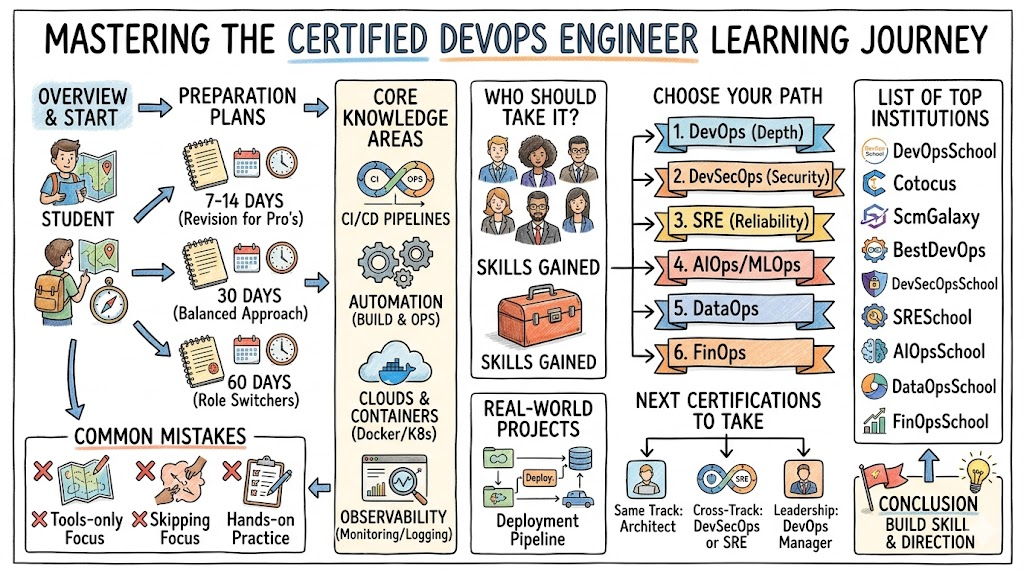
    Software teams today are expected to release faster, recover quicker, automate more, and maintain better visibility across systems. That change has made DevOps one of the most important skill areas for engineers and technical managers. A professional-level certification in this area can help learners understand not only the tools, but also the full delivery mindset behind modern engineering teams.

    Certified DevOps Professional is built for working professionals who want to grow beyond the basics. It is meant for people who already know something about software delivery, cloud, automation, containers, or operations, and now want to strengthen their credibility in the DevOps space. For many engineers, this kind of certification becomes the bridge between doing technical work and owning the delivery process in a more complete way.

    This guide explains the certification in a clear and practical format. It covers what the certification means, who should choose it, what skills it develops, how to prepare, what mistakes to avoid, what certification to take next, how it fits different career roles, and which institutions can support training and certification preparation.

    The provider is DevOpsSchool, and the official certification page is the reference point for the program details.


    Certification Overview

    CertificationProviderLevelBest For
    Certified DevOps ProfessionalDevOpsSchoolProfessionalEngineers, automation specialists, cloud professionals, DevOps practitioners, release and platform teams

    Certification Table

    TrackLevelWho it’s forPrerequisitesSkills coveredRecommended order
    DevOpsProfessionalDevOps Engineers, Platform Engineers, Release Engineers, Cloud Engineers, Senior Developers, Automation SpecialistsFamiliarity with software delivery, CI/CD basics, Linux, cloud, containers, and operational workflowsCI/CD, automation, logging, monitoring, cloud management, microservices, orchestrationAfter foundational DevOps learning and some project experience

    What Is Certified DevOps Professional?

    Certified DevOps Professional is a professional-level certification for people who want to prove they can work with modern software delivery systems in a practical way. It is designed for professionals who already understand basic DevOps ideas and now want to go deeper into automation, release systems, cloud delivery, container operations, and service visibility.

    This certification is valuable because it supports a more complete understanding of DevOps. Instead of focusing on only one tool or one part of the workflow, it helps learners connect build, release, monitoring, operations, and platform thinking into a single engineering approach.


    Why This Certification Matters

    In many companies, technical roles are changing. Developers are expected to understand delivery. Operations teams are expected to automate. Cloud engineers are expected to support CI/CD. Platform teams are expected to improve engineering productivity. Because of this, professionals who understand DevOps at a broader level are becoming more valuable.

    Certified DevOps Professional matters because it helps you build that broader view.

    It can help you:

    • understand how software moves from code to production
    • improve release quality through automation
    • connect cloud, containers, and deployment workflows
    • bring monitoring and logging into the delivery process
    • reduce manual work and deployment errors
    • strengthen your profile for platform and DevOps roles
    • prepare for senior technical or leadership certifications later

    For many working professionals, this is not only a learning path. It is also a career positioning step.


    Certified DevOps Professional

    What it is

    Certified DevOps Professional is a structured certification focused on practical DevOps capabilities. It helps professionals develop stronger understanding of CI/CD, cloud operations, automation, monitoring, logging, microservices, and container orchestration.

    It is designed for learners who want to move beyond beginner-level DevOps and become more effective in modern software delivery environments.

    Who should take it

    • DevOps Engineers
    • Build Engineers
    • Release Engineers
    • Platform Engineers
    • Cloud Engineers
    • Senior Software Engineers
    • Site operations professionals moving into DevOps
    • Automation specialists
    • Technical leads
    • Engineering managers who want practical delivery knowledge

    Skills you’ll gain

    • designing and improving CI/CD pipelines
    • understanding release flow and deployment stages
    • working with automation across build and operations tasks
    • integrating monitoring and logging into delivery systems
    • understanding cloud platform support for DevOps
    • improving software delivery consistency
    • understanding microservices deployment patterns
    • learning container orchestration concepts
    • supporting team collaboration across engineering functions
    • building a more reliable and repeatable release process

    Real-world projects you should be able to do after it

    • create an automated pipeline for code build, testing, and release
    • support deployment across development, staging, and production environments
    • help containerize applications for repeatable delivery
    • participate in Kubernetes-based release setups
    • improve logging and monitoring for running applications
    • reduce manual deployment dependency in engineering teams
    • support microservices delivery workflows
    • align developers and operations teams around one release process
    • help document and standardize DevOps practices
    • support cloud-based delivery modernization efforts

    Preparation plan

    7–14 days

    This works best for people who already use DevOps tools regularly.

    • revise end-to-end DevOps concepts
    • review CI/CD and deployment stages
    • revise containers, microservices, and cloud basics
    • go through monitoring and logging concepts
    • do focused revision on weak topics

    30 days

    This is a balanced preparation path for most professionals.

    • Week 1: DevOps principles, workflow, SDLC, team collaboration
    • Week 2: CI/CD, release management, automation
    • Week 3: Docker, orchestration, cloud, microservices
    • Week 4: observability, logging, revision, self-testing

    60 days

    This is suitable for learners growing into DevOps from another role.

    • First 15 days: DevOps foundations and software delivery lifecycle
    • Next 15 days: CI/CD and automation practice
    • Next 15 days: containers, orchestration, and cloud basics
    • Final 15 days: monitoring, logging, review, and scenario-based revision

    Common mistakes

    • believing DevOps is only about tools
    • studying pipelines without understanding delivery goals
    • ignoring operational visibility and monitoring
    • not learning how cloud and containers support DevOps
    • avoiding hands-on workflow practice
    • focusing only on theory and definitions
    • skipping microservices and orchestration basics
    • forgetting the collaboration aspect of DevOps

    Best next certification after this

    A good next certification depends on where you want your career to go.

    • Same track: Certified DevOps Architect
    • Cross-track: DevSecOps Certified Professional or SRE-focused certification
    • Leadership: Certified DevOps Manager

    Choose Your Path

    1. DevOps Path

    This path is ideal for professionals who want to grow in delivery engineering, CI/CD, deployment automation, infrastructure workflows, and overall DevOps maturity. It is the most natural direction after this certification if you want to keep growing in technical depth.

    2. DevSecOps Path

    This path is right for people who want to make security part of software delivery. After building a DevOps foundation, you can move into secure pipelines, compliance-aware automation, secrets handling, image scanning, and shift-left security models.

    3. SRE Path

    This path fits professionals who care most about service reliability, uptime, observability, alerts, incident response, and production health. DevOps gives the delivery foundation, while SRE builds operational excellence on top of it.

    4. AIOps/MLOps Path

    This path is useful for learners who want to work where AI, ML, and operations meet. Once you understand automation, pipelines, and deployment thinking, you can grow into model lifecycle management or AI-driven operational workflows.

    5. DataOps Path

    This path is relevant for data engineers and analytics teams that need better process control, repeatability, testing, quality, and governance in data pipelines. A DevOps mindset helps make data delivery more dependable.

    6. FinOps Path

    This path is meant for professionals who want to connect engineering and cloud cost awareness. After learning DevOps delivery, you can expand into cloud usage efficiency, cost optimization, budget visibility, and financial accountability in platform work.


    Role → Recommended Certifications

    RoleRecommended certifications
    DevOps EngineerCertified DevOps Engineer → Certified DevOps Professional → Certified DevOps Architect
    SRECertified DevOps Professional → SRE Certification
    Platform EngineerCertified DevOps Professional → Certified DevOps Architect
    Cloud EngineerCertified DevOps Professional → Cloud-focused DevOps specialization
    Security EngineerCertified DevOps Professional → DevSecOps Certified Professional
    Data EngineerCertified DevOps Professional → DataOps Certification
    FinOps PractitionerCertified DevOps Professional → FinOps Certification
    Engineering ManagerCertified DevOps Professional → Certified DevOps Manager

    Next Certifications to Take

    Same track option

    Certified DevOps Architect
    This is a strong choice for professionals who want to design enterprise DevOps environments, shape platform architecture, and support large-scale automation strategy.

    Cross-track option

    DevSecOps Certified Professional
    This option is best for learners who want secure software delivery, stronger compliance thinking, and security integration across pipelines and platforms.

    SRE Certification
    This is a good next move for people who want more depth in observability, operational reliability, incident handling, and production service performance.

    Leadership option

    Certified DevOps Manager
    This path supports professionals who are moving toward delivery leadership, team enablement, governance, transformation planning, and organizational DevOps maturity.


    List of Top Institutions Which Provide Help in Training cum Certifications for Certified DevOps Professional

    DevOpsSchool

    DevOpsSchool is the direct provider of Certified DevOps Professional and is the most aligned option for learners who want official training and certification preparation. It is useful for professionals who prefer structured learning, guided preparation, and certification-focused practice.

    Cotocus

    Cotocus is helpful for learners who want a more industry-connected view of DevOps and cloud delivery. It can support professionals who want to understand how these skills apply in practical enterprise settings.

    ScmGalaxy

    ScmGalaxy is well known for its connection to software configuration management, release flow, build systems, and CI/CD learning support. It is a useful option for people who want to strengthen the process side of DevOps.

    BestDevOps

    BestDevOps is often considered by learners seeking practical DevOps and cloud-oriented learning. It is useful for career-focused professionals who want skill development linked to real engineering roles.

    DevSecOpsSchool

    DevSecOpsSchool is a strong follow-on option for people who want to add security into their DevOps journey. It can support skill growth in secure pipelines, policy integration, and shift-left delivery practices.

    SRESchool

    SRESchool is valuable for professionals who want to focus on system stability, service reliability, observability, production incidents, and engineering support for uptime.

    AIOpsSchool

    AIOpsSchool supports professionals interested in intelligent operations, event correlation, automation assistance, and modern AI-supported operations practices.

    DataOpsSchool

    DataOpsSchool is relevant for data-focused professionals who want to improve pipeline repeatability, governance, testing, and operational maturity in data environments.

    FinOpsSchool

    FinOpsSchool is useful for engineers and cloud professionals who want to build skills in cost visibility, cloud spending control, budgeting awareness, and financial accountability across infrastructure usage.


    FAQs on Certified DevOps Professional

    1. Is Certified DevOps Professional an advanced certification?

    Yes. It is better suited for learners who already understand the basics of DevOps, cloud, or automation and want to go deeper into professional-level delivery practices.

    2. How much preparation time is usually needed?

    It depends on your background. A highly experienced engineer may prepare in two weeks, while most professionals are better with a 30-day plan. Newer learners may need around 60 days.

    3. Do I need prior DevOps experience?

    Some prior exposure is very helpful. This certification makes more sense when you already know at least the basic ideas behind CI/CD, automation, and delivery workflows.

    4. Can developers take this certification?

    Yes. Developers who want to understand deployment, automation, and operational collaboration can benefit greatly from it.

    5. Is this certification useful for cloud engineers?

    Yes. It helps cloud professionals move from infrastructure support into delivery automation, platform enablement, and release-focused roles.

    6. Is Kubernetes knowledge required?

    Expert-level knowledge is not always necessary, but container and orchestration awareness is very important for understanding modern DevOps practice.

    7. Will this certification help my career growth?

    Yes. It can strengthen your profile for DevOps, platform, automation, cloud delivery, and release engineering roles, especially when combined with project experience.

    8. Is this certification only for technical people?

    No. It is also useful for technical managers and engineering leaders who need to understand how DevOps improves collaboration, speed, and release quality.


    Additional Career FAQs

    9. What comes after Certified DevOps Professional?

    The next step depends on your interest. You may move toward Architect, DevSecOps, SRE, FinOps, or DevOps management.

    10. Is this good for platform engineering roles?

    Yes. Platform engineering depends heavily on automation, consistency, delivery enablement, and operational support, which match well with DevOps knowledge.

    11. Can this certification help me switch roles?

    Yes. It can help developers, cloud engineers, and operations professionals move toward DevOps or platform-oriented roles.

    12. Is practical work more important than certification?

    Practical work is always very important, but certification adds structure, credibility, and a better learning roadmap.

    13. Should I learn cloud before this certification?

    Basic cloud knowledge is very useful because modern DevOps often works closely with cloud infrastructure and managed services.

    14. Does it help with release engineering?

    Yes. Release engineering is closely connected to pipeline design, automation, deployment consistency, and coordination across teams.

    15. Is it useful outside one specific country or market?

    Yes. DevOps practices are widely used across global software companies, making the learning useful in many job markets.

    16. Can it help engineering managers?

    Yes. It helps managers better understand the practical side of delivery systems, team collaboration, automation strategy, and release improvement.


    Conclusion

    Certified DevOps Professional is an excellent option for professionals who want to become more capable in modern software delivery. It goes beyond basic knowledge and helps learners think in terms of full workflows, not isolated tools. It supports engineers who want stronger CI/CD skills, better automation understanding, improved cloud delivery awareness, and deeper familiarity with monitoring and operational readiness. It also helps managers understand how fast and stable delivery systems are built. Whether your goal is to become a stronger DevOps engineer, move into platform work, or prepare for advanced certifications in security, reliability, or leadership, this certification gives you a solid next step. It builds not just skill, but direction.

  • Mastering the Certified DevOps Engineer Path

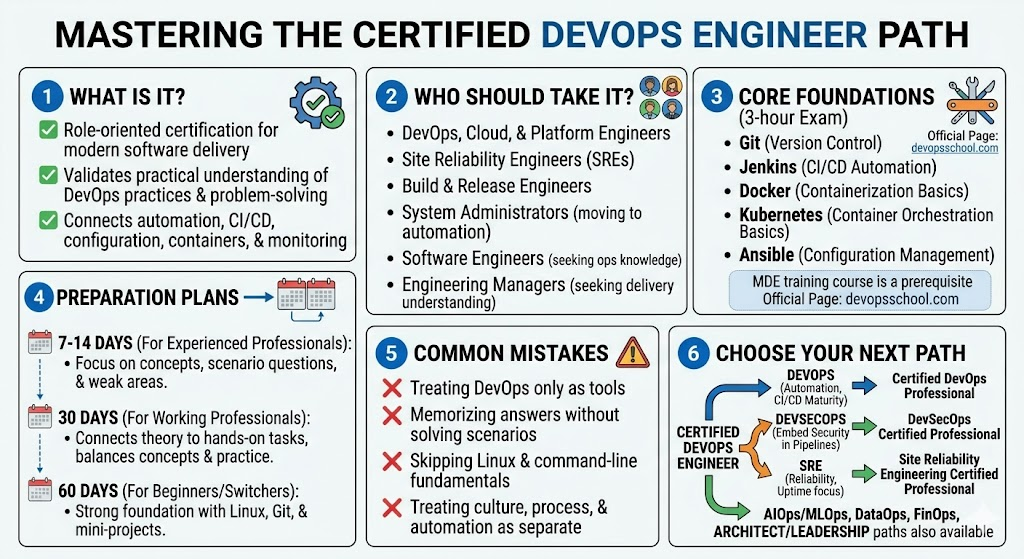
    DevOps is no longer just a trending word in software teams. It has become a practical way of building, testing, releasing, and operating software faster and with fewer mistakes. For working engineers and managers, that shift has created a real need for structured learning. The Certified DevOps Engineer program from DevOpsSchool is designed to validate that kind of practical understanding. The official page describes it as a 3-hour exam-focused certification that checks knowledge in CI/CD pipelines, infrastructure automation, configuration management, monitoring, and cloud-native implementation.

    This matters because many professionals know individual tools, but they do not always know how the full delivery system fits together. A DevOps engineer is expected to connect version control, build automation, containers, deployment flow, monitoring, collaboration, and reliability into one working model. The official certification also names Jenkins, Docker, Kubernetes, Git, and Ansible among the core foundations expected from candidates.

    This guide is written for software engineers, cloud professionals, platform teams, and engineering managers who want a clearer understanding of where this certification fits. It explains the certification itself, how to prepare for it, which roles benefit most, what you should be able to do after it, and what certification path can come next. The broader certification reference from Gurukul Galaxy also places Certified DevOps Engineer within a larger learning ecosystem that includes DevOps, DevSecOps, SRE, AIOps, MLOps, DataOps, and FinOps paths.

    Why This Certification Deserves Attention

    Most software teams want faster releases, better quality, fewer manual steps, and stronger visibility into production systems. That is exactly where DevOps creates value. But in interviews and real projects, companies often look beyond buzzwords. They want people who understand delivery pipelines, automation, release safety, configuration consistency, collaboration, and operational feedback.

    The Certified DevOps Engineer program is useful because it is not positioned as a general awareness badge. The official page frames it as a certification for professionals who want to validate expertise in core DevOps practices and real-world problem solving. It also lists DevOps Engineers, Cloud Engineers, and SREs among the intended audience.

    For managers, this certification helps in a different way. Even if a manager is not writing pipeline code every day, understanding DevOps helps in planning team workflows, reducing delivery friction, and improving communication between developers, QA, operations, and security teams. For individual contributors, it provides a cleaner path toward platform engineering, cloud operations, SRE, DevSecOps, and architecture roles.

    Certification Overview

    CertificationProviderTrackLevelWho it’s forPrerequisitesSkills coveredRecommended order
    Certified DevOps EngineerDevOpsSchoolDevOpsEngineerDevOps Engineers, Cloud Engineers, SREs, software professionalsStrong foundation in Jenkins, Docker, Kubernetes, Git, Ansible; official page also lists the MDE training course as a prerequisite for the exam pathCI/CD, infrastructure automation, configuration management, monitoring, cloud-native deliveryStart here for the core DevOps track

    The official page states that the certification program is a 3-hour online-proctored exam with multiple-choice and multiple-select questions, while the related training program is listed separately. It also notes the MDE training course as the prerequisite on the page.

    What It Is

    Certified DevOps Engineer is a role-oriented certification that helps professionals prove they understand how modern software delivery works. It focuses on the practical side of DevOps, not just vocabulary.

    In simple words, it is for people who want to show that they can connect automation, CI/CD, configuration, containers, monitoring, and collaboration into real engineering workflows. The official description specifically highlights real-world problem solving and cloud-native technologies as part of the assessment focus. (DevOps School)

    Who Should Take It

    This certification is a good fit for professionals such as:

    • DevOps Engineers
    • Cloud Engineers
    • Site Reliability Engineers
    • Platform Engineers
    • Build and Release Engineers
    • System Administrators moving into automation
    • Software Engineers who want stronger deployment and operations knowledge
    • Engineering Managers who want practical delivery understanding

    The official certification page directly identifies DevOps Engineers, Cloud Engineers, and SREs as target candidates, and the broader topic list on the page makes it clear that adjacent engineering roles can also benefit.

    Skills You’ll Gain

    • Understanding of DevOps principles and delivery flow
    • CI/CD pipeline design basics
    • Practical use of Git-based collaboration
    • Jenkins-driven automation thinking
    • Docker and container workflow awareness
    • Kubernetes exposure for modern deployment environments
    • Configuration management concepts with tools like Ansible
    • Monitoring and feedback loop understanding
    • Infrastructure automation mindset
    • Better coordination between development and operations teams

    These skill areas align with the official program description and agenda, which mentions CI/CD, automation, monitoring, Git, Jenkins, Docker, Kubernetes, Ansible, SDLC models, DevSecOps, SRE, and microservices-related topics.

    Real-World Projects You Should Be Able to Do After It

    • Build a basic CI/CD workflow for application delivery
    • Automate build, test, and deployment stages
    • Containerize an application for consistent deployment
    • Manage code movement through Git-based workflows
    • Support configuration consistency across environments
    • Assist with Kubernetes-based deployment preparation
    • Add basic monitoring and operational visibility into delivery flow
    • Reduce manual handoffs between development and operations teams

    These projects are not listed word for word on the page, but they are reasonable practical outcomes based on the tools, agenda, and competencies described in the official certification details.

    Preparation Plan

    7–14 Days

    This path is best for professionals who already work with DevOps tools or delivery environments.

    Spend the first few days revising DevOps concepts, SDLC, Agile flow, CI/CD, and collaboration principles. After that, review Git, Jenkins, Docker, Kubernetes, and Ansible. In the final stretch, focus on scenario-based questions, troubleshooting logic, and end-to-end delivery flow. This shorter plan works only when you already have strong practical exposure.

    30 Days

    This is the most balanced option for working professionals.

    Use the first week for DevOps principles, software delivery models, and automation basics. Spend the second week on Git, Jenkins, and CI/CD. Use the third week for Docker, Kubernetes, and configuration management. Keep the last week for monitoring, revision, and practice questions. This path gives enough time to connect theory with hands-on tasks.

    60 Days

    This is ideal for beginners, career switchers, or professionals coming from support, testing, or traditional admin roles.

    Start with Linux basics, command-line confidence, networking fundamentals, and software delivery concepts. Then move to Git and Jenkins. After that, learn containers, Kubernetes basics, and Ansible. In the last phase, study monitoring, cloud-native flow, and practice real mini-projects. The official agenda on the DevOpsSchool page supports this broader foundation because it includes SDLC models, Agile, DevOps, DevSecOps, SRE, Ubuntu, SSH, command line work, and microservices context in addition to core tools. (DevOps School)

    Common Mistakes

    • Studying tool names without understanding workflow
    • Treating DevOps as only Jenkins or Docker
    • Ignoring monitoring and feedback loops
    • Memorizing answers instead of solving scenarios
    • Skipping Linux and command-line fundamentals
    • Moving to advanced certifications too early
    • Focusing on theory without building small practical exercises
    • Missing the connection between culture, process, and automation

    This matters because the official agenda clearly goes beyond one or two tools and includes culture, adoption, risks, software development models, microservices, and implementation thinking.

    Best Next Certification After This

    The best next step depends on the kind of career you want.

    If you want to stay in the same track and go deeper, Certified DevOps Professional is the most natural next move. If you want a cross-track option, DevSecOps Certified Professional or Site Reliability Engineering Certified Professional make sense. If you are moving toward leadership, Certified DevOps Architect or Certified DevOps Manager are stronger choices.

    The Gurukul Galaxy reference lists all of these as part of the broader certification landscape for software engineers, alongside cloud, Kubernetes, AIOps, MLOps, DataOps, and FinOps certifications.

    Choose Your Path

    DevOps

    Choose this path if your goal is automation, release engineering, CI/CD maturity, infrastructure workflow, and faster delivery. This is the core path for platform-minded engineers.

    DevSecOps

    Choose this when security becomes part of your daily delivery work. It is ideal for professionals who want to shift security left and embed checks into the pipeline.

    SRE

    Choose this if you care more about uptime, reliability, observability, alerting, incident response, and service quality in production systems.

    AIOps / MLOps

    Choose this if your work involves intelligent operations, model lifecycle management, automation at scale, or data-driven operational platforms.

    DataOps

    Choose this when your role is centered around data pipelines, orchestration, data quality, analytics platform delivery, and repeatable movement of data across systems.

    FinOps

    Choose this when cloud cost, optimization, accountability, budgeting, and value-driven engineering decisions matter in your role.

    These paths are supported by the certification list in the Gurukul Galaxy article, which includes DevOps, DevSecOps, SRE, AIOps, MLOps, DataOps, and FinOps certifications as parallel and connected learning routes.

    Role → Recommended Certifications

    RoleRecommended certifications
    DevOps EngineerCertified DevOps Engineer → Certified DevOps Professional → Certified DevOps Architect
    SRECertified DevOps Engineer → Site Reliability Engineering Certified Professional → Certified Site Reliability Engineer
    Platform EngineerCertified DevOps Engineer → Kubernetes / cloud DevOps path → Certified DevOps Architect
    Cloud EngineerCertified DevOps Engineer → Azure DevOps Engineer Expert or GCP Professional Cloud DevOps Engineer
    Security EngineerCertified DevOps Engineer → DevSecOps Certified Professional → Certified DevSecOps Engineer
    Data EngineerCertified DevOps Engineer → DataOps path or cloud data engineering path
    FinOps PractitionerCertified DevOps Engineer → Certified FinOps Engineer → Certified FinOps Professional
    Engineering ManagerCertified DevOps Engineer → Certified DevOps Manager → architect or leadership path

    This mapping is based on the certification families listed in the Gurukul Galaxy source, especially the DevOps, DevSecOps, SRE, cloud, DataOps, and FinOps entries.

    Next Certifications to Take

    Same Track

    Certified DevOps Professional is the best option if you want deeper capability in DevOps implementation, process maturity, and practical delivery expertise.

    Cross-Track

    DevSecOps Certified Professional is a smart choice if you want to bring security into delivery. Site Reliability Engineering Certified Professional is better if you want stronger reliability and production depth.

    Leadership

    Certified DevOps Architect or Certified DevOps Manager fit professionals who are growing into platform design, delivery governance, engineering transformation, and team leadership.

    Top Institutions Which Help in Training cum Certifications

    DevOpsSchool

    DevOpsSchool is the direct provider of the Certified DevOps Engineer program. The official page presents both training and certification options and highlights industry-recognized certification, online delivery, accredited courseware, and practical training emphasis. It is the strongest choice when you want a direct path aligned with the certification itself.

    Cotocus

    Cotocus appears in the mentor information on the official DevOpsSchool page through leadership association. That makes it relevant in the wider ecosystem around enterprise delivery, architecture, and professional mentoring support. (DevOps School)

    ScmGalaxy

    ScmGalaxy is widely associated with technical learning support, tutorials, and practical knowledge building for software professionals. It is helpful for learners who want additional exposure to real tool usage and broader engineering topics.

    BestDevOps

    BestDevOps is commonly recognized for structured training support in modern engineering tracks. It is useful for professionals who want practical orientation and certification guidance in DevOps-aligned domains.

    devsecopsschool.com

    This is a natural next stop for learners who want to extend DevOps into application security, compliance, and secure release engineering.

    sreschool.com

    This platform is relevant for engineers who want stronger focus on reliability, service health, incident response, and production excellence.

    aiopsschool.com

    This is useful for professionals interested in intelligent operations, event-driven automation, and AI-assisted platform decision making.

    dataopsschool.com

    This is a solid fit for engineers working with data workflows, orchestration, governance, and delivery of analytics platforms.

    finopsschool.com

    This is best for cloud and platform professionals who want to connect engineering work with cloud cost visibility, efficiency, and optimization.

    FAQs on Certified DevOps Engineer

    1. Is Certified DevOps Engineer difficult?

    It is moderately challenging. Professionals with exposure to Git, Jenkins, Docker, Kubernetes, Linux, and CI/CD usually find it manageable. Beginners need more time because DevOps combines process, tooling, and practical thinking.

    2. How much time should I spend preparing?

    That depends on your background. An experienced engineer may revise in 7 to 14 days. A working professional with limited daily study time may need 30 days. A fresher or career switcher may be more comfortable with a 60-day plan.

    3. Do I need prerequisites before starting?

    Yes, a foundation helps. The official page says candidates should be strong in Jenkins, Docker, Kubernetes, Git, and Ansible, and it also lists the MDE training course as a prerequisite on the certification page.

    4. Is this certification valuable for software engineers?

    Yes. It helps software engineers understand how code moves from development to production, how automation reduces manual work, and how deployment becomes safer and more repeatable.

    5. Should I learn DevOps before DevSecOps or SRE?

    Usually yes. DevOps gives you the base for pipeline thinking, automation, release management, and team collaboration. After that, moving to DevSecOps or SRE becomes more logical.

    6. What kind of roles can this help me get?

    It can support movement toward DevOps Engineer, Platform Engineer, Cloud Engineer, SRE, Release Engineer, or automation-oriented infrastructure roles. It can also strengthen your profile for internal role changes.

    7. Is hands-on practice necessary?

    Absolutely. DevOps is not a purely theoretical field. Without practice, it is difficult to understand pipeline failures, container issues, deployment flow, and monitoring decisions.

    8. What should I do after passing this certification?

    Pick your next move based on your role. Go deeper into DevOps, shift to DevSecOps, specialize in SRE, or move toward architecture and leadership. The right answer depends on where you want your career to go next.

    Conclusion

    Certified DevOps Engineer is a strong starting point for professionals who want a practical and respected DevOps foundation. It helps you understand more than just tools. It teaches how modern software delivery works as a connected system across development, automation, infrastructure, deployment, and monitoring. That is why it is useful for engineers, cloud teams, SREs, platform professionals, and even managers who want clearer delivery understanding. Once you complete it, you do not just earn a certification. You build a base that can lead into DevSecOps, SRE, AIOps, MLOps, DataOps, FinOps, architecture, or engineering leadership with much more confidence.