Introduction
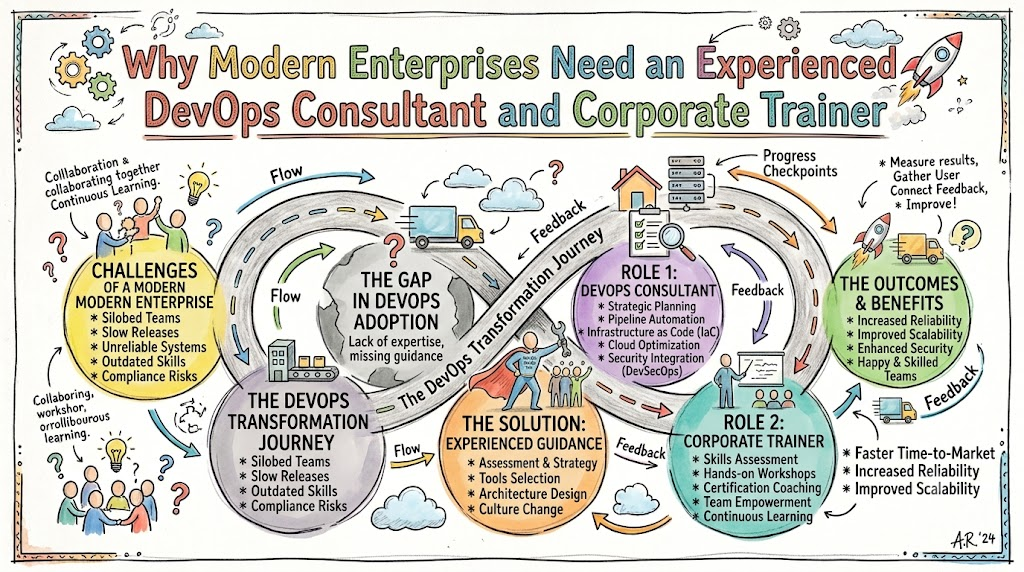
Every organization wants to release software faster, improve application stability, reduce infrastructure costs, and deliver better customer experiences. However, many digital transformation initiatives fail because businesses focus on technology before strategy.
Companies often purchase new DevOps tools, migrate workloads to the cloud, or deploy Kubernetes clusters expecting immediate improvements. Months later, deployment pipelines remain slow, environments become difficult to manage, security challenges increase, and engineering teams continue to work in silos.
The missing element is rarely another tool. Instead, organizations need a clear implementation strategy, experienced leadership, and practical guidance from professionals who understand enterprise software delivery.
This article explains why modern businesses benefit from working with an experienced DevOps consultant and corporate trainer, how DevOps consulting differs from traditional IT services, and what organizations should expect when building a successful engineering culture.
The Evolution of Software Delivery
Software development has changed dramatically over the last decade.
Traditional release models relied on manual testing, scheduled deployments, dedicated operations teams, and lengthy approval cycles. While these processes offered control, they also slowed innovation.
Today’s organizations compete in an environment where customers expect rapid feature releases, continuous improvements, and highly available digital services.
To meet these expectations, engineering teams need automation, collaboration, cloud-native architectures, and reliable operational practices.
This shift has transformed DevOps from a technical discipline into a business strategy.
Why Many DevOps Initiatives Fail
Organizations frequently encounter similar challenges during their DevOps journey.
Tool-First Thinking
Purchasing automation software without redesigning engineering workflows creates additional complexity instead of solving existing problems.
Manual Infrastructure Management
Servers configured manually often become inconsistent, making deployments unreliable and troubleshooting difficult.
Limited Automation
Partial automation still leaves critical deployment activities dependent on manual intervention.
Weak Collaboration
Development, operations, testing, and security teams frequently operate independently, causing delays and communication gaps.
Skills Gap
Advanced technologies such as Kubernetes, GitOps, Infrastructure as Code, and Site Reliability Engineering require specialized knowledge that many internal teams are still developing.
What Does a DevOps Consultant Actually Do?
A professional DevOps consultant does far more than install software.
Their responsibilities typically include:
- Assessing current engineering practices
- Designing modernization roadmaps
- Improving release processes
- Building CI/CD pipelines
- Introducing Infrastructure as Code
- Planning cloud migration
- Implementing Kubernetes platforms
- Improving observability
- Integrating security automation
- Coaching engineering teams
Rather than delivering isolated technical solutions, consultants align engineering practices with business objectives.
The Business Value of DevOps Consulting
Organizations investing in professional DevOps consulting frequently experience improvements across multiple areas.
Faster Software Releases
Automation reduces repetitive manual work, enabling development teams to deploy updates more frequently.
Improved System Reliability
Better monitoring, standardized deployments, and proactive operational practices reduce production incidents.
Reduced Operational Costs
Infrastructure automation minimizes manual effort while improving cloud resource utilization.
Stronger Security
Security becomes integrated into development pipelines instead of remaining a final deployment checkpoint.
Better Developer Experience
Standardized workflows allow engineers to focus on innovation rather than repetitive operational tasks.
Building a Modern CI/CD Pipeline
Continuous Integration and Continuous Delivery form the backbone of modern software engineering.
A mature delivery pipeline generally includes:
- Source code management
- Automated builds
- Unit testing
- Code quality validation
- Security scanning
- Artifact repositories
- Deployment automation
- Environment validation
- Rollback capabilities
Well-designed pipelines increase release confidence while reducing deployment risks.
Infrastructure as Code: The Foundation of Automation
Infrastructure should evolve with the same discipline as application code.
Infrastructure as Code enables teams to define cloud resources through reusable templates instead of manual configuration.
Key benefits include:
- Consistency
- Repeatability
- Version control
- Easier disaster recovery
- Faster environment provisioning
Organizations implementing Infrastructure as Code often experience greater operational stability.
Why Kubernetes Requires More Than Installation
Many companies view Kubernetes as the ultimate DevOps solution.
In reality, Kubernetes introduces new operational responsibilities including:
- Cluster management
- Networking
- Security
- Storage
- Monitoring
- Scaling
- Backup strategies
- Resource optimization
Successful Kubernetes adoption depends on architecture, governance, automation, and team readiness rather than installation alone.
Integrating DevSecOps into Engineering
Security cannot remain isolated from software delivery.
Modern DevSecOps practices automate security throughout development by incorporating:
- Dependency analysis
- Static code scanning
- Container security
- Secret detection
- Infrastructure validation
- Compliance automation
Embedding security earlier significantly reduces deployment risks.
Site Reliability Engineering and Operational Excellence
Reliable digital services require measurable objectives.
Site Reliability Engineering introduces engineering practices focused on availability, automation, incident response, and operational efficiency.
Core concepts include:
- Service Level Indicators
- Service Level Objectives
- Error budgets
- Post-incident reviews
- Capacity planning
Organizations combining DevOps with SRE achieve both faster releases and improved reliability.
Observability as a Competitive Advantage
Engineering teams generate enormous amounts of operational data.
Without effective observability, identifying root causes becomes increasingly difficult.
A modern observability strategy includes:
- Metrics
- Centralized logging
- Distributed tracing
- Real-time dashboards
- Intelligent alerting
These capabilities enable proactive operational management instead of reactive troubleshooting.
Corporate DevOps Training: Building Internal Capability
Technology transformation succeeds when people evolve alongside processes.
Corporate training helps organizations:
- Upskill engineering teams
- Standardize development practices
- Accelerate cloud adoption
- Improve Kubernetes knowledge
- Strengthen automation skills
- Increase deployment confidence
Practical workshops and hands-on learning produce significantly better outcomes than theoretical presentations.
Characteristics of an Effective DevOps Trainer
The most effective trainers combine technical expertise with teaching ability.
Important qualities include:
- Real enterprise experience
- Practical demonstrations
- Hands-on laboratories
- Cloud-native expertise
- Strong communication skills
- Industry best practices
- Customized learning paths
Effective training empowers teams to implement concepts independently.
Emerging Trends Shaping DevOps
DevOps continues to evolve alongside modern software engineering.
Current trends include:
- Platform Engineering
- GitOps
- AI-assisted operations
- FinOps
- Internal developer platforms
- Cloud-native security
- Policy as Code
- Intelligent observability
Organizations investing in continuous learning remain better positioned for future technological changes.
Selecting the Right Consulting Partner
When evaluating DevOps consulting services, organizations should consider:
- Practical implementation experience
- Enterprise transformation projects
- Cloud platform expertise
- Kubernetes specialization
- Infrastructure automation knowledge
- Security integration capabilities
- Corporate training experience
- Long-term support and mentoring
The right partner should help organizations build sustainable engineering capabilities rather than creating dependency.
Conclusion
Successful DevOps adoption requires more than installing modern tools. It demands a thoughtful strategy, automation, cultural transformation, continuous learning, and experienced leadership.
Organizations that combine structured consulting with practical corporate training build stronger engineering teams, deliver software more efficiently, improve operational reliability, and create a foundation for long-term digital innovation.
By investing in the right expertise and focusing on measurable business outcomes, companies can transform DevOps from a collection of technologies into a sustainable competitive advantage.
Frequently Asked Questions
What is the primary role of a DevOps consultant?
A DevOps consultant assesses existing software delivery processes, designs improvement strategies, implements automation, and guides organizations through technical and cultural transformation.
Why is corporate DevOps training important?
Corporate training equips engineering teams with practical skills required to adopt CI/CD, cloud technologies, Kubernetes, security automation, and modern operational practices effectively.
How does DevOps improve business performance?
DevOps enables faster software delivery, greater system reliability, improved collaboration, enhanced security, and more efficient use of infrastructure resources.
Is Kubernetes enough to achieve DevOps success?
No. Kubernetes is only one component of a successful DevOps ecosystem. Organizations also require automation, Infrastructure as Code, monitoring, security integration, and collaborative engineering practices.
How should organizations begin their DevOps journey?
The best starting point is a comprehensive assessment of existing processes, followed by a phased implementation roadmap that aligns technical improvements with business goals.
