Introduction
The Certified Kubernetes Administrator (CKA) Certification has emerged as the definitive benchmark for professionals operating within the cloud-native ecosystem. As organizations transition from traditional infrastructure to containerized microservices, the ability to manage complex orchestration platforms is no longer a niche skill but a fundamental requirement. This guide is crafted for engineers and technical leaders who aim to navigate the complexities of platform engineering and site reliability.
By choosing to pursue this credential, you are validating your expertise in one of the most critical components of the modern tech stack. Throughout this journey, institutions like DevOpsSchool provide the necessary technical scaffolding to move from basic container knowledge to advanced cluster administration. This guide serves as a strategic roadmap to help you understand the career impact, technical depth, and practical steps required to master the Kubernetes landscape.
What is the Certified Kubernetes Administrator (CKA) Certification?
The Certified Kubernetes Administrator (CKA) Certification is a performance-based exam that tests an individual’s ability to install, configure, and manage production-grade Kubernetes clusters. Unlike traditional exams that rely on multiple-choice questions, the CKA requires candidates to solve real-world problems in a live command-line environment. This ensures that the professional can handle the operational rigors of a live environment.
The certification was developed by the Cloud Native Computing Foundation (CNCF) in collaboration with The Linux Foundation. Its primary existence is to establish a high standard of competence in the industry, focusing on the core components of the Kubernetes control plane and worker nodes. It emphasizes practical skills over theoretical rote memorization, making it highly respected among hiring managers globally.
Who Should Pursue Certified Kubernetes Administrator (CKA) Certification?
This certification is designed primarily for systems administrators, DevOps engineers, and site reliability engineers (SREs) who manage containerized workloads. It is equally valuable for cloud architects who need to understand the underlying mechanics of the platforms they design for their clients. Even beginners with a strong interest in infrastructure find it a rewarding challenge that sets a solid foundation for their careers.
In the global market, and specifically within the rapidly growing tech hubs in India, the CKA is often a prerequisite for senior-level infrastructure roles. Managers and technical leads also benefit from this knowledge as it allows them to make informed decisions regarding tool selection and architectural patterns. If your daily work involves ensuring the availability and scalability of applications, this certification is for you.
Why Certified Kubernetes Administrator (CKA) Certification is Valuable
The value of this certification lies in its alignment with enterprise adoption of Kubernetes, which shows no signs of slowing down. As cloud providers like AWS, Azure, and Google Cloud offer managed Kubernetes services, the need for administrators who understand the “vanilla” or core version remains paramount. It ensures that your skills remain portable across different cloud environments and on-premises setups.
Beyond technical validation, the CKA offers a high return on investment in terms of career longevity and compensation. It distinguishes you in a crowded job market by proving you can handle high-pressure troubleshooting scenarios. In an era where tools change rapidly, the principles learned through the CKA process—networking, storage, and security—provide a lasting framework for professional growth.
Certified Kubernetes Administrator (CKA) Certification Overview
It consists of a series of tasks that must be completed within a two-hour window. The exam is proctored online, providing a flexible yet secure environment for candidates to demonstrate their technical proficiency.
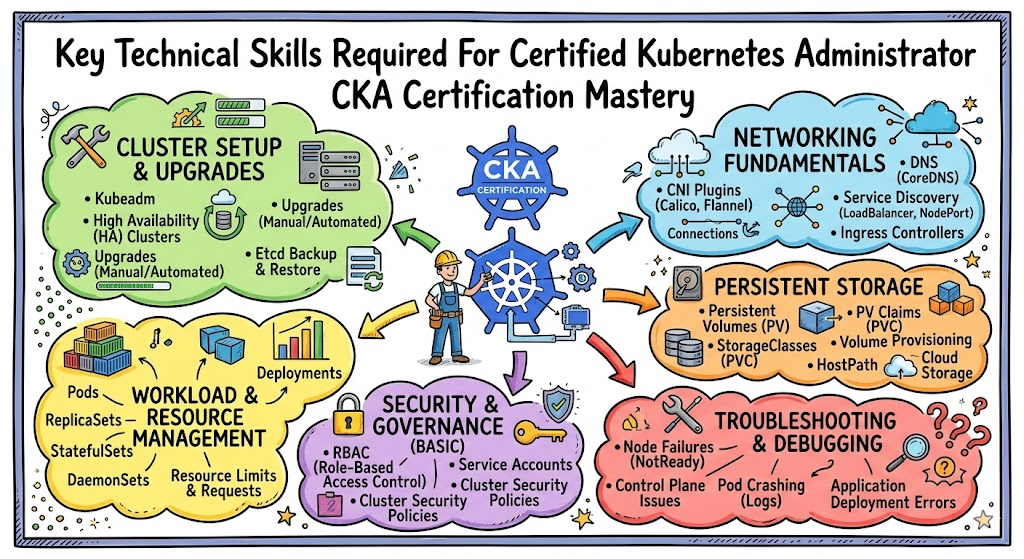
The assessment covers five major domains: Cluster Architecture, Installation & Configuration (25%), Workloads & Scheduling (15%), Services & Networking (20%), Storage (10%), and Troubleshooting (30%). This structure ensures a holistic evaluation of an administrator’s responsibilities. Ownership of the curriculum rests with the CNCF, which updates the syllabus regularly to keep pace with Kubernetes releases.
Certified Kubernetes Administrator (CKA) Certification Tracks & Levels
The Kubernetes certification ecosystem is structured to support professionals at various stages of their careers. It begins with foundational certifications that cover general cloud-native concepts and moves into specialized associate and professional levels. This tiered approach allows engineers to build a cohesive skill set that evolves with their professional responsibilities.
Foundational levels focus on the broad landscape of the CNCF projects, while the associate level targets specific tasks like application development. The professional level, represented by the CKA, focuses on the deep infrastructure management required to keep clusters healthy and secure. Specialty tracks are also available for those who wish to focus specifically on security or other advanced operational domains.
Complete Certified Kubernetes Administrator (CKA) Certification Table
| Track | Level | Who it’s for | Prerequisites | Skills Covered | Recommended Order |
| Cloud Native | Foundational | Beginners/Managers | Basic IT Literacy | Ecosystem & Terminology | 1 |
| Development | Associate | App Developers | Container Basics | Deployment & Config | 2 |
| Administration | Professional | SRE/Admins | Linux/Networking | Installation/Debugging | 3 |
| Security | Specialty | Security Ops | CKA Knowledge | Hardening/Auditing | 4 |
Detailed Guide for Each Certified Kubernetes Administrator (CKA) Certification
Foundational Level
Certified Kubernetes Administrator (CKA) Certification – Kubernetes and Cloud Native Associate (KCNA)
What it is
The KCNA is an entry-level certification that validates a candidate’s conceptual knowledge of the Kubernetes ecosystem. It serves as a bridge for those who understand the value of cloud-native but haven’t yet mastered the command line.
Who should take it
This is perfect for students, project managers, and junior engineers who need a broad understanding of the CNCF landscape. It is also suitable for sales and marketing professionals working in the cloud sector.
Skills you’ll gain
- Understanding of Kubernetes architecture
- Familiarity with the CNCF project landscape
- Knowledge of observability and security basics
- Understanding of the principles of GitOps
Real-world projects you should be able to do
- Navigating a Kubernetes environment and identifying components
- Participating in high-level architectural discussions
- Explaining the benefits of microservices to stakeholders
Preparation plan
- 7-14 days: Review official documentation and foundational videos on Kubernetes.
- 30 days: Experiment with local clusters like Minikube to visualize concepts.
- 60 days: Deep dive into the CNCF landscape and study for the exam syllabus.
Common mistakes
- Ignoring the non-Kubernetes projects in the CNCF ecosystem
- Focusing too much on deep technical commands instead of concepts
- Not reviewing the exam weightage for each section
Best next certification after this
- Same-track option: Certified Kubernetes Application Developer (CKAD)
- Cross-track option: AWS Cloud Practitioner
- Leadership option: Certified Cloud Manager
Associate Level
Certified Kubernetes Administrator (CKA) Certification – Certified Kubernetes Application Developer (CKAD)
What it is
The CKAD focuses on the skills required to design, build, and configure cloud-native applications for Kubernetes. It validates that a developer can leverage the platform’s features to ensure application reliability and scalability.
Who should take it
Software engineers, DevOps practitioners, and application architects should pursue this. It is ideal for those responsible for the deployment lifecycle of modern applications.
Skills you’ll gain
- Creating and managing Pods, Deployments, and Services
- Implementing Liveness and Readiness probes
- Configuring ConfigMaps and Secrets for apps
- Managing persistent storage for stateful applications
Real-world projects you should be able to do
- Deploying a multi-container application with sidecars
- Setting up automated rolling updates and rollbacks
- Configuring network policies to secure application traffic
Preparation plan
- 7-14 days: Practice writing YAML files and using imperative commands.
- 30 days: Build complex deployments and practice troubleshooting pod failures.
- 60 days: Take timed mock exams to improve speed and accuracy.
Common mistakes
- Relying too much on copying YAML from the documentation
- Not practicing with the vi or nano editors in the terminal
- Failing to manage time effectively during the performance exam
Best next certification after this
- Same-track option: Certified Kubernetes Administrator (CKA)
- Cross-track option: Docker Certified Associate
- Leadership option: Senior Application Architect
Professional/Specialty Level
Certified Kubernetes Administrator (CKA) Certification – CKA Core Exam
What it is
The core CKA exam is a professional-level validation of an administrator’s ability to maintain a cluster’s health. It covers everything from bootstrapping the control plane to complex networking and storage issues.
Who should take it
SREs, systems administrators, and senior platform engineers are the primary candidates. It is for those who are “on the hook” for the uptime and performance of production clusters.
Skills you’ll gain
- Cluster bootstrapping with kubeadm
- Troubleshooting control plane and worker node issues
- Configuring etcd backup and restore procedures
- Implementing cluster-wide networking and storage classes
Real-world projects you should be able to do
- Upgrading a production cluster without impacting running apps
- Debugging network connectivity issues between pods and services
- Automating the scaling and recovery of cluster components
Preparation plan
- 7-14 days: Deep dive into Kubernetes networking and storage concepts.
- 30 days: Practice building clusters from scratch and breaking them to learn.
- 60 days: Solve complex troubleshooting scenarios in a proctored setting.
Common mistakes
- Forgetting to back up the etcd database before major changes
- Misconfiguring CNI plugins during cluster setup
- Poor time allocation between easy configuration tasks and difficult debugging
Best next certification after this
- Same-track option: Certified Kubernetes Security Specialist (CKS)
- Cross-track option: HashiCorp Certified Terraform Associate
- Leadership option: Principal Platform Engineer
Choose Your Learning Path
DevOps Path
The DevOps path focuses on the seamless integration of software development and infrastructure operations. Professionals here should master both CKAD and CKA to understand the entire application lifecycle. The goal is to build automated pipelines that can deploy and manage applications on Kubernetes with minimal human intervention.
DevSecOps Path
The DevSecOps path emphasizes security as a core component of the infrastructure rather than an afterthought. After completing the CKA, candidates should immediately pursue the CKS (Security Specialist). This path focuses on cluster hardening, vulnerability scanning, and implementing zero-trust network policies within the container ecosystem.
SRE Path
Site Reliability Engineering focuses on using software engineering principles to solve operations problems. The SRE path requires a deep mastery of the CKA to ensure cluster reliability, availability, and performance. This professional path often involves heavy focus on observability, monitoring, and automated incident response using Kubernetes-native tools.
AIOps Path
The AIOps path is for engineers looking to use artificial intelligence to enhance IT operations. By understanding the core mechanics of Kubernetes through the CKA, these professionals can implement AI models that predict cluster failures. They focus on using data-driven insights to automate the management of complex distributed systems.
MLOps Path
MLOps is a specialized path that deals with the unique challenges of running machine learning workloads on Kubernetes. Professionals here use their CKA knowledge to manage GPU resources and scale ML pipelines. They ensure that data scientists have the high-performance infrastructure needed to train and deploy sophisticated models effectively.
DataOps Path
DataOps focuses on the management and orchestration of data pipelines within containerized environments. Professionals on this path must understand how Kubernetes handles stateful applications and persistent volumes. The CKA provides the foundational infrastructure skills needed to ensure data integrity and availability across the enterprise.
FinOps Path
The FinOps path is dedicated to cloud financial management and cost optimization within Kubernetes. By understanding the CKA syllabus, FinOps practitioners can implement better resource quotas and request limits. They focus on balancing technical performance with cost-efficiency to maximize the business value of cloud-native investments.
Role → Recommended Certified Kubernetes Administrator (CKA) Certifications
| Role | Recommended Certifications |
| DevOps Engineer | CKAD, CKA |
| SRE | CKA, CKS |
| Platform Engineer | CKA, CKS, KCNA |
| Cloud Engineer | CKA, Cloud Provider Certificates |
| Security Engineer | CKA, CKS |
| Data Engineer | CKAD, CKA |
| FinOps Practitioner | KCNA, CKA |
| Engineering Manager | KCNA |
Next Certifications to Take After Certified Kubernetes Administrator (CKA) Certification
Same Track Progression
Once you have cleared the CKA, the natural progression is to deepen your administrative expertise. The Certified Kubernetes Security Specialist (CKS) is the industry standard for this progression. It builds directly on the CKA knowledge base but adds a heavy layer of security auditing and runtime protection. This ensures you are not just an administrator, but a secure operator capable of defending the cluster.
Cross-Track Expansion
For those who want a more rounded skill set, moving into Infrastructure as Code (IaC) is highly recommended. Achieving a Terraform or Ansible certification allows you to manage the entire stack, from the virtual machines and networks to the Kubernetes clusters running on top of them. This cross-track expansion makes you a more versatile engineer who can architect end-to-end cloud solutions.
Leadership & Management Track
If your goal is to move into management, your focus should shift from technical implementation to strategic oversight. Certifications in Cloud Architecture or Technical Project Management are beneficial here. These credentials help you translate technical Kubernetes concepts into business value, allowing you to lead large engineering teams and manage multi-million dollar cloud budgets effectively.
Training & Certification Support Providers for Certified Kubernetes Administrator (CKA) Certification
- DevOpsSchool
DevOpsSchool is a premier training provider that offers an exhaustive curriculum for those aiming to master the CKA exam. They provide hands-on lab environments that are essential for the performance-based nature of the Kubernetes certification. Their instructors are industry veterans who bring real-world scenarios into the virtual classroom, ensuring students understand the “why” behind every command. With a strong community focus and extensive post-training support, they help engineers navigate the complex transition to cloud-native roles effectively. - Cotocus
Cotocus specializes in high-end consulting and training for modern infrastructure and DevOps workflows. They offer tailored programs that focus on the architectural aspects of Kubernetes, making them a great choice for aspiring platform engineers. Their training methodology is built around solving production-level problems, which aligns perfectly with the CKA exam requirements. They help organizations and individuals bridge the skill gap in container orchestration through intensive workshops and mentorship programs that emphasize technical excellence and operational best practices. - Scmgalaxy
Scmgalaxy is a widely recognized community and resource hub for software configuration management and DevOps professionals. They offer a wealth of free and premium content, including tutorials, blogs, and practice questions that are vital for CKA preparation. Their platform serves as a collaborative space where engineers can share knowledge and stay updated on the latest Kubernetes releases. For those who prefer self-paced learning supported by a massive library of technical assets, this provider offers an invaluable repository of information. - BestDevOps
BestDevOps provides focused and practical training modules designed to get engineers exam-ready in a short period. Their CKA training is built on a foundation of real-world use cases, ensuring that candidates can handle both the exam tasks and daily job responsibilities. They emphasize the mastery of the command line and troubleshooting, which are the most critical skills for any Kubernetes administrator. Their simplified teaching approach makes complex networking and storage concepts accessible to engineers at all experience levels. - devsecopsschool.com
devsecopsschool.com is the leading authority for engineers who want to specialize in the security aspects of the cloud-native ecosystem. While they provide strong support for the CKA, their real strength lies in preparing students for the subsequent CKS certification. They teach how to integrate security into every layer of the Kubernetes stack, from the container image to the network layer. This specialized focus is essential for professionals who want to lead security-first infrastructure teams in modern enterprise environments. - sreschool.com
sreschool.com focuses on the principles of site reliability engineering, placing Kubernetes at the center of the reliability conversation. Their training programs are designed to help administrators build systems that are not only functional but also highly available and scalable. They provide deep dives into observability, performance tuning, and automated recovery within Kubernetes clusters. For CKA candidates who want to excel in high-stakes SRE roles, this school provides the advanced operational knowledge needed to succeed. - aiopsschool.com
aiopsschool.com provides cutting-edge training at the intersection of artificial intelligence and IT operations. They teach CKA holders how to apply machine learning algorithms to manage and optimize Kubernetes infrastructure. Their curriculum covers automated root-cause analysis and predictive scaling, skills that are becoming increasingly important as clusters grow in size and complexity. This training is ideal for forward-thinking engineers who want to be at the forefront of the next wave of infrastructure automation. - dataopsschool.com
dataopsschool.com addresses the specific needs of managing data-intensive applications on Kubernetes. Their training focuses on the complexities of persistent storage, database operators, and data lifecycle management within containers. For CKA professionals working with big data or large-scale databases, this provider offers the specialized knowledge required to ensure data consistency and performance. They bridge the gap between traditional data management and modern container orchestration, providing a comprehensive roadmap for DataOps success. - finopsschool.com
finopsschool.com focuses on the financial management aspect of the cloud, teaching professionals how to optimize the costs associated with running Kubernetes. They provide CKA holders with the tools and techniques needed to implement resource quotas, track spending, and reduce cloud waste. As organizations look to justify their cloud spending, the skills learned here become a vital part of an administrator’s toolkit. They help engineers become fiscally responsible architects who can deliver performance without exceeding the budget.
Frequently Asked Questions
1. How long does the CKA certification last?
The certification is valid for three years, after which you must retake the exam to maintain your credential.
2. Is the CKA exam multiple choice?
No, it is a 100% performance-based exam where you must solve tasks in a live terminal environment.
3. Can I use the official documentation during the test?
Yes, you are allowed to open one browser tab for the official Kubernetes documentation site.
4. What is the passing score for the CKA?
The passing score is 66%, and the results are typically delivered within 24 to 36 hours.
5. Do I need to know programming to pass the CKA?
Deep programming is not required, but you should be comfortable with YAML and basic shell scripting.
6. What happens if my internet disconnects during the exam?
Proctors usually allow you to reconnect, but it is critical to have a stable connection to avoid disruption.
7. Is the CKA exam proctored?
Yes, it is a proctored exam, and you must have a webcam and microphone active throughout the session.
8. Can I take the CKA exam at home?
Yes, the exam is taken remotely through a secure browser provided by the testing platform.
9. How much does the exam cost?
The standard price is $395 USD, which typically includes one free retake if you fail your first attempt.
10. What version of Kubernetes is used in the exam?
The exam version is updated every few months to stay current with the latest stable Kubernetes releases.
11. Is there a specific Linux distribution used in the exam?
The exam environment typically uses Ubuntu, though the commands for Kubernetes are consistent across distributions.
12. How quickly should I expect to get my certificate?
Once you pass, the digital certificate and badge are usually issued within a few days of the result notification.
FAQs on Certified Kubernetes Administrator (CKA) Certification
1. What is the best way to handle the time limit during the exam?
The best strategy is to use imperative commands like “kubectl run” instead of writing full YAML files to save time on basic tasks.
2. How important is the etcd backup and restore question?
It is a core part of the syllabus; missing this task can significantly impact your final score as it is a critical administrative skill.
3. Do I need to memorize all the kubectl flags?
No, but you should be familiar enough with them to find information quickly in the help menus or official documentation.
4. What are the common reasons for failing the CKA?
Most candidates fail due to poor time management, losing track of the cluster context, or simple typos in their YAML files.
5. Can I use external tools like Helm during the exam?
Generally, the exam focuses on core Kubernetes resources, but you should follow the specific instructions provided in each task description.
6. How do I switch between clusters during the exam?
You will be given a specific command at the start of each question to ensure you are working in the correct cluster context.
7. Should I practice “Kubernetes The Hard Way” before the exam?
Yes, building a cluster from scratch without automated tools is the best way to understand the underlying components required for the CKA.
8. Is there partial credit for questions?
Yes, the grading system often awards points for the successful completion of specific parts of a multi-step problem.
Final Thoughts: Is Certified Kubernetes Administrator (CKA) Certification Worth It?
The Certified Kubernetes Administrator (CKA) Certification remains one of the most impactful credentials an engineer can earn. It represents a significant commitment to mastering the backbone of modern cloud-native architecture. While the journey to certification is demanding, the skills you acquire are deeply rooted in practical, real-world operations. This process turns you into a more resilient troubleshooter and a more capable architect, regardless of the specific cloud provider you use. Beyond the technical validation, the CKA provides a clear path for career advancement and professional recognition. It signals to the industry that you possess the grit and the technical expertise to manage critical production infrastructure. If you are looking to future-proof your career in DevOps or platform engineering, focusing your energy on this certification is a highly recommended and rewarding investment. Focus on hands-on practice, stay patient with the learning curve, and the rewards will follow.
Leave a Reply