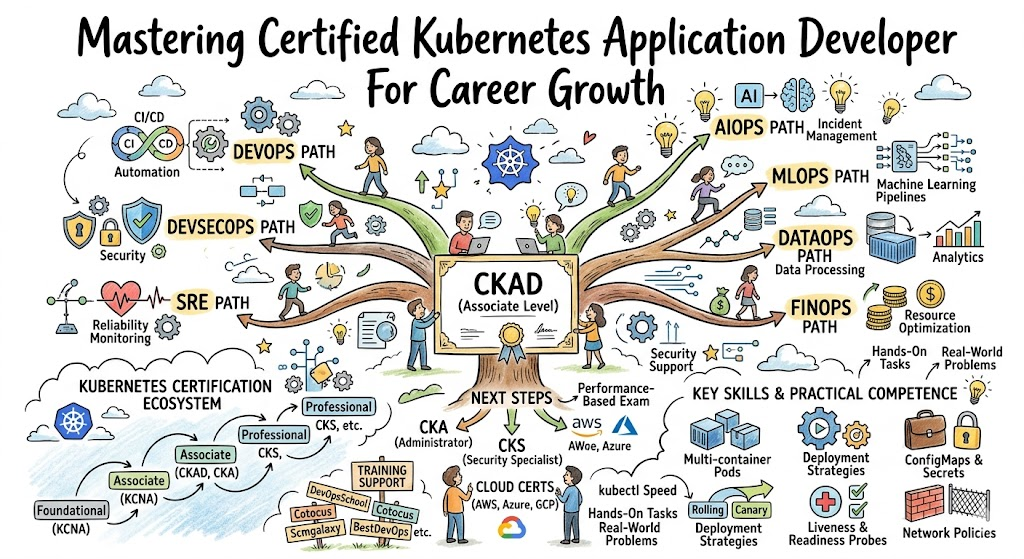
Introduction
As a seasoned engineer who has seen the shift from monoliths to microservices, I can confidently say that the Certified Kubernetes Application Developer (CKAD) is a cornerstone for modern developers. This guide is designed by DevOpsSchool to help you navigate the complexities of cloud-native development and understand where this credential fits in your career trajectory.
The landscape of software delivery has changed fundamentally with the rise of container orchestration, making Kubernetes an essential skill for any serious technologist. This comprehensive guide serves as a roadmap for professionals who want to move beyond theoretical knowledge and prove their ability to build, configure, and expose cloud-native applications.
By understanding the nuances of this certification, you can make informed decisions about your learning path and resource allocation. Whether you are a backend developer or a platform engineer, mastering these concepts will allow you to interact with production environments with confidence and precision.
What is the Certified Kubernetes Application Developer (CKAD)?
The Certified Kubernetes Application Developer (CKAD) is a performance-based certification that validates an individual’s ability to design, build, and deploy cloud-native applications for Kubernetes. Unlike traditional multiple-choice exams, this assessment requires candidates to solve real-world problems in a command-line environment within a specific timeframe.
It represents a standard of excellence that ensures a developer can not only write code but also understand how that code behaves inside a containerized ecosystem. This includes managing resource requirements, configuring security contexts, and ensuring high availability through various Kubernetes primitives.
In modern enterprise environments, the focus has shifted from just “writing code” to “owning the lifecycle” of an application. The CKAD aligns perfectly with this philosophy by forcing developers to think about logging, monitoring, and troubleshooting from the very beginning of the development cycle.
Who Should Pursue Certified Kubernetes Application Developer (CKAD)?
This certification is primarily targeted at software engineers and developers who are responsible for building and deploying applications in a containerized environment. It is equally beneficial for Site Reliability Engineers (SREs) and DevOps professionals who need a deep understanding of the developer-facing side of the Kubernetes API.
Beginners who have a basic grasp of Docker and Linux containers will find this a challenging yet rewarding next step in their journey. For experienced engineers, it serves as a formal validation of their skills, helping them stand out in a competitive global job market, particularly in high-growth tech hubs like India and the United States.
Engineering managers and technical leaders should also consider the foundational concepts of this certification. Having this knowledge allows leaders to better understand the technical constraints their teams face and helps them make more informed decisions regarding architectural patterns and infrastructure investments.
Why Certified Kubernetes Application Developer (CKAD) is Valuable
The demand for Kubernetes talent continues to outstrip supply as more enterprises migrate their workloads to the cloud. Earning this certification demonstrates to employers that you possess the hands-on skills required to handle production-grade clusters, reducing the time needed for onboarding and technical training.
The longevity of Kubernetes as the industry standard for orchestration means that the skills learned during preparation are highly portable across different cloud providers like AWS, Azure, and Google Cloud. This prevents vendor lock-in and gives you the flexibility to work across diverse technical stacks without relearning core principles.
Beyond the immediate career benefits, the process of preparing for the exam forces a deep dive into the internal mechanics of distributed systems. This rigorous training builds a mental model of how applications scale and fail, which is a return on investment that pays dividends throughout an entire engineering career.
Certified Kubernetes Application Developer (CKAD) Certification Overview
The assessment is purely practical, conducted in a proctored online environment where you are given a set of tasks to complete on a live cluster. This approach ensures that holders of the certification have actual keyboard-time experience rather than just the ability to memorize facts from a textbook or video course.
The ownership of the certification lies with the Cloud Native Computing Foundation (CNCF) in collaboration with The Linux Foundation. It is structured to focus on the core responsibilities of an application developer, such as pod design, networking, storage, and observability, rather than cluster administration or infrastructure maintenance.
Certified Kubernetes Application Developer (CKAD) Certification Tracks & Levels
The certification ecosystem is divided into foundational, associate, and professional levels to provide a clear progression path for learners. The foundational level focuses on the “what” and “why” of cloud-native technologies, providing the vocabulary and conceptual framework needed for more advanced study.
As you move to the associate and professional levels, the focus shifts to the “how.” For developers, the progression usually starts with a general understanding of the ecosystem and then moves into the specific implementation details covered by the CKAD, followed by specializations in security or advanced administration.
Specialization tracks allow professionals to align their credentials with their specific job roles, such as focusing on Security (CKS) or broader Administration (CKA). This tiered approach ensures that you are constantly challenged and that your resume reflects a growing depth of expertise as you advance in your career.
Complete Certified Kubernetes Application Developer (CKAD) Certification Table
| Track | Level | Who it’s for | Prerequisites | Skills Covered | Recommended Order |
| Cloud Native | Foundational | Beginners/Managers | None | Containers, Orchestration | 1 |
| Developer | Associate | App Developers | Linux/Docker | Pods, Deployments, Jobs | 2 |
| Admin | Professional | SREs/Ops | CKAD/Linux | Cluster Setup, ETCD | 3 |
| Security | Specialty | Security Engineers | CKA | Hardening, Policies | 4 |
Detailed Guide for Each Certified Kubernetes Application Developer (CKAD) Certification
Foundational Level
Certified Kubernetes Cloud Native Associate (KCNA)
What it is
This is a foundational certification designed to validate a candidate’s entry-level knowledge of the Kubernetes ecosystem. It covers the basic terminology and the general landscape of cloud-native architecture.
Who should take it
It is ideal for students, recent graduates, or managers who need to speak the language of Kubernetes without necessarily being responsible for writing YAML files or managing clusters daily.
Skills you’ll gain
- Understanding of the CNCF landscape and projects.
- Knowledge of Kubernetes architecture components.
- Familiarity with cloud-native observability and security.
- Basic understanding of application delivery workflows.
Real-world projects you should be able to do
- Explain the difference between serverless and containerized deployments.
- Identify the correct CNCF tool for a specific infrastructure problem.
- Navigate a Kubernetes dashboard to view resource usage.
Preparation plan
- 7-14 days: Review official CNCF documentation and watch introductory overview videos.
- 30 days: Complete a basic cloud-native course and take two practice quizzes.
- 60 days: Not typically required for this level unless starting from zero technical background.
Common mistakes
- Overcomplicating the study by diving too deep into technical implementation.
- Ignoring the broader CNCF landscape outside of Kubernetes itself.
Best next certification after this
- Same-track: CKAD
- Cross-track: Cloud Provider Foundations (AWS/Azure)
- Leadership: Certified Cloud Practitioner
Associate Level
Certified Kubernetes Application Developer (CKAD)
What it is
This is the core certification that validates the ability to build and configure applications for Kubernetes. It is a 100% hands-on exam that tests your speed and accuracy in a terminal.
Who should take it
Software engineers, backend developers, and SREs who want to prove they can deploy and manage applications in a production Kubernetes environment effectively.
Skills you’ll gain
- Creating and configuring Pods and Deployments.
- Implementing Liveness and Readiness probes for health checks.
- Managing persistent storage using PVs and PVCs.
- Configuring NetworkPolicies and SecurityContexts.
- Troubleshooting application failures using logs and describe commands.
Real-world projects you should be able to do
- Deploy a multi-container pod with a shared volume.
- Update a running application with zero downtime using rolling updates.
- Create a CronJob to handle periodic database backups.
Preparation plan
- 7-14 days: Intense lab practice focusing on
kubectlimperative commands and aliases. - 30 days: Complete a full CKAD course and perform every exercise at least twice.
- 60 days: For those new to Linux, spend the first 30 days mastering the command line.
Common mistakes
- Relying too much on writing YAML from scratch instead of using imperative commands.
- Poor time management during the exam; getting stuck on a single difficult question.
Best next certification after this
- Same-track: Certified Kubernetes Administrator (CKA)
- Cross-track: Certified Jenkins Engineer
- Leadership: Engineering Lead Roles
Professional/Specialty Level
Certified Kubernetes Security Specialist (CKS)
What it is
A high-level certification focused on securing the container orchestration platform and the applications running within it. It covers the entire lifecycle of security from build to runtime.
Who should take it
Security engineers and senior DevOps professionals who have already cleared the CKA and want to specialize in infrastructure hardening and threat detection.
Skills you’ll gain
- Hardening the API server and worker nodes.
- Implementing pod security standards and admission controllers.
- Scanning images for vulnerabilities and managing secrets.
- Runtime security monitoring and auditing.
Real-world projects you should be able to do
- Configure a cluster-wide Pod Security Admission policy.
- Restrict access to the metadata API from within pods.
- Audit cluster logs to identify unauthorized access attempts.
Preparation plan
- 7-14 days: Review security benchmarks and specific tools like Falco or Trivy.
- 30 days: Deep dive into each domain of the CKS curriculum with hands-on labs.
- 60 days: Essential if you are not already comfortable with Linux security concepts.
Common mistakes
- Attempting this without a very strong foundation in general Kubernetes administration.
- Forgetting to practice the setup of external security tools.
Best next certification after this
- Same-track: Advanced Cloud Security (AWS Security Specialty)
- Cross-track: Certified DevSecOps Professional
- Leadership: CISO track
Choose Your Learning Path
DevOps Path
The DevOps path focuses on the intersection of development and operations. You should prioritize the CKAD to understand how applications live on the platform, followed quickly by the CKA to understand the platform itself. This path emphasizes automation, CI/CD integration, and the seamless movement of code from a local machine to a production cluster.
DevSecOps Path
In the DevSecOps path, security is integrated into every step of the development lifecycle. Start with the CKAD to understand application primitives, then move to CKA and finally CKS. This path is for those who want to ensure that speed does not come at the cost of safety, focusing on automated security gates and policy enforcement.
SRE Path
The Site Reliability Engineering path prioritizes uptime, performance, and latency. After gaining the CKAD, you should focus heavily on the CKA and observability tools. SREs use the knowledge from these certifications to build self-healing systems and define Service Level Objectives (SLOs) that are technically achievable within the Kubernetes framework.
AIOps Path
The AIOps path involves using artificial intelligence to automate and enhance IT operations. Professionals here use Kubernetes to orchestrate the complex machine learning models that monitor system health. Understanding the CKAD is vital for deploying these AI-driven monitoring agents as sidecars or standalone services within a cluster.
MLOps Path
The MLOps path is specifically for managing the lifecycle of machine learning models. You will use Kubernetes to handle the heavy compute requirements of model training and serving. The CKAD provides the necessary skills to manage GPU resources, persistent storage for datasets, and the scaling of inference endpoints.
DataOps Path
The DataOps path focuses on the flow of data within an organization, often involving complex data pipelines. In this path, the CKAD helps you deploy stateful sets and manage the connectivity between databases and application layers. It ensures that data engineers can treat their infrastructure as code, leading to more predictable data delivery.
FinOps Path
The FinOps path is about bringing financial accountability to the variable spend of the cloud. While less technical on the coding side, understanding the CKAD allows a FinOps practitioner to understand resource requests and limits. This knowledge is essential for identifying “waste” at the pod level and implementing cost-saving measures like spot instances.
Role → Recommended Certified Kubernetes Application Developer (CKAD) Certifications
| Role | Recommended Certifications |
| DevOps Engineer | CKAD, CKA, Jenkins |
| SRE | CKAD, CKA, Prometheus |
| Platform Engineer | CKA, CKS, Terraform |
| Cloud Engineer | CKAD, AWS/Azure Solutions Architect |
| Security Engineer | CKAD, CKS, DevSecOps Professional |
| Data Engineer | CKAD, Spark/Airflow |
| FinOps Practitioner | KCNA, FinOps Certified Practitioner |
| Engineering Manager | KCNA, CKAD (Overview) |
Next Certifications to Take After Certified Kubernetes Application Developer (CKAD)
Same Track Progression
Deep specialization within the Kubernetes ecosystem involves moving toward cluster administration. Once you can develop for the platform, learning to build and maintain the platform itself is the next logical step. This ensures you understand the full stack from the kernel level up to the application’s runtime environment, making you an invaluable asset during major outages.
Cross-Track Expansion
Broadening your skills means looking at the tools that feed into Kubernetes. Certifications in CI/CD tools like Jenkins or GitLab, or infrastructure-as-code tools like Terraform and Pulumi, complement the CKAD perfectly. This expansion allows you to manage the entire “software factory,” rather than just the final deployment target, giving you a wider impact on the organization.
Leadership & Management Track
For those looking to move into leadership, the focus shifts toward governance and strategy. Certifications that cover cloud economics, team topology, and agile delivery are beneficial. Use your technical CKAD foundation to maintain credibility with engineering teams while you focus on the high-level business goals and digital transformation strategies of the enterprise.
Training & Certification Support Providers for Certified Kubernetes Application Developer (CKAD)
- DevOpsSchool
This provider offers extensive hands-on training tailored for the CKAD exam. Their curriculum is updated frequently to reflect the latest changes in the Kubernetes API and exam patterns. Students benefit from live interactive sessions and a vast library of recorded content that covers everything from basic containerization to complex microservices deployment strategies. The focus here is on practical lab work, ensuring that every learner gets significant terminal time under the guidance of experienced industry experts. - Cotocus
This organization specializes in enterprise-level training and workforce transformation. They provide customized learning paths for teams looking to migrate their applications to Kubernetes. Their CKAD training is known for its focus on real-world scenarios that engineers encounter in production environments. By using industry-standard tools and methodologies, they help professionals bridge the gap between theoretical certification and actual job performance, making them a preferred choice for corporate training programs globally. - Scmgalaxy
As a community-driven platform, this provider offers a wealth of resources, including blogs, tutorials, and practice exams for Kubernetes enthusiasts. Their CKAD support is geared toward self-paced learners who need deep dives into specific technical topics. They provide a unique blend of community support and expert-led webinars, allowing students to clarify doubts and share experiences with a global network of DevOps professionals, which is invaluable for staying current with rapidly evolving cloud-native technologies. - BestDevOps
This provider focuses on high-quality, curated content specifically designed to help candidates pass their certification exams on the first attempt. Their CKAD bootcamp is structured to be intensive, covering all exam domains in a logical and easy-to-digest format. They offer simulated exam environments that closely mimic the actual testing conditions, helping students build the speed and confidence necessary for the performance-based nature of the Kubernetes application developer assessment. - devsecopsschool.com
This platform focuses heavily on the integration of security within the DevOps lifecycle. For CKAD aspirants, they provide a unique perspective on how to build secure-by-default applications. Their training covers essential security primitives like NetworkPolicies and Secrets management in much greater detail than general courses. This makes them an excellent choice for developers who want to specialize in building resilient and secure cloud-native applications from the ground up. - sreschool.com
With a strong emphasis on reliability and system performance, this provider tailors its CKAD training for those moving into Site Reliability Engineering roles. They emphasize monitoring, logging, and troubleshooting aspects of the Kubernetes developer curriculum. Students learn how to build applications that are not just functional, but also highly observable and easy to maintain in high-traffic production environments, aligning perfectly with the core principles of the SRE discipline. - aiopsschool.com
This provider bridges the gap between traditional IT operations and artificial intelligence. Their support for the CKAD focuses on how Kubernetes can be used as a platform for AI-driven operations tools. They teach developers how to containerize and deploy machine learning models for system monitoring and automated incident response, making it a specialized destination for engineers looking to stay at the cutting edge of the AIOps revolution. - dataopsschool.com
Focused on the data lifecycle, this training provider helps professionals understand how to run data-intensive applications on Kubernetes. Their CKAD-related training emphasizes stateful applications, persistent storage management, and data pipeline orchestration. They provide practical insights into how developers can use Kubernetes to manage large-scale data processing tasks efficiently, ensuring that data integrity and performance are maintained across distributed environments. - finopsschool.com
This organization focuses on the financial management of cloud resources. Their perspective on the CKAD is unique, as they focus on the cost-implications of developer choices. They teach students how to optimize resource requests and limits and how to design applications that can leverage cost-effective infrastructure. This training is essential for professionals who want to balance technical excellence with fiscal responsibility in large-scale cloud deployments.
Frequently Asked Questions
1. How difficult is the CKAD exam compared to other IT certifications?
The CKAD is considered moderately difficult because it is a performance-based exam rather than multiple-choice. You must be very comfortable with the command line and kubectl to pass within the two-hour time limit.
2. Are there any specific prerequisites for taking the CKAD?
There are no formal prerequisites required by the CNCF, but a strong working knowledge of Docker, Linux containers, and basic YAML syntax is highly recommended for success.
3. What is the validity period of the CKAD certification?
The certification is typically valid for three years from the date you pass the exam, after which you will need to retake the exam to maintain your active status.
4. How much does the CKAD exam cost?
The standard price for the exam is around $395 USD, though discounts are frequently available through various training partners or during special events like Cyber Monday.
5. Can I use a notepad or external resources during the exam?
You are generally allowed to access the official Kubernetes documentation during the exam, but you cannot use external blogs, Google search, or personal notes.
6. What is the passing score for the CKAD?
The passing score is usually set at 66%, but because the exam is task-based, your score depends on the completion of specific objectives within the cluster.
7. How long does it take to prepare for the CKAD if I have basic Kubernetes experience?
Most professionals find that 4 to 6 weeks of dedicated study and hands-on lab practice is sufficient to feel confident for the exam.
8. Is the CKAD better than the CKA for a software developer?
Yes, the CKAD focuses specifically on application-related tasks like pod design and storage, whereas the CKA focuses more on cluster installation and administration.
9. Can I take the exam from home?
Yes, the exam is proctored online, allowing you to take it from any location that meets the technical and environmental requirements specified by the Linux Foundation.
10. What terminal editor should I learn for the exam?
Vim or Nano are the standard editors available in the exam environment; mastering Vim is generally recommended for speed and efficiency during the test.
11. Is the CKAD certification recognized globally?
Yes, it is the industry-standard certification for Kubernetes developers and is highly regarded by tech companies and enterprises worldwide.
12. Does the CKAD help in getting a higher salary?
While a certification alone doesn’t guarantee a raise, it provides a powerful validation of your skills that often leads to better job opportunities and higher compensation packages.
FAQs on Certified Kubernetes Application Developer (CKAD)
1. What are the most important domains covered in the CKAD curriculum?
The exam focuses heavily on Application Deployment (20%), Application Configuration (18%), and Application Observability and Maintenance (18%). Understanding how to manage Pods, Deployments, and Services is the core of the test. You should also be proficient in using ConfigMaps, Secrets, and persistent storage solutions to manage application data and state.
2. How should I manage my time during the CKAD exam?
Time management is the biggest challenge; you have 120 minutes for approximately 15-20 tasks. Never spend more than 5-7 minutes on a single question. If you get stuck, flag the question and move on to the next one. Use imperative commands like kubectl run or kubectl create instead of writing YAML files from scratch to save precious minutes.
3. What documentation am I allowed to use during the test?
You are allowed one extra tab in your browser to access the official Kubernetes documentation at kubernetes.io/docs. Knowing how to quickly search and navigate this site is a skill in itself. Practice finding example YAML snippets for things like NetworkPolicies or PersistentVolumeClaims so you can copy and modify them quickly during the exam.
4. Is knowledge of Helm required for the CKAD?
Yes, basic knowledge of Helm is now part of the CKAD curriculum. You should know how to install, uninstall, and list Helm releases. You don’t necessarily need to be a Helm chart developer, but you must understand how to use Helm to deploy existing applications and how to override default values during the installation process.
5. How important are resource limits and quotas for this exam?
They are very important. You will likely be asked to create pods with specific CPU and memory requests and limits. Understanding how Kubernetes manages these resources and what happens when a pod exceeds its limit (like OOMKilled errors) is essential for the observability and troubleshooting sections of the practical assessment.
6. Do I need to know how to set up a cluster from scratch?
No, cluster setup and maintenance (like kubeadm or ETCD backups) are part of the CKA (Administrator) exam. For the CKAD, the cluster is already provided, and your focus is entirely on interacting with the Kubernetes API to deploy and manage your applications within that pre-existing infrastructure.
7. What is the best way to practice for the performance-based format?
The best way to practice is through “killer.sh” or similar exam simulators that provide a timed, high-pressure environment. Repeatedly performing tasks in a real terminal until the commands become muscle memory is the only way to ensure you can work fast enough to finish the exam on time.
8. Can I retake the exam if I fail on my first attempt?
Most exam purchases from the Linux Foundation include one free retake. This is a great safety net, as it allows you to experience the actual exam environment and identify your weak areas without the pressure of having to pay for a second attempt immediately if you don’t succeed the first time.
Final Thoughts: Is Certified Kubernetes Application Developer (CKAD) Worth It?
If you are looking for a definitive answer on whether to invest your time in this certification, the answer is a resounding yes. In my two decades of engineering, I have seen many technologies come and go, but the shift toward container orchestration is a fundamental change in how we build software. The CKAD is not just a piece of paper; it is a grueling practical test that proves you can actually do the work. Many developers shy away from it because it requires hands-on skill rather than just memorization, but that is exactly what makes it so valuable to employers. It filters out those who only have a surface-level understanding of the technology. By clearing this exam, you are signaling that you are ready for the rigors of production-grade systems and that you can be trusted with the keys to the cluster.
Leave a Reply